
- Entertainment
- Style
- Lifestyle
- Food & Drinks
- Tech & Auto
- Culture
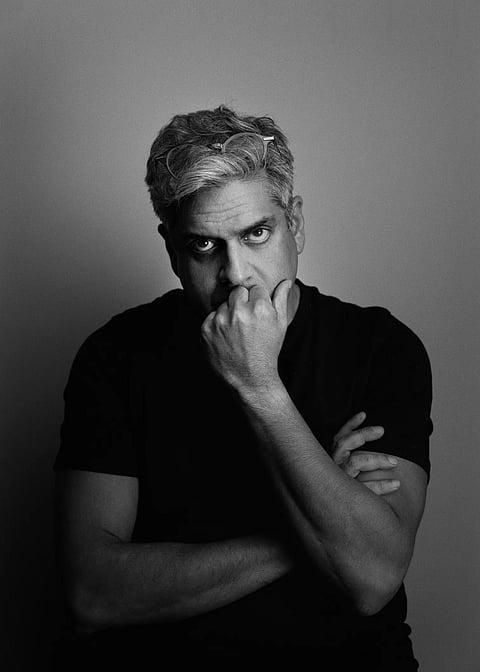
For more than a century, the iconic expanse of the Mahalaxmi racecourse has been a stage for spectacle. Thundering hooves, ritzy race days and the feverish hopes of punters studying their odds. Yet, behind the grandstand and glamour rests a quieter world. In his forthcoming photobook titled Raceday, filmmaker and photographer Sunhil Sippy turns his lens toward that hidden universe, chronicling nearly a decade of life within the racecourse.
The story of the book began almost accidentally. Sippy had been photographing the racecourse sporadically since 2015, initially without any grand plan in mind. Photography, for him, has always been an act of wandering—of allowing images to reveal themselves over time rather than chasing them with a rigid narrative. “I like photographs to marinate,” he says. “Images need to sit for a while—they develop a kind of maturity and only then do you begin to understand why they matter.”
It was during those early explorations that he captured what would become the first photograph in the book: a haunting scene of horses emerging through the morning mist at the racecourse. The moment felt serendipitous. Sippy had arrived late that day, convinced he had missed the action entirely, when suddenly the horses burst through the fog—an image that would later serve as the emotional starting point for the project. That photograph also led to an unexpected introduction. At a dinner soon after, a racehorse trainer spotted the image on Sippy’s phone and urged him to return to the racecourse with his camera. What followed was extraordinary access—carte blanche entry into spaces rarely seen by outsiders: jockey rooms, stables, training grounds and the quiet corners where the everyday drama of racing unfolds.

For two years Sippy photographed intensely, documenting the rhythms of a world that seemed suspended in time. Then life intervened and the images lingered in his archive. The turning point came years later, when redevelopment plans for the racecourse began to circulate.
The announcement sharpened his sense that he had been witnessing something fragile—an ecosystem of rituals, personalities and traditions that might not survive the city’s transformation. “I realised this was a sacred space in the city,” he recalls, returning with renewed intensity between 2023 and 2025 to capture the secret life of thoroughbreds and the rough-edged gamblers who define the racetrack.
What also fascinated Sippy most was the strange stillness at the heart of the racing world. Jockey rooms remain almost exactly as they were decades ago. Punters sit in the same corners, hunched over betting slips, their faces etched with hope and resignation in equal measure. Even photographs taken ten years apart reveal an uncanny continuity—men occupying the same stools, staring at the same boards, chasing the same fortunes. “The world inside racing is unbelievably static,” Sippy observes. But the deeper he looked, the more complex the emotional landscape became. The romance he sought was not the obvious glamour of race-day fashion or champagne in the stands. Instead, it emerged in the more human moments: the weary concentration of gamblers, the tenderness between trainers and horses, the fleeting expressions of anxiety before a race began.
Taken in 2015, one particularly striking photograph shows a jockey standing up on a bench in prayer at the jockey room while another prepares nearby—an intimate moment of faith unfolding within the high-stakes world of professional racing. For Sippy, the image slowly acquired deeper resonance over time. Horse racing is a global sport, governed by international rules and traditions. Yet in India, its rituals carry a distinctly local texture. The sight of a jockey pausing to pray before images of Lord Krishna, Goddess Lakshmi, Sai Baba, Jesus Christ and Mother Mary—before mounting his horse—adds a spiritual dimension rarely encountered elsewhere in the racing world: many gods, many names, yet a single, shared faith in fortune, protection and grace before a race begins.
The finished book reflects this layered exploration, spanning 300 pages and roughly 150 images, moving fluidly between colour and black-and-white photography. Interspersed within the main volume are unexpected elements. One is a small booklet inspired by the racecourse “form guide” used by gamblers—reimagined with portraits of punters and the colourful slang that punctuates betting culture. Another feature is a set of acetate transparencies drawn from Sippy’s analogue work. These luminous slides can be held up to the light, transforming into miniature artworks. Accompanying the photographs is a stream-of-consciousness essay by Sippy himself, weaving personal reflections with observations about the racecourse and the city beyond. A glossary at the end catalogues the people and places that populate the images, allowing readers to trace characters across a decade of photographs.
Through years of patient observation, Sippy has created a meditation on Mumbai itself: a city constantly reinventing itself, even as fragments of its past endure in unexpected places. Like the racecourse at dawn, where the mist lifts slowly to reveal horses charging through the light, the book captures a striking world while gently preserving the fragile balance between the past and present.