
- Entertainment
- Style
- Lifestyle
- Food & Drinks
- Tech & Auto
- Culture

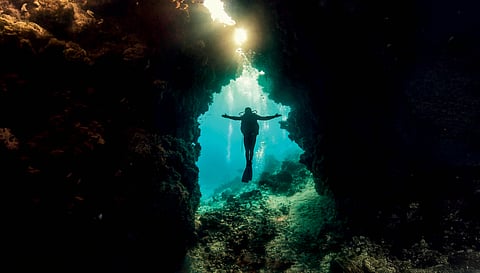
When Rohan Shrestha's friends first asked him to go scuba diving with them, he remembers being adamantly against it—“If humans were meant to be underwater, we’d have gills,” he told them. And then he went underwater, saw an octopus, and his life changed.
Three hundred and twenty-six dives later, Shrestha’s love for the ocean is perhaps only rivalled by Herman Melville’s Ishmael. You can see it in his eyes and hear it in his voice—the deep reverence he holds for the sea and all its creatures.
On his 300th dive, he got pulled away from his group by the current, and found himself surrounded by hundreds of hammerhead sharks. In that moment, he had the choice to swim away and hurry back to his group, or double down, take out his camera, and swim right into the middle. Guess which one he opted for? “Since it was my 300th dive, I thought, f**k it. As stupid as it sounds, I took out my camera and swam straight into the school of sharks,” he says, grinning.
It’s definitely not something he’d recommend for people who aren’t experienced—heck, even with 300 dives, it’s risky. But sometimes, we do stupid things for love. And there are very few things the ace photographer holds as close to his heart as scuba diving. His appetite for risk, to go deeper and seek newer territories, remains unquenched and only increases with each dive. His aim is always “to find the most obscure diving spots because the more obscure they are, the further they are from civilisation and fishing, and the more likely it is that you’ll see amazing things.”
Looking ahead, Shrestha is excited to be returning to the Galapagos in September—nine years after his first visit. The Galapagos offers some of the toughest diving conditions in the world, but that’s exactly what excites him. The chance to encounter whale sharks and orcas.
No internet, no immediate Insta-posting, being completely cut off from civilisation. It’s almost like you’ve gone back to how it used to be—adventurers charting the seas, discovering the beautiful world around us.
The first time I ever dived, we were in Mauritius on holiday— just a bunch of 18-, 19-year-old boys trying to figure out what we wanted to do with our lives. That’s when we ended up scuba diving. I was so adamantly against it. I remember saying, ‘If humans were meant to be underwater, we’d have gills’. But then, the first time I went under, I saw an octopus. It was the very first thing I saw underwater.
So, the octopus means a lot to me. And if you read about it, you realise it’s one of the most intelligent sea creatures out there. I was completely fascinated.
It’s not a picture I’ve taken, but a picture taken of me. It shows two dolphins mimicking my behaviour underwater. I was right in front of them, holding my camera, shooting them. And luckily, my friend—who was further away—managed to capture a shot of me photographing the dolphins. It was unbelievable. We were diving off the west coast of Mexico, in a place called Socorro. It takes a long time to get there—after you arrive, you still have to sail another two days. But once you reach the dive sites, you realise that the fish there have barely, if ever, interacted with humans.
So, they behave differently. They’re not afraid. They come right up to you, curious and unbothered. So those dolphins—they were actually mimicking me. And I was so engrossed in the shot, filming them, just watching two wild dolphins playing with me underwater.
The Galapagos Islands. It’s like going back into Jurassic Park—because a lot of that was actually shot there, around Costa Rica and those regions. It really feels like a completely different planet. The ocean’s different. And like I’ve said before, the behavioural patterns of fish are different. It’s also some of the toughest diving you’ll ever do. What all you see there, man! Sea lions come right up to you to play. They’re like little dogs underwater.
It’s nature in all its glory. And I always bring this up: the ocean is bigger, deeper, more mysterious than anything we’ve explored. It’s beautiful, nurturing and to me, it’s like my second home.
I’ve seen things like a blue-ringed octopus, or psychedelic squids that light up and shift through all these wild colours. I’ve watched octopuses change from red to this cement-like grey and blend in with dead coral—just disappear into it. There are fish called scorpionfish. They’re highly poisonous. They’re found a lot in waters around Asia. And then there are stonefish, crocodile fish—literally resembling crocodiles. They’re actually fairly common around the Andaman Islands.
The thing is, because we’re all city kids, all of this stuff fascinates us. But if you live on those beaches, have travelled a lot or are a risk-taking adventurer—these things stop surprising but never stop being fascinating.
I actually have one device that I take underwater—a safety buoy called a surface marker buoy, or SMB. I found one in 2014 inside a giant coral. I was just shooting the inside of the coral when I came across this perfectly preserved SMB in a coral. I thought, What am I supposed to do with this guy? And you know, sometimes superstition sticks with you.
So, I picked it up, attached it to my jacket, to my Buoyancy Compensating Device, and I’ve never dived without it since. It’s been 11 years now, and I take it everywhere in the world. Thankfully, I’ve never had to use it, because it’s really meant for emergencies. I’ve never faced anything that extreme yet.
Banda Sea is one of the places I want to go to. There is Fiji, the islands. Belize in Central America, is home to the Great Blue Hole that I want to dive in. I also aim to dive up in Northern Europe to see whales.
To read more stories from Esquire India's May-June 2025 issue, pick up a copy of the magazine from your nearest newspaper stand or bookstore. Or click here to subscribe to the magazine.