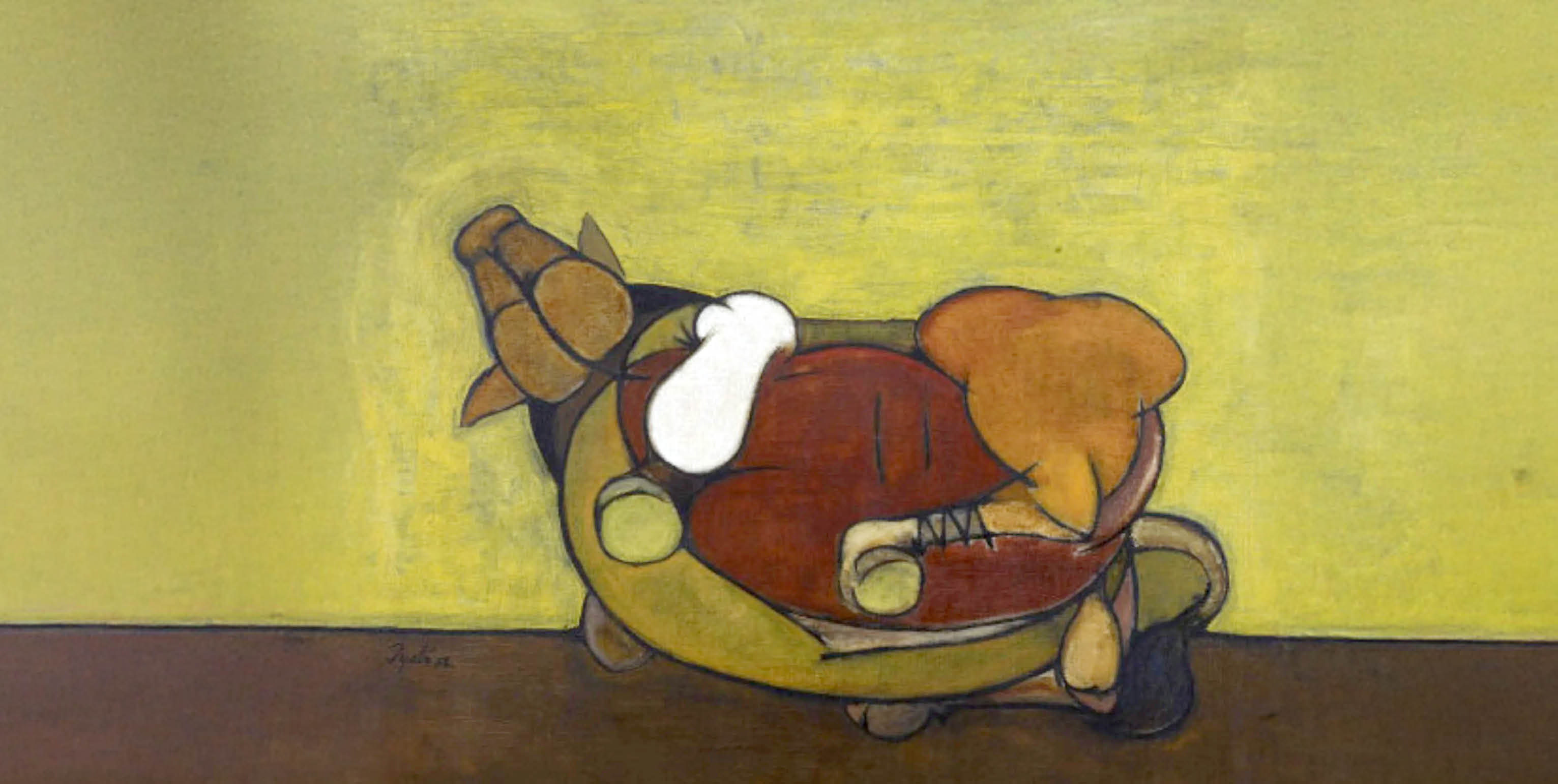
Tyeb Mehta’s Trussed Bull Makes History
After M.F Hussain, late Indian painter and sculptor, Tyeb Mehta’s ‘Trussed Bull’ garners the second spot on the list of most expensive Indian paintings. Here's why.
One of the first major works created in 1956, Tyeb Mehta’s Trussed Bull- a series of paintings- went under the hammer for ₹61.80 Crore at Saffronart's 25th anniversary auction in Mumbai this month.
Originally, considered to fetch for around ₹4-7 lakh, the piece defied all predictions. Trussed Bull with its modernist, rawness, and symbolism broke all records, becoming the highest value achieved by Mehta.
It now shares the title of second highest value work by an Indian artist sold in an auction worldwide, tied with Amrita Sher-Gil's The Story Teller that went for the same price in 2023. But it’s not every day that a painting of a bleeding, bound animal fetches a staggering sum. What makes Mehta’s Trussed Bull so special?
You May Also Like: What’s the M.F. Husain Painting That Just Broke Records?
The Power Of Restraint
According to art historian Yashodhara Dalmia, Mehta used three motifs regularly that became part of his painterly career, one of which was the Trussed Bull. She notes that the bull was symbolic of ‘‘a strong sense of life being nipped in the bud that is not being allowed to grow or fully attain its achievement”.
A powerful animal like the bull, when restrained reflects an assault on life itself. To Mehta, the bull is more than an animal. It is symbolic of helpless suffering in post-independence India, of line stunted before it could bloom, of strength tied down. It’s a poignant metaphor for the psychological weight of witnessing Partition, violence and anguish.
You May Also Enjoy : Fractured Forms: Picasso's Radical Portrayal of Men
Writer and artist Dilip Chitre once observed that Mehta’s Bull was born out of haunting experiences having witnessed violence during Partition and scenes from a slaughterhouse. He observes that the bull is a metaphor for the violence Mehta experienced and sought to make peace with through art. So, the bulls became art.
Visually, the bull has jagged black lines to define its symmetry. It uses fragmentary geometric shapes to define the shape and stillness of the animal. No expressions, no context. All we know is that the bull is muscular alluding to its strength.
The palette is red, bruised brown- colours that focuses your attention to the violence caused. It is uncomfortably alive. It almost feels like its slaughtered and served on a plate the way its tied up.
You May Also Like: What To Expect At India Art Fair 2025
More Than A Bull
In post-colonial India, Tyeb Mehta’s painting was radical. In today’s fractured world, it’s a mirror echoing something deeper.
At first glance, it’s a bull -massive yet restrained. But when you meditate on it a little longer, it speaks to you about violence and anguish inherent in human condition. It speaks to the unresolved self that is the being and not the beast.
Mehta, whose fascination with bulls began as a student visiting slaughterhouses in Bandra, Mumbai to sketch the bound buffaloes awaiting their end. It’s this tension, a loop, a deep breath before something breaks or blooms that Mehta subtly captured in his paintings.
More than the body, the essence – the consciousness under pressure- became the subject matter of the series. It echoes the questions, “What do we do with the pain we didn’t choose” and ‘‘can we culturally evolve if we refuse to address the bruise and the restrained”. Because the restrained bull from Mehta’s painting is still asking us what’re we made of.
You May Also Read: The Art Of Talking About Art: A Beginner's Guide
Beyond this, it speaks to a generation that looks ‘‘free” but is trussed in invisible ways- algorithms, climate dread, cultural dislocation, and inherited trauma. We are all trussed bulls: tensed and trapped.
In that sense, binding is not necessarily a restraint, it’s a beginning of reflection. It speaks to the contemporary binaries of life- freedom and restraint, identity and displacement, silence and screams.