
- Entertainment
- Style
- Lifestyle
- Food & Drinks
- Tech & Auto
- Culture

Maqbool Fida Husain, popularly known as M.F. Husain, one of India’s most celebrated artists, made history recently.
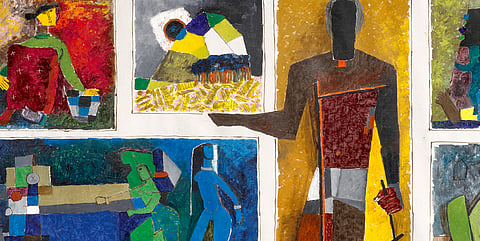
His painting, Untitled (Gram Yatra), sold for a staggering $13.8 million (₹118.7 crore) at a Christie’s auction in New York on Wednesday, making it the most expensive modern Indian painting ever sold. The record-breaking sale nearly doubles the previous high set by Amrita Sher-Gil’s "The Story Teller" in 2023, solidifying Husain’s place at the pinnacle of the Indian art market.
But what is Gram Yatra, and why did it command such a record price?
Created in 1954, Untitled (Gram Yatra)—translating to “village pilgrimage”—is a sweeping, 14-foot-long masterpiece composed of 13 interlinked panels. The painting serves as a panoramic ode to rural India, depicting scenes of agrarian life with Husain’s signature cubism. At its heart, a man and woman ride a bullock cart, while around them, vignettes of daily village activities unfold—women milking cows, farmers tending to crops, and children at play.
The composition is both lyrical and monumental, weaving mythology, history, and social realism into one cohesive narrative. Husain, who was deeply influenced by classical Indian art, European modernism, and his own early years painting cinema billboards in Bombay, infuses the piece with bold colours, striking forms, and an energy that defines his best works.
You May Also Like: Fractured Forms: Picasso's Radical Portrayal of Men
While Husain’s legacy has always been significant, Gram Yatra remained largely unseen for decades. Shortly after its completion, the painting left India in 1954 when it was acquired by Ukrainian-born, Norway-based doctor Leon Elias Volodarsky. Volodarsky, who was in Delhi establishing a thoracic surgery training centre for the World Health Organization (WHO), later bequeathed the painting to Oslo University Hospital in 1964.
For 70 years, this masterpiece sat outside the public eye—until now. Its rediscovery and sale have reignited excitement among collectors and art historians, not only for its artistic brilliance but also for its role as a cultural artifact from post-Independence India. The proceeds from the auction will support the training of future doctors at Oslo University Hospital, adding another layer of historical significance to its journey.
Born in 1915 in Pandharpur, Maharashtra, M.F. Husain rose from painting Bollywood billboards to becoming India’s most celebrated modern artist. His work often drew from mythology, history, and contemporary socio-political themes, earning him both admiration and controversy.
You May Also Like: Art Beyond The Canvas: 5 Most Exciting Artists To Watch Out
By the 1990s and early 2000s, his paintings of Hindu goddesses—depicted in the nude—sparked a firestorm of legal cases and death threats. Branded anti-national by right-wing factions, he left India in 2006 and later accepted Qatari citizenship. Until his passing in 2011 in London, he lived between Dubai, London, and New York. Even in death, his work continues to be a battleground—between reverence and resistance, nationalism and artistic freedom.
Husain, often referred to as the “Picasso of India,” was no stranger to setting benchmarks. Before this, his most expensive work was Untitled (Reincarnation), which sold for $3.1 million (₹25.7 crore) in 2023. Gram Yatra has now eclipsed that figure by a wide margin, underscoring the surging demand for modern Indian artists in the global art market.
Beyond the numbers, the sale of Gram Yatra reaffirms Husain’s place as a defining voice in 20th-century Indian art. His work, often a fusion of the past and present, speaks to India’s evolving identity—something that continues to resonate with audiences worldwide.