
- Entertainment
- Style
- Lifestyle
- Food & Drinks
- Tech & Auto
- Culture

Time and again, the spectre of an artist refuses to rest in its grave in Château of Vauvenargues. Instead, it travels across the world, slipping through the walls and haunting headlines, remaining one of the most sold artists at auctions. The co-founder of Cubism- deconstructing perspectives and breaking them into geometric shapes -the revolutionary artist, Pablos Picasso has resurfaced again, this time in Tehran, Iran. Like King Hamlet's ghost, he is one of those figures that refuse to be laid to rest.
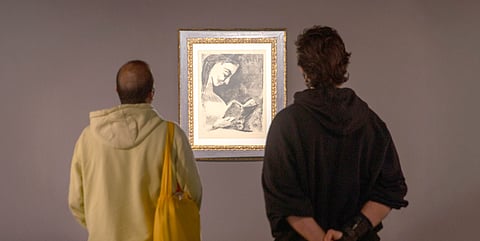
Just this month, the Tehran Museum Of Contemporary Art unveiled a long-hidden collection of Picasso's works that were locked away since the revolution of 1979 in Iran, making his presence more tangible than ever. (If the Immersive Experience Exhibition wasn't enough to nod to his pop culture presence...) The largest museum in Iran, Tehran Museum Of Contemporary Art, pulled the curtain back on 66 works that remained hidden from the public eye.
A series of 12 aquatint prints titled La Tauromaquia showcase his deep fascination with Spanish bullfighting culture. Other works include ''Portrait of a Man'', ''Cry of War'' and ''Echo of Sorrow''. These exhibits in Tehran echo far bigger conversation- one of gender and power. It's about connection, resilience, and power of creativity to endure.
Some of Picasso's famous work that negotiate with male power and fragility provoking, evoking, and calling for interpretations. Although these are not part of the exhibit in Tehran, a look at these offers a mirror and a critique.
An anti-war painting in grey, black, and white on canvas, Picasso painted Guernica, a gored horse, a bull, screaming women, a dead baby, a dismembered solider, and flames, in Paris. The somber mood and the choice of paints express pain and chaos. According to critics, the soldier with his broken sword and a flower in one hand, particularly, reflects the combination of hope and futility of war. The broken sword is emblematic of his heroic yet futile against the fight of terror. This is in contrast to the women wailing in suffering yet resilient.
An aging male figure, Homme Assis or The Seated Man, is a painting that is distorted yet the exaggerated brushstrokes evoke a raw, unapologetic force of masculinity in old age. According to Linda Nochlin, it is a deconstructed form of male form, suggesting introspective exploration of masculine identity in the modern world.
A portrait of his son, Paul dressed as Harlequin (a frequent motif in his works) is connected to Commedia dell'arte tradition. The portrait is one of gender roles and performative nature of identity.
Critiqued as the ''cerebral masculinity of the avant-garde'' by Helene Cixous, the geometric portrayal of the Russian composer is reimagined as a masculine identity that embraces intellect and creativity over physical prowess.
Part of the series of self-portraits, in this particular painting, Picasso, is a matador, a symbol of Spanish masculinity and bravado.
While Picasso's work has been widely analsyed, it has also widely faced criticism for being misogynistic particularly, in the way he has portrayed the power dynamics between the two genders and his treatment of women in his life. Perhaps, this is the facet of Picasso's work that forces one to question whether the myths that he often alluded to or interpreted in his works, his depictions of men and women and children should be indulged in or as any art expects, question it.