- Entertainment
- Style
- Lifestyle
- Food & Drinks
- Tech & Auto
- Culture

Let’s face it: The art world has a knack for making people feel like outsiders.
Gallerists in Comme des Garçons, wine in plastic cups, everyone referencing a show you didn’t attend. Full of obscure references, words like “semiotics” casually tossed into conversation, and a lot of nodding at things no one really understands. It can feel like you’re one mispronounced “Basquiat” away from social exile – especially when your only frame of reference is a print of “Starry Night” in your dentist’s waiting room.
But the truth is art isn’t actually that inaccessible—people just talk about it like it is. Talking about art—really talking about it—shouldn’t be the intellectual equivalent of tightrope walking. You just need some grounding, a bit of language, and most importantly—a sincere way of looking.
But we get it. It’s easier said than done.
You May Also Like: M.F. Husain Painting That Just Broke Records
So here’s a cheat sheet, not to fake your way through art conversations, but to join in without sounding like you’re trying too hard.
Nothing screams “I Googled this ten minutes ago” like dropping names without context. Don’t be the guy talking about “Duchampian irony” when asked what you thought of a painting of a dog. The best way to talk about art is to start with what you actually see. Is it beautiful? Disturbing? Did it make you laugh? Did it make you uncomfortable? Start there. Art is not a secret language for insiders—it’s meant to be felt before it’s deciphered.
This is the equivalent of asking someone you’ve just met what their “deal” is. It’s clumsy, confrontational, and usually misses the point. Instead, ask: What’s it doing? Or What’s happening in the space between the artwork and me? This subtle shift moves the conversation from textbook to personal. Because good art rarely explains itself—and when you start overexplaining it, you risk ruining it.
You May Also Like: Weathered Walls: How Street Art Bridges Culture And Science
This sounds basic, but it’s oddly rare. Most people leap to interpretation before observation. Talk about composition, colour, texture, material. Say: “I love how the light in this is doing something theatrical,” or “There’s something in the looseness of the brushstrokes that feels unfinished on purpose.” You don’t need the right answer—there isn’t one. But describing what you see is often more insightful than reciting something you read on a wall label.
“Tension” is a brilliant word because it works in nearly any context. Visual tension, emotional tension, cultural tension—it gives you space to sound thoughtful without being too specific.
“Form vs content” makes you sound like someone who once dated an artist. As in: “I’m not sure if the form is serving the content here.”
“Gesture” is good for abstract work. “There’s something really gestural about this” = you’ve noticed movement in the mark-making.
“Negative space” is for when the emptiness is doing more than the subject.
Use them sparingly. Buzzwords are salt, not the meal.
You will get caught. Someone will ask you what your favourite piece from the show was and you’ll panic and say “the big one,” and it’ll be a conceptual sound piece installed in a toilet. It’s okay to say you haven’t seen it. It’s even okay to say you don’t get it. In fact, that’s often the best place to start: “I didn’t really get it, but it made me think.” That’s more honest—and more interesting.
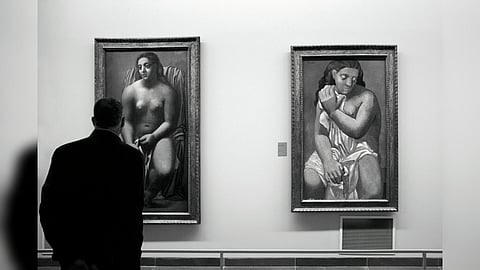
This might be the most underrated part of learning to love art: silence. Not everything needs a take. Not everything is a debate. You don’t need to turn every gallery visit into a podcast. Sometimes, the most intelligent thing you can do is say nothing and just be with the work.
Confidence in art, as in life, often looks like stillness. Instead, try this: point towards something that really stands out and say, “I have no idea what’s going on here, but I can’t stop looking.” You’re in. Mystery is magic.
Stand in front of something and give it more than eight seconds. Let it get weird. Let yourself get bored. Then look again. Don’t rush to read the text on the wall. Sit with the work. Good art often unfolds slowly. If you walk away still thinking about it, that’s the beginning of your take—not the end of it.
The people who are most fluent in the art world are often the most relaxed about it. They don’t need to prove what they know, which is precisely what makes them sound informed. If you’re unsure, ask. If something moves you, say so. If something bores you, say that too. But say it like you’ve thought about it, not like you’re dismissing it.
You May Also Like: Art Beyond The Canvas: 5 Most Exciting Artists To Watch Out
The smartest art people aren’t the ones making speeches. They’re the ones asking, “What did you see in it?” Art isn’t a pop quiz. You don’t win by knowing the right answer—you win by caring enough to look. Remember, curiosity always trumps pretension.
Historically, art institutions have thrived on gatekeeping. Not always maliciously, but academia, money, class, coded language—it’s all part of the furniture. Museums became temples. Critics became priests. And somewhere along the way, people forgot that art was once made in caves and marketplaces, not white cubes with security guards.
Another possible reason is that maybe no one wants to feel stupid. Don’t we have the same problem with wine? We’ve over-labelled it, over-dissected, and gate-kept it so much that if someone doesn’t “get” something, they assume they’re the problem.
But here’s the truth—most people don’t get it either. They’re just better at faking it. The trick is to stop trying to belong and start trying to connect.
The first step? Go alone. Seriously. No pressure to perform, no one to impress. Walk into a gallery, pick one piece, and sit with it for ten minutes. Ask yourself: what am I actually feeling right now? You don’t need to like everything. In fact, you shouldn’t. You just need to react. Boredom, confusion, awe—all of it counts.
Then, slowly, start looking more. Visit exhibitions that confuse you. Read the wall text after you’ve formed your opinion. Talk to people who don’t sound like critics. And most importantly, let yourself feel stupid from time to time. That means you’re learning.
You May Also Like: Fractured Forms: Picasso's Radical Portrayal of Men
The best art doesn’t make you feel smart. It makes you feel awake. The rest—lingo, labels, language—will come. And if it doesn’t? You’re still allowed to say: “I don’t know what’s going on here, but I kind of love it.”
That’s enough.