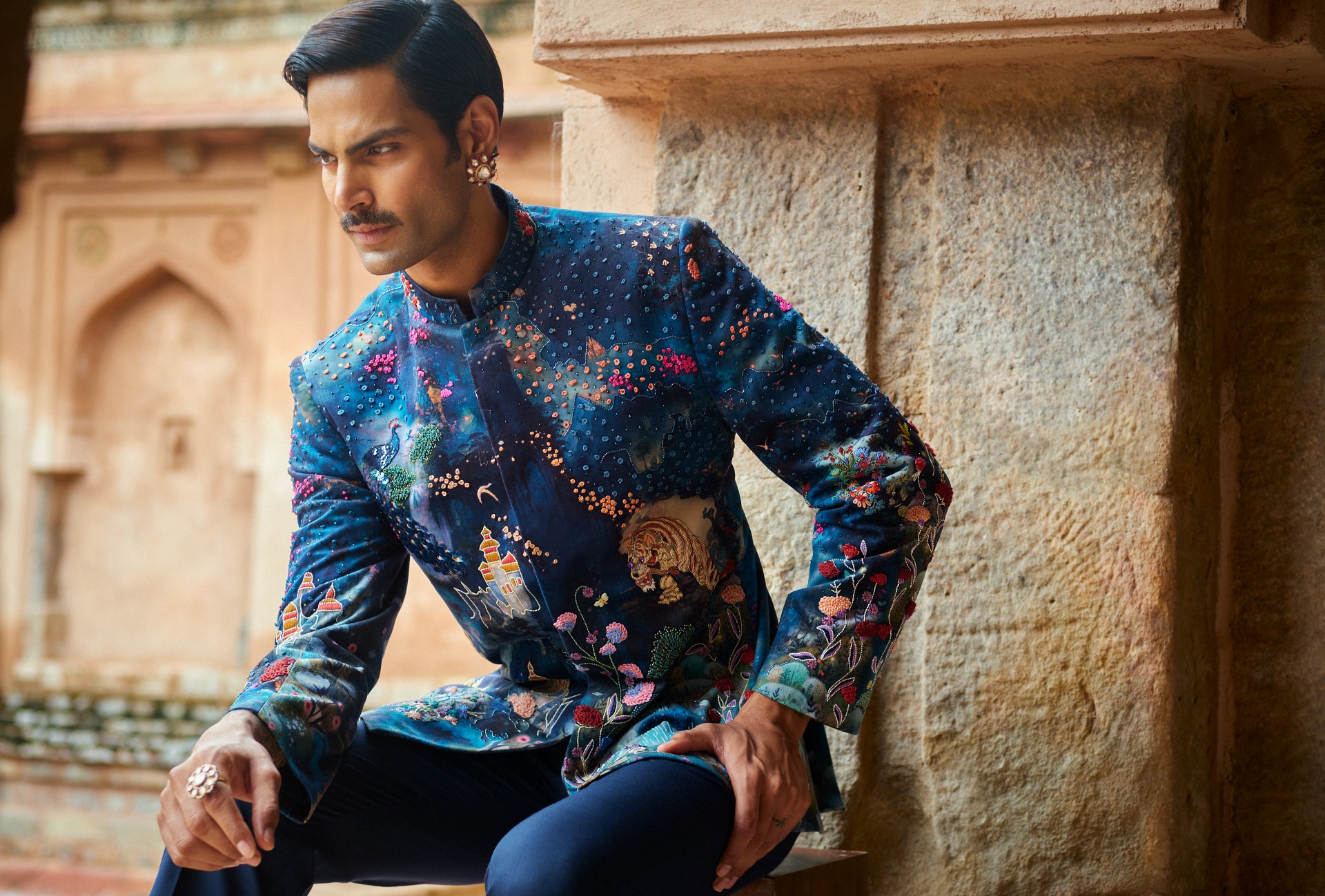
The Bandhgala Is Telling Its Own Story This Season
This wedding season’s pick is dialing up some desi drama in the fashion chat
Heading to a formal gathering? Try a bandhgala—and go light, bright, and embroidered while you’re at it. Once a somber staple of politicos, mostly seen in blacks and blues, the classic Indian suit is in the middle of a full-blown revival. Florals, pastels, metallics, and architectural cuts are giving it a new audacity, embraced by everyone from Harry Styles and Nick Jonas to Shah Rukh Khan.
Designer Shantanu of Shantnu & Nikhil puts it simply: “Modern India now wears the bandhgala with a very different lens. It’s no longer tied only to tradition or the mandap. Men style it for cocktails, after-parties, destination weddings, airport-to-event dressing, even press appearances. The bandhgala has shifted from ‘occasion wear’ to a high-fashion power silhouette.”
Cuffs, cuts, cool… repeat
Addressed in different ways — a tuxedo alternative, a Jodhpuri jacket – the bandhgala is playing to a full gallery of Sartorialists. Think micro-prints, sleek shoulders, geometric elements, and updated draping. Designer Nivedita explains, “Today’s bandhgalas have evolved into a new-age classic—leaner, sleeker, and far more versatile. The craftsmanship lies within the garment: intricate texturing, cut-and-sew panels, pleated details. It’s all about effortless elegance with a contemporary twist.”
Expect hybrid cuts—cropped, layered, or worn over T-shirts—as well as versions that go bold with florals or metallic accents. Designer Rahul Khanna of Rohit Gandhi + Rahul Khanna notes, “Luminous metallic weaves, textured jacquards, and breathable suiting fabrics are giving the silhouette a modern ease. What’s inspiring is how it has transcended gender. Its appeal lies in its ability to adapt."
Hues and motifs
Younger consumers are driving the shift toward expressive, mood-driven bandhgalas. In Rohit Gandhi + Rahul Khanna’s Altair, Starlit, Midnight, Nebula, and Comet styles, luminosity and intricate work catch the light at post-sunset gatherings. The colour palette has also expanded: botanicals, sequins, epaulettes, and playful prints are redefining the silhouette.
Designer Aisha Rao embraces this new freedom. “Our bandhgalas really carry that sense of play,” she says. From teakberry raw silk dotted with whimsical motifs—cacti, palm trees, tiny personality-packed details—to her fluid gunmetal “Skydust” version, the look balances Indian formality with movement and comfort. Piyush Mohnani of Asuka Couture sums it up: “Elegance isn’t about excess—it’s about expression.”
Once confined to ceremonial halls, the experimentation is also seeing it find a space everywhere as Khanna shares, “The bandhgala is now worn by HNIs and global professionals, whether paired with tailored pants for a work meeting, styled open over a T-shirt for an evening gathering, or even layered for an after-hours soirée. In lighter fabrics, punctuated by understated metallic accents and sculpted silhouettes, you can literally wear a modern bandhgala on so many occasions.”
What’s Driving The Shift?
It’s sartorial, yes, but cultural too. Grooms want individuality; men across the board want versatility. “Indian men are no longer dressing to ‘fit in’ to tradition,” Shantnu notes. “They’re dressing to stand out within it.” That shift has allowed for cropped military styles, draped pairings, and clean architectural lines.
“We have cropped military bandhgalas, asymmetric drape pairings, and clean architectural lines that reflect our house codes. The modern bandhgala is no longer just ceremonial, it’s surely become a power silhouette,” he states.
Traditional Embroideries Find New Rendition
Traditional embroideries—mukaish, zardozi, ari, appliqué—remain central, but designers are updating them with structure and technology. “We guide artisans toward a more contemporary aesthetic: linear thread architecture, metallic geometry, precision crest insignias,” Shantnu explains. Across ateliers in Rajasthan, Lucknow, and Benaras, embroidery clusters are using innovations like laser-cut velvet appliqué and recycled zari.
Rao adds a sustainable lens: “We use leftover fabric, off-cuts, and material waste, reimagining them into layered appliqué motifs. The appliqué is integrated into seams, lapels, collars—part of the structure. What you get is a garment with character, movement, and texture, modern and wearable yet rooted in craft.”
What’s Next?
The bandhgala is entering its global phase. Tech materials, androgynous styling, and gender inclusivity are shaping its future, but the core remains unmistakably Indian. “Stylists overseas are already treating it like an architectural alternative to the tux,” Shantnu says. “Sharper cuts, lighter fabrics, international proportions—without losing the Indian spine.”
His dream muse for a global moment? “Timothée Chalamet. He would be an incredible canvas for the modern bandhgala. He has the kind of global influence and experimental instinct that could take an Indian silhouette to the world stage with ease.”
Designers who are giving the bandhgala an avant-garde spin:
Raghavendra Rathore: Dramatic detailing that meets powerful silhouettes
Kunal Rawal: Multi-panel, deconstructed bandhgalas
Shantnu & Nikhil: Military-glam bandhgalas
Manish Malhotra: Colour-pop and metallic bandhgalas
Abu Jani Sandeep Khosla: Embroidered and swarovski-laden bandhgalas
Suket Dhir: Quirky prints and handloom textures
Antar-Agni: Asymmetrical, draped and minimalist bandhgalas