Inside Kimikai, The Silk Route House That Just Opened In Gurugram
A layered, Silk Route-inspired menu finds its footing in Gurugram
Golf Course Road has a way of humbling restaurants. The rents are punishing, the crowd is fickle, and the spaces — however beautiful — have a habit of cycling through concepts every eighteen months or so. I've watched good restaurants open here with real ambition and then disappear before they found their footing. So when Kimikai opened at One Horizon, in the same space that once held Ping's Bia Hoi — a place I visited every Sunday for its drunken noodles — I showed up with the kind of cautious curiosity you reserve for things you want to like but aren't sure you will.
Kimikai is built around a fictional character: a woman who trades spices along the Silk Route as a front for something more illicit. The team, including co-founders Rakshay Dhaliwal, Samarthya Bhargava, and Akshay Khurana, alongside chef Ruhani Singh, have been deliberate about one thing — this is not a pan-Asian restaurant. "Kimikai was born from the idea that food is history in disguise," Singh told me. "We were fascinated by the Silk Route — not just as a trade network, but as a space of exchange: spices, ideas, rituals, even identities." It's a strong idea.
The Space
From outside, Kimikai is very understated. There is no shiny glass facade, no neon signage. It’s honestly hidden in the corner in the dark. If no one told me its opened up in place of Ping’s, I probably wouldn’t notice this place to begin with.
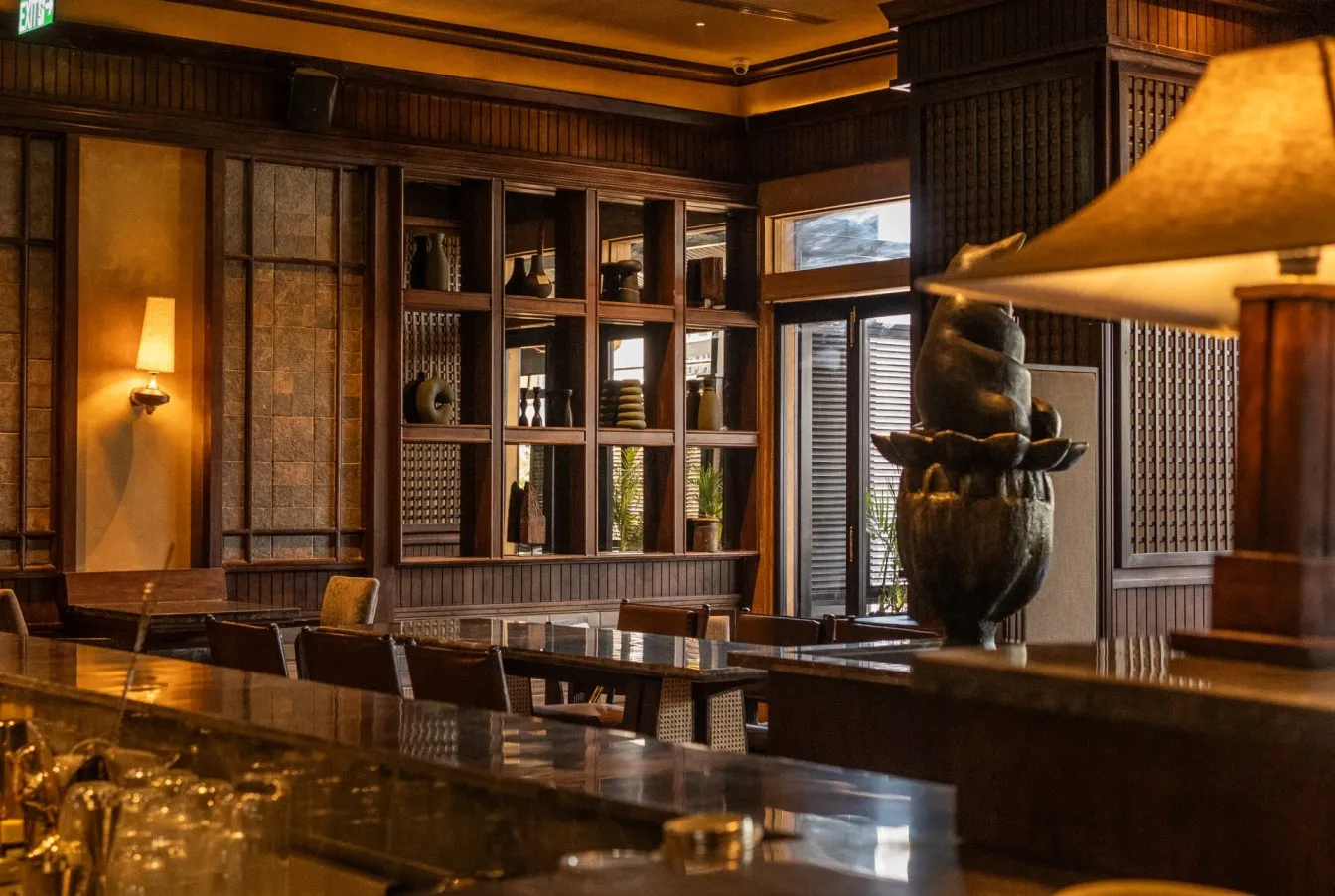
Inside, however, is a different matter. Inside, the space is warm. There's heavy wood, carved screens, silk draped in corners, poppy motifs pressed into wallpaper and napkins. A bathrobe hangs in the washroom. A small statue of Kimikai herself sits in the dining room, in case the wallpaper wasn't enough.
There is an outdoor section — plants, a mix of high and low seating — that the staff refer to as Kimikai's garden, which is charming. The private dining room is designed to resemble her personal study. An omakase counter sits tucked behind the bar, perfect for solo diners.
The design is, genuinely, some of the best work I've seen in a Gurugram restaurant in years.
The Food
Ruhani Singh is 29, trained at Le Cordon Bleu, and spent her most formative years in the kitchen at Zuma Dubai. "We see Kimikai as Silk Route cuisine," she told me. "Not a geography, but a journey." The menu moves across Japan, Korea, Thailand, Vietnam, and India — not as a checklist, but as a confident conversation between those places. "Instead of flattening everything into pan-Asian, we focus on memory, trade, the movement of flavours,” she said.
That duality, she says, also runs through the food itself. "A dish might look familiar but carry an unexpected layer. Sweetness might hide smoke, spice might reveal depth." It sounds like a manifesto, but it holds up on the plate.
Start with the carpaccios. The tomato version — ginger dressing, bubu arare, roasted sesame — is bright and pleasantly sharp, a strong vegetarian option. But the salmon carpaccio, dressed with fresh yuzu, bubu arare, and wasabi cream, is the one worth ordering. It's clean without being bare, the yuzu cutting through the fat of the fish just enough. The hamachi carpaccio hits the same note. Order all three if you can.
The pork rice paper taco is one of the best bites on the menu. The pork is cooked well, but the real win is the fried rice paper shell — a refreshing departure from the usual. The prawn and crab dumpling, served with a house peanut sauce, is another quiet triumph. And yes, although the lamb chops in hoisin and teriyaki have already been raved about in every early review of this place — they deserve it. They are meaty, balanced, cooked right, and they really do melt in the mouth.
For dessert, the miso honey toast is the one to order. Like don’t even question it, it’s amazing.
The Bar
"The bar and kitchen are designed to complete each other," Singh told me. "The drinks aren't an afterthought — they're an extension of the same philosophy. If the food is about the Silk Route, the bar is about what people drank along the way." The cocktail programme was developed with Pass Code Hospitality — the group behind PCO, SAZ, and Jamun — and it shows. The bar at Kimikai is tall and monolithic and, in the dim light of the dining room, genuinely striking. The drinks themselves lean into Asian botanicals: banana, avocado, pandan, yuzu, jaggery. Some of it works beautifully.
The Bae of Bengal (shochu, arugula, muskmelon, spice cordial, lime, tajin rim) is the standout: herbal, spicy, sour. The Golden Gambit and Forbidden Fruit both work well if you want something cleaner and more citrus-forward.
Then there is the Silk Loot: a three-course cocktail tasting menu, which is not something you find often in this city. The first course, Crush — Tanqueray No. 10, gherkin brine, lime cordial — is savoury and herbaceous, a strong opener. Roll, the second course, pairs Ketel One vodka with myoga brine and chardonnay, and arrives alongside a nori roll; it's umami-forward and surprisingly delicate. Smoke, the closer, is made with Pistola Añejo, Luxardo maraschino, and gherkin brine, and is the most polarising of the three — complex, a little aggressive, not for everyone. Each drink comes with a specific food pairing, and the concept is genuinely interesting, and the Silk Loot is worth ordering at least once.
Verdict
I asked Singh what it's been like going from chef to co-founder — from running a kitchen to running everything. "As a chef, your world is the kitchen," she said. "As a founder, your world is everything — people, finances, landlords, design, hiring, crisis management. It forces you to evolve from being a creator to being a builder." You can feel that in Kimikai. This is not a restaurant that was thrown together. Every corner has been considered.
The food is genuinely more confident than I expected. The space is among the best-designed in Gurugram. And the bar, for all its occasional overreach, has a point of view that most cocktail programmes in this city lack. When I asked Singh what Kimikai is offering that no one else on Golf Course Road is, she didn't hesitate: "We're not trying to be the loudest room in the building. We're trying to be the one people come back to. Everything here is layered and intentional. It reveals itself over time."