- Entertainment
- Style
- Lifestyle
- Food & Drinks
- Tech & Auto
- Culture

“Avoid the Sunday brunch," the man warned, and millions of us nodded grimly into their hollandaise. Bourdain wrote about line cooks the way Hemingway wrote about bullfighters — with reverence, irony, and a working knowledge of the bar afterwards. The chapter where he describes his first oyster on a boat in France — "Everything was different now" — is the closest thing food writing has to a religious conversion. Twenty-five years on, it still reads like it was written last night, on a bar napkin, in a hurry.
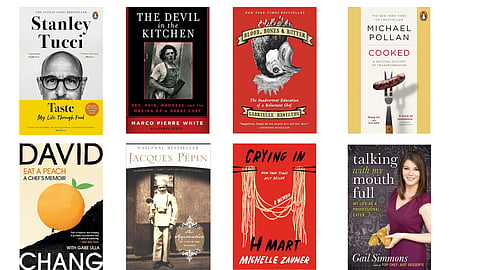
Chang opens the book by basically saying he never wanted to write a memoir, which is the most Chang way to start a memoir. What follows is the least-flattering self-portrait any major chef has ever published — the rage, the bipolar diagnosis, the conviction that Momofuku might be a fluke right up until the noodles hit the bowl. "I'd rather be hated for who I am than loved for who I'm not," he writes, and you believe him.
If Bourdain wrote like a rock star, Hamilton writes like a poet. The opening — a lamb roast in a New Jersey field, her bohemian mother in espadrilles — is one of the great first chapters in American memoir, full stop. She calls Prune "a tiny restaurant with thirty seats and a kitchen the size of a school bus”. The sentences are so beautiful you forget to be impressed that she's also feeding people.
The original enfant terrible, before the phrase migrated to start-ups! Marco won three Michelin stars at thirty-three, threw out customers who asked for salt, and once made Gordon Ramsay cry — a fact Gordon himself has confirmed. "I was a wild boy," Marco writes. It's gloriously unhinged in places, occasionally appalling, and an essential document of what kitchens were before HR.
Pépin is the gentleman of the cookbook shelf — the boy who started peeling potatoes in his mother's restaurant at thirteen, cooked for Charles de Gaulle in his twenties, and turned down a job as JFK's personal chef to work at Howard Johnson's, of all places. "I learned to cook by cooking," he writes, and there is something so French about that line I want to laminate it.
Pollan isn't a chef, technically, which becomes the entire point. He apprentices himself to a pitmaster, a baker, a fermenter, and a braiser, and writes about it with the wide-eyed humility of a man who has been very good at writing for a long time and is suddenly very bad at making bread. The fire chapter alone — whole hog, North Carolina, three a.m. — is worth the cover price. "Cooking, I found, is the place where nature meets culture," he writes, and somehow doesn't make it sound like a TED talk. A book that will make you want to braise something on a Tuesday.
A memoir told entirely through meals, which is to say, the only kind of memoir Stanley Tucci could plausibly write. There is the timpano, the negronis (extra-strong, extra-everything), the chapter on his late wife that will absolutely undo you in a coffee shop. Tucci describes his Italian grandmother's kitchen as "the centre of the universe," and he means it, and he convinces you. It's the prose equivalent of being invited to his house for dinner — which, frankly, is the entire offer here.
Yes, she's a musician, not a chef — but try to imagine a list of essential modern food books without it. Zauner loses her mother and finds her again in jjigae, in tteokguk, in the freezer aisle of a Korean supermarket in suburban Philadelphia. "H Mart is where your people gather," she writes, "under one roof, to remind you of who you are." The whole book moves like that — quiet, devastating, exact. I cry every single time and then run to hug my mother.
W.H. Auden — W.H. Auden — said she was the best prose writer in America, and that was before half of these other books existed. She wrote about a single tangerine drying on a radiator in Strasbourg as if it were the last fruit on earth, and somehow she was right. "First we eat, then we do everything else," she said, and every food writer working today has been stealing from her ever since.
The view from the other side of the pass — the editor's chair, the Top Chef judging panel, the long unsexy climb through food media that nobody puts on Instagram. Simmons writes brilliantly about the apprenticeship most people skip past: the unpaid stages at Le Cirque, the early days at Food & Wine, the gradual education of a palate. "I learned that tasting is a verb," she writes, and you suddenly understand why your friend who edits cookbooks is so insufferable at dinner.