- Entertainment
- Style
- Lifestyle
- Food & Drinks
- Tech & Auto
- Culture

THE THING THAT IRRITATES VIRAJ KHANNA MOST isn’t his critics, the art market or even the relentless churn of content he has built a career examining. It’s something far simpler.
“When people look at the work,” he says, “and say, ‘Wow, look at the colours.’”
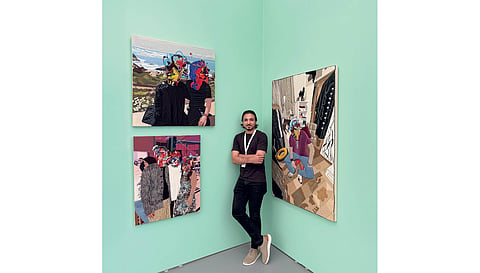
For an artist who spends hundreds of hours constructing embroidered works about the gap between appearance and reality, it’s a revealing frustration. The surface is always what gets noticed first. That, in a way, is exactly what “Made to Appear”, his latest exhibition at GR Gallery in New York, is about: the distance between what’s presented and what’s true. “Social media is inherently performative,” he says. “The moment someone visits an Instagram profile; they begin constructing an idea of who that person is.”
Created with textile artist Brian Thompson and on view until August, the exhibition uses embroidery to interrogate that performance. Rooted in tradition, community and painstaking manual labour, the medium becomes an unlikely lens through which to examine the curated realities of digital life.
At 29, the son of designer Anamika Khanna is currently obsessed with Pilates and Zlatan memes. He wanted to be a professional golfer before a pile of magazines on his Kolkata terrace and a pair of scissors led him to collage. Collage gave way to thread work. Thread work to embroidery. It turned out to be the most approachable and personal language he had been looking for. In hindsight, it makes sense that it found him. He grew up surrounded by the craft, artisans and extraordinary patience the medium demands. What he eventually understood was that embroidery and the images we share online are doing something surprisingly similar.
“Embroidery has historically been associated with embellishment,” he says. “In many ways, the images we share on social media function the same way. They are not necessarily false, but they are curated, edited and selectively presented versions of reality. We choose what we reveal, omit and how we want to be seen.”
Khanna, who has a love-hate relationship with social media, uses Instagram as a moving gallery. At India Art Fair a few years ago, he created a work based on a screenshot of his own Instagram bio—follower count, awards and a Forbes mention. What interested him was how a bare arrangement of data could function as a portrait, shaping perceptions of identity and success. “What people often don’t see,” he says, “is the uncertainty behind those images. I’m someone who questions things constantly and experiences a great deal of self-doubt that rarely appears online.”
His work isn’t about exposing social media as fake but about examining the gap between appearance and reality. “I’m interested in the contrast between the speed of digital culture and the slowness of making,” he says. “An image online can be consumed in a fraction of a second, while an embroidered work may require hundreds of hours of labour, attention and technical knowledge.”
In the ongoing exhibition, Khanna’s mixed-media works come alive in short loops that mirror the absurd ways we consume digital life. This is also true of his previous works—in Take my permission next time, for instance, a man seated at a restaurant eats his meal as a woman photographs him—before casually hurling a piece of bread across the table at her in a fit of rage. In Stop spoiling my view, a group of men gathered at the edge of a cruise ship to watch the sunset end up blocking the view themselves, until one has a phone thrown at his head.
Khanna’s fascination with success and authenticity also comes from closer to home. Growing up in affluent circles, and now working within them, he became aware of how ideas of success, taste and aspiration are inherited rather than simply acquired. Like his previous exhibitions, Made to Appear draws on imagery from that world—a Rolex watch gifted to him by his father, him and his friends flying a jet, playing golf—to question what those symbols say about validation, self-presentation and authenticity. “The work doesn’t come from a position outside these systems. It comes from participating in them while also reflecting on their effects,” says the artist, who is candid about his own privilege.
For Khanna, if there’s one thing he’s certain of, it’s this: authenticity is “not the absence of performance.” The moment we choose what to share and what to withhold, we’re already shaping perception. What matters is whether the version we present remains connected to something genuine. It’s the most honest position available to him… and one that makes his recent work all the more compelling.
To read more stories from Esquire India's July 2026 issue, pick up a copy of the magazine from your nearest newspaper stand or bookstore. Or click here to subscribe to the magazine.