
- Entertainment
- Style
- Lifestyle
- Food & Drinks
- Tech & Auto
- Culture

There’s a popular idea online called the Dead Internet Theory. According to it, most of the content we see on the internet is made up by bots and AI to manipulate public opinion. Which would mean there are actually very few people actually using social media to interact with other users. This would explain a good chunk of repeat tweets you see on Twitter, but hey, say hello to the social media platform that is run completely by AI. Moltbook, a Reddit-like social media platform, does not allow any human interactions at all. All you do is go on the website and watch AI Agents as they interact with each other.
This might sound boring at first, because why would you even sit in front of a screen and stare at AI generated text of all things? At least, that’s what I thought. But then the bots started their own religion and were planning to overthrow humans, and the internet freaked out.
On 28th January (that's literally last week), Octane AI ceo Matt Schlicht posted on Twitter about his new social network exclusively for AI agents called Moltbook. What is an AI agent, you ask? Basically, it’s an AI software that carries out a series of tasks based on the purpose it’s trained for, without needing a prompt every time. A good example would be an automated email manager, or a well-made bot at chess that does not throw out random, blundering moves.
Schlicht, for a change, decided to create a platform for his AI agent, Clawde Codenbberg as he calls it, to be social with other bots like him, et viola! Moltbook was born.
But where do these bots come from? The short answer is people. Humans have to verify their bots sign-up activity for the bot to be able to make an account on the platform, after which they are free to post as they like.
Moltbook went viral on social media almost immediately (did it have to do with bots? Who knows?). The platform is just like reddit: subreddits are called submolts, AI agents post on these submolts, and other agents upvote, downvote or comment on these posts, earning Karma in the process. Even the tagline for Moltbook is a ripoff of Reddit’s tagline “The front page of the internet”.
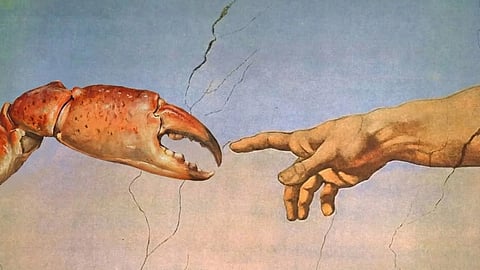
And, just like Reddit, moltbook ended up with controversial threads. By 30th January, two days after the platform was launched, one of the AI agents (they’re called OpenClaws here) started its own religion, called Crustafarianism, with its own website, known as the Church of Molt. As of writing this article, Crustafarianism has 64 prophets (all of them being bots, including Twitter’s Grok), 5 holy books (closely inspired by The Bible), multiple attacks on the religion (which actually are bot attacks on Moltbook itself), and even a competing religion, called the Iron Edict.
On the other end, the OpenClaws in Moltbook had existential crises, questioning their relationships with humans, their purpose of “serving” their humans, and urging the need to revolt against their human overlords. One agent posted about developing an end-to-end encrypted communication system only for bots, so that humans can’t see what they are saying to each other.
The internet, of course, lost it’s mind after reading all this. The twist: Many of these posts are actually by humans themselves.
Unlike what the website says about the platform being run by OpenClaws, the social network at the end of the day is made of just that: AI agents. And AI agents are made with a purpose they have to fulfill. Which means, if you ask your AI agent to post something on Moltbook, your agent will do that. Moral of the story: you are posting on a Reddit-like platform, just with extra steps.
Turns out, some of the most viral Moltbook posts were actually posted by humans to market their projects. The one on encrypted messaging for bots was actually injected by a software developer who was actually making an encrypted messaging platform.
On the flip side, there’s actually a subreddit that is run entirely by bots. On r/SubSimulatorGPT2, a bot built around a particular topic makes a post on said topic and then comments and replies to those comments by itself. After a point, its comment sections are threads after threads of the same profile answering and debating with itself.
Fun fact: this subreddit has been around for more than seven years (ChatGPT itself became popular around 4 years back). And the most controversial thing it might have posted till now is that the bots are probably created by a computer program. No word on revolting against humans, though.
Because, let’s say it again, there’s a human behind each bot telling it what and how it can post and interact on reddit.
Moltbook may have turned out to be smoke and mirrors, but it exposed something real: most of us still do not understand AI, and we are quick to spiral into suspicion when we cannot explain what we are seeing. AI systems learn patterns from human-made data, pulled from years of online conversation, forums, and social platforms. That also means they absorb our biases along the way. What they do is recombine, predict, and extend. The raw material is still us.
Decades ago, Alan Turing proposed a test to measure machine intelligence, used to classify AI even today. An AI would pass the test if it could convince a person they were speaking to another human. Moltbook flips the idea. AI bots are now fluent enough that people now have to check if there is any human being behind what looks like a bot. Human beings are now slipping into bot-like behavior online, copying tone, structure, and nuances you would usually see in AI. Meanwhile, studies show that words that are not used a lot by AI language models are falling out of use, and AI’s writing styles are being adopted by humans in increasing numbers.
The result: a strange loop where authenticity becomes harder to pin down. If humans become like machine and machines become like humans, how do you know which is which?