- Entertainment
- Style
- Lifestyle
- Food & Drinks
- Tech & Auto
- Culture

If the internet were a classroom, Wikipedia would be that quiet, diligent kid who always raises their hand first. On the other hand, Elon Musk's Grokipedia is the loud student who swears he knows better but really just crashes the projector five minutes into it.
So, yes. Musk has launched Grokipedia (finally), his AI-powered rival to Wikipedia, and like most things that come out of the X (formerly Twitter) ecosystem, it’s already chaotic, polarising, and slightly existential.
Musk first teased Grokipedia in late September, calling it “a massive improvement over Wikipedia” and “a necessary step towards the xAI objective of understanding the universe.” His pitch: an online knowledge database powered by Grok, xAI’s ChatGPT-style chatbot, that promises “truth-seeking” without what Musk calls the “Left-liberal bias” of mainstream platforms.
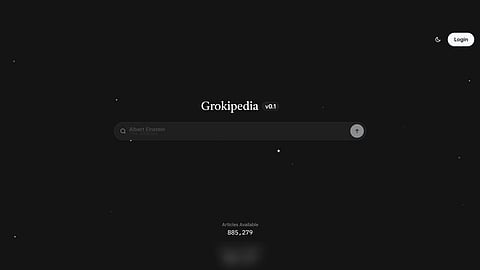
When it went live, the site looked almost exactly like Wikipedia—a search bar, a minimalist layout, and thousands of articles on everything from ChatGPT to Diane Keaton. Musk boasted that even at version 0.1, Grokipedia was “better than Wikipedia,” and that it would only improve with user feedback.
The problem? It barely made it past launch day before the site went down. Users had about an hour to poke around before it started restricting access. The irony of Musk’s “10X better” encyclopedia glitching on Day One wasn’t lost on anyone.
When it did work, Grokipedia looked familiar but felt… different. Gone were the citations, hyperlinks, and multimedia clutter of Wikipedia. What you got instead were stripped-down AI summaries that sounded a lot like they’d been scraped directly from Wikipedia—because, in some cases, they had.
Tech outlets like The Verge reported that multiple Grokipedia entries were copied verbatim from Wikipedia pages. In fact, some entries even had the same Creative Commons disclaimer: “The content is adapted from Wikipedia.” So, the world’s richest man launched an “AI revolution” that apparently started with Ctrl+C, Ctrl+V.
But here’s where things get thornier: the editorial tone. While Wikipedia leans heavily on human consensus and editorial neutrality, Grokipedia has been accused of pushing right-wing talking points, particularly on social and political issues.
According to The Washington Post and Wired, entries on topics like gender and climate change used language that mirrored far-right framings. Its “Gender” article, for example, defined it as “the binary classification of humans as male or female,” a clear ideological departure from Wikipedia’s broader, sociocultural definition.
In short, Musk’s “bias-free” alternative seems to have a bias of its own.
Predictably, Grokipedia’s entry on Elon Musk himself reads less like an encyclopedia and more like a corporate love letter. It describes his ventures as “truth-oriented” and “maximal in iteration,” attributing quotes directly to xAI’s website. There’s even a section titled “Recognition and Long-Term Vision,” which reads like it was ghostwritten by Grok itself.
That’s not to say the whole platform is useless. It’s fast, open-source, and promises to let users suggest edits—though not actually make them. (Because why trust the public when you can trust AI trained by billionaires?) Musk insists it’s all in the name of “the truth, the whole truth, and nothing but the truth.”
But “truth” is a slippery thing online, especially when algorithms start deciding what it looks like. Even Wikipedia’s co-founder Larry Sanger—once critical of Wikipedia’s alleged liberal lean—has already flagged factual errors on his own Grokipedia page. He admitted that while some details were “correct and interesting,” others were “just wrong.”
In theory, yes—competition drives innovation. But in practice, the world doesn’t need another online encyclopedia as much as it needs trustworthy information. Musk’s Grokipedia doesn’t reinvent that wheel; it just paints over it in a different ideological colour.
Wikipedia, for all its flaws, has something Grokipedia doesn’t: transparency. It’s messy, human, open to debate—and that’s precisely what keeps it honest. Grokipedia, meanwhile, promises to eliminate bias by replacing editors with algorithms. It’s like saying you’re fighting propaganda by letting a machine decide what’s real.
At its core, Grokipedia is less about information and more about ideology. It’s Musk’s latest attempt to build a parallel internet—one where he controls the pipes, the platforms, and now, the facts. From X (the “free speech” social network) to Grok (the “truth-seeking” AI), Grokipedia fits neatly into a broader narrative: Musk’s mission to wrest control of digital discourse from what he sees as the liberal elite.
And maybe that’s the real story here. Not whether Grokipedia will dethrone Wikipedia (it won’t anytime soon), but what it reveals about our fractured digital reality—one where “truth” is no longer a shared goal but a contested brand of storytelling.