
- Entertainment
- Style
- Lifestyle
- Food & Drinks
- Tech & Auto
- Culture

FOR SOMEONE WHO’S NEVER BEEN MUCH OF A FACIAL regular, I’ve been making up for lost time. It’s not an indulgence, though; technically part of the job entails trying new treatments so you, dear reader, know what’s actually worth doing. But I’d be lying if I said I minded the occasional professional pampering. Someone has to make these sacrifices for the greater good.
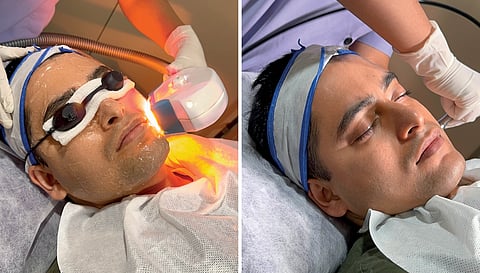
So when the folks at Influennz Skin & Hair Clinic, founded by Dr Geetika Srivastava, invited me to try their photofacial treatment, I was curious. It’s one of the most talked-about treatments right now, mostly because it’s non-invasive. The treatment uses light energy—Intense Pulsed Light (IPL)—to target concerns such as sun damage and dark spots, using broad-spectrum light pulses to reach deep into the skin and target melanin and blood vessels.
The promise is simple enough: skin that looks brighter, more even and less dull. The question, as always with these things, is whether the reality lives up to the promise.
Here’s how it works: it starts with a thorough cleanse, which is how things should be done in any case. Then, exfoliation. At Influennz, they used microdermabrasion and a cocktail to exfoliate more deeply and boost glow. Be warned that the peel could sting a little for the first few seconds, but other than that, there’s no discomfort whatsoever. Next up is the main thing: administering the IPL shots, which at Influennz range from 400 to 700 nanometres, depending on the amount of sun damage that needs to be addressed, along with multiple filters, each one meant to target excess haemoglobin production or redness on the face. Again, these shots could hurt slightly for some, so buyer beware, though I didn’t feel a thing.
Lastly, all of this is followed by a collagen mask to help calm the skin in case of any redness or temporary inflammation. The whole process takes about 45 minutes in total, in case you were keeping track. As for aftercare, diligent use of sunscreen, no actives for 24 hours, no sweating on the face—the typical stuff that’s applicable for any kind of facial.
I came out of the treatment definitely feeling more lifted, probably because of the shots. There was immediate visible glow as well, though actual results could take a day to fully realise. One is recommended to get this facial every two weeks should you be suffering from chronic hyperpigmentation; otherwise, even once a month should be good for basic upkeep of your skin.
As someone who doesn’t really struggle with a lack of glow, I’d probably recommend a photofacial post a beach holiday when your skin is tanned and feeling quite dull. Or maybe in the lead-up to a wedding or event you’ve been looking forward to.
Or maybe, just to treat yourself and your skin—who said you need a reason for that!
To read more stories from Esquire India's September 2026 issue, pick up a copy of the magazine from your nearest newspaper stand or bookstore. Or click here to subscribe to the magazine.