Ode To The Negroni
A slow striptease of bittersweet flavours
I like amber in perfume. Warm, deep, slightly sweet.
Now, the Negroni is amber poured in a glass. It is all the things amber is in perfumery—exotic, sensual and musky too. Other things that foreshadow the cocktail for me are cherries, late sunsets, garnets, Italian summers, George Clooney in white linen, and of course, oranges. When Pablo Neruda wrote his Ode to the Orange, when he called it a ‘fruit of fire’, he captured the full force of its singular splendour in one visual.
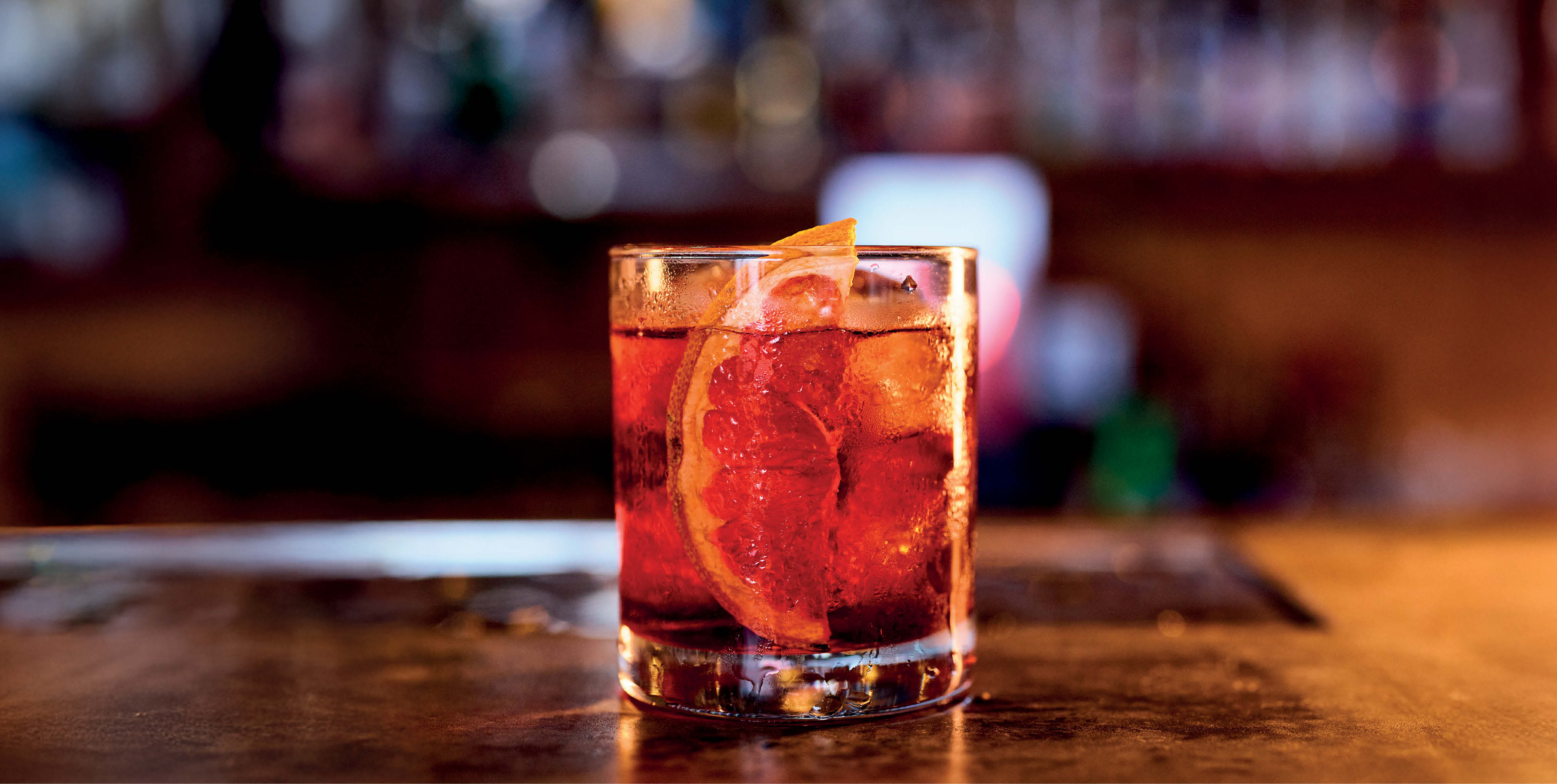
I think of the Negroni as that fire served on ice. First, it is a thing to look at. In it, no errant fleck from olive brine like in a Dirty Martini. And no tetra pack touch of the gauche Cosmopolitan (Tell me, have you ever come across fresh cranberry juice?).
You May Also Like: 5 Drinks Every Man Should Know How To Make
No, the Negroni is clear. It gleams like a jewel. It is the Monica Bellucci of drinks. Monica Bellucci in black silk, to be precise. Confident of its beauty, it is dialled back, wearing only one accessory—the orange rind. It needs no make-up. And the scent is seductive: a delicate citrus hint, so delicate that you must lean closer. When you hold a Negroni, the cold crystal sends tingles down your fingers. But on your tongue, it tastes warm. We are still talking about the Negroni.
Why do I love the Negroni? The three-ingredient cocktail is a curiously harmonious threesome of sweet, bitter and strong flavours that come undone in a slow striptease. They are unlikely bedfellows but they pair well. The resulting frisson is electric. It’s the kind of thing long nights are made of.
Let’s isolate the ingredients. While the Negroni is equal parts Campari, vermouth and gin, some ingredients are more equal than others. The Campari is the soul of the drink, giving it its jewel tones and its herbaceous complexity. The vermouth must be sweet and the gin must be dry.
You May Also Like: The Modern Man’s Guide to Drinking Well
As with all heroes, the origin story varies but most mixologists agree that the Negroni was born in the early 20th century in Caffè Casoni (now Caffè Giacosa) in Florence when a certain Count Camillo Negroni asked his bartender to add more power to his Americano, which was a cocktail of Campari, vermouth and soda. The bartender swapped out the soda for gin and the Negroni was born. I wasn’t sure what an ‘Americano’—nothing to do with coffee—was doing in Italy in the first place so I reached out to a Milanese bartender who clarified that ‘Americano’ was a generic term used for drinks that featured bitters, which had gained popularity in America. This style of drink probably arrived to the continent with bartenders who immigrated during the Prohibition. Other accounts suggest that the Negroni was once a long drink, that at some point it featured a lemon rind instead of orange, and I even came across mentions of Angostura bitters. However, over time, the Negroni as we know it today—served in an Old Fashioned glass with a large block of ice—was born.
Traditionally designated as an aperitif, the Negroni is now considered suitable for all occasions, a classic cocktail of the past and present that is still very much in fashion in Italy.
This means that your Italian business colleague who rolled her eyes when you ordered a Cappuccino at 4 pm will not be similarly disdainful if you ask for a Negroni with brunch.
You may also like: Who Says Men Don't Drink Wine?
And why wouldn’t you order a Negroni round the clock? It remains a drink that delivers beyond its brief. It is both a refreshing conversation starter with friends at 7 pm and a date night showstopper at 10 pm. It somehow manages to be both breezy and polished. Think, suit with sneakers. The flamed orange peel, the blend of herbs and aromatic botanicals, all add a lingering complexity. And like the best endings—as in short stories, summer romances and cinema—it ends bittersweet.
Notes On A Negroni
The Raw Materials: You need a bold gin to balance the Campari: a London dry gin like Tanqueray works best. Mumbai-based bartender Pawan Singh Rawat has instructed me to refrigerate vermouth for best results—sweet vermouth is a kind of fortified wine and will oxidize and lose its flavours if left out for too long. I use Martini Rosso but will go with Cinzano in a pinch.
Stirred, Not Shaken: The Negroni is a built drink so you simply pour the three ingredients over a large cube of ice in a chilled Old Fashioned glass. I use a 35 ml shot glass measure of each over a 2” cube of ice. Do not shake. This is not a drink for James Bond. Rawat shares that unlike white spirit-based drinks, coloured spirit cocktails such as the Negroni aren’t meant to be too cold. It should have the right dilution though. So stir the ice, but not for too long. About 6-8 seconds is just right.
You may also like: Inside India's Hyperlocal Drinking Culture
The Garnish: Use an orange wedge or use an orange peel. Or both, as I do. I freeze an orange slice in my 2” ice and also twist a fresh orange peel to express oils into the drink, torching it before serving. Rawat has a tip for when you’re making this at home. Graze your guest’s wrists (or lips, if they consent?) with your orange-scented fingertips.
The Variations: There are plenty. Try the Negroni Sbagliato, for instance, which replaces gin with Prosecco.
Pairings: Avoid serving with spicy food or creamy fare. Bruschetta, cold cuts or salted nuts and crackers work best. I find the Negroni to be a good graduation from an Aperol Spritz when you want your evening to turn.
To read more stories from Esquire India's March 2025 issue, pick up a copy of the magazine from your nearest newspaper stand or bookstore. Or click here to subscribe to the magazine.