Here's How Streaming Is Writing Its Male Characters
Writers of some of OTT’s most loved recent projects tell us how these guys were made
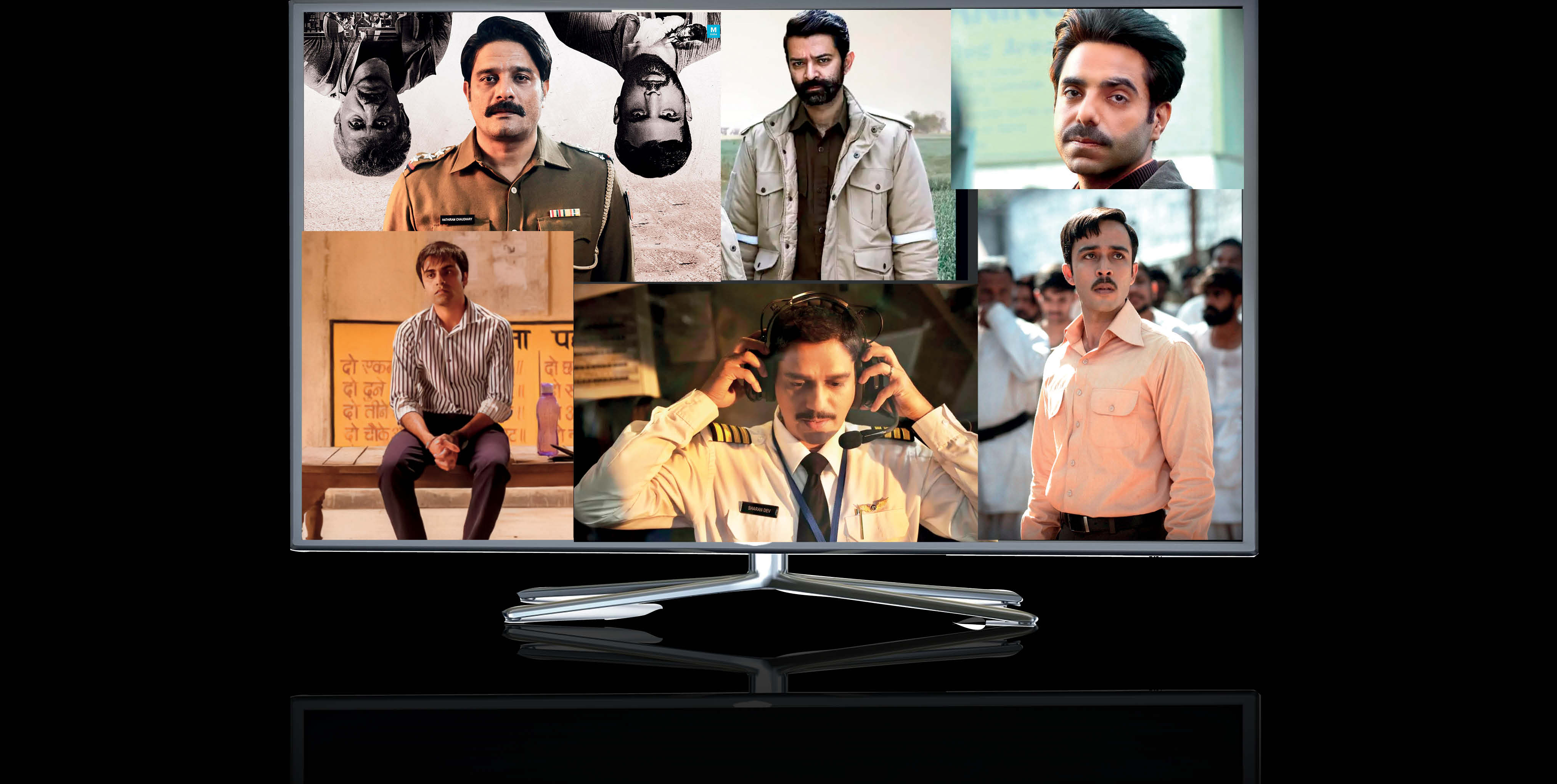
The first thing anybody watching Black Warrant is acquainted with is the lineage of its lead star, Zahan Kapoor. I am, too—watching Hindi cinema veteran and OG soft boy, the late Shashi Kapoor’s grandson walk into the frame. It’s a job interview—for the position of a jailer at Tihar. Almost immediately, the interviewer lets him know that this job mostly needs brawn over brain, like he will be reminded over and over on the show.
Despite the younger Kapoor’s alternative path to the screen, his link with an illustrious film family renders his choice for this very basic, everyday part a fortunate incongruity. Sunil has a distinctive ’80s look—oiled hair, pencil moustache, khaki shirts. He walks with an awkward posture, has an anxious and quietly impulsive demeanour where he is completely at home in his ordinariness. He even has a West Delhi twang: naukri becomes nokri, mehnat becomes mennat, contribute becomes cuntribute.
“The idea in the show is that the real Sunil’s accent should reflect where he’s from—a Delhi guy with a middle-class background. That slight Delhi lilt or twang was important because it helps root him socially and culturally—makes him specific. How someone from Sunil’s milieu and education will throw in English words, the way they stress certain syllables,” says screenwriter Arkesh Ajay, who worked on Black Warrant.
In addition to being directed by Vikramaditya Motwane, the show stood out also because of the characterisation of Sunil. A young, diffident young man assigned a particularly tricky duty. A lamb among wolves. This was a far cry from the heroes we’ve come to see in the crime-drama genre. Sunil is the confirmation that a new kind of hero has scooched down among us while we weren’t looking. Does he know how to throw a punch?
Maybe, but not in the cosmetised way you’re expecting. Unlike the macho guy of not too long ago, he’s in no need of giving away his perfectly sculpted forearms and lush pompadour. His voice drips no sexy testosterone. And when he leaps from a floor during a chase, he doesn’t land on his feet or execute a stylish roll along the ground before resuming the chase. He crashes with a thud, holds on painfully to his 40-something haunches and winces into the heavens. Characters like Sunil, and—notably, Hathi Ram Chaudhary—are the herald of a new demand in storytelling on streaming. That new demand is believability. The geography of the male protagonist on the small screen has shifted, and a slate of recent shows on OTT have borne witness to that.
You may also like: The PG Joke That Put An Eff In The Family
It’s been half a decade since Paatal Lok, the show that in the truest sense took over the Indian streaming space’s emergent gritty identity from Sacred Games, arrived in our midst. Unlike The Family Man, the first season of which released the year prior, Paatal Lok took up a down-on-his-luck police officer posted on the outskirts of the National Capital. Jaideep Ahlawat aced the weary, exhausted hero struggling to survive a broken system. The show, written and created by Sudip Sharma, returned earlier this year, shortly after Black Warrant, with its second season, sating viewers hungry for more ever since
they first fell in love with Hathi Ram during the dog days of the pandemic.
"The main battle is in retaining one's soul, one's moral compass as much as realistically possible. Hathi Ram Chaudhary is defined by this—he has had a rough childhood and, yet, as emotionally damaged as he is, he tries to undo or not do the same things that were done to him. So, he remains a man of few words, stoic and world weary—his sarcasm is a coping mechanism,” says Tamal Sen, who co-wrote the second season of Paatal Lok alongside Abhishek Banerjee and Rahul Kanojiya.
Hathi Ram has brought to the screen a never-before version of gritty realism within the Northern Indian milieu. It helps that he is played by Ahlawat, who is also fluent in Haryanvi and brings a natural sense of unpolished and lumbering gravity to the idea of the hero. He is often down on his luck, facing taunts and put-downs from his superiors, and doesn’t have the professional success trajectory that would have made any of the scores of screen ACPs in the early 2000s proud. He has a pot belly from a harsh field life and crappy lifestyle choices, curses unlike any other major protagonist in Hindi cinema and has a fractured relationship with his family.
“I might be stating the obvious, but there is a rule in storytelling—the more specific the character, the more universal it becomes,” Sen tells me. “Hathi Ram is beloved because everybody sees a little bit of themselves in him—he is not a hero that takes on 20 guys. He falls from grace at times, but he is dogged in his pursuit.”
Ajay stresses on the quiet weight of “ordinariness”: “It is actually one of the hardest things to pull off in storytelling—especially in a medium that naturally leans toward the big dramatic. To make a character feel ordinary yet compelling, the writing has to embrace the small. Small choices, small thoughts, small reactions. The audience needs to see reflections of their own lives—hesitation, awkwardness, bad timing, fear of speaking up—not just heroism or clarity.”
Despite fulfilling viewers' need for believability and the real, these characters mustn’t be watered down as simply ‘relatable’ or stamped with a basic sort of grounded goodness. Both Sunil and Hathi Ram aren’t really the plaid-shirt-wearing everymen validating the universal male experience. They aren’t reluctant Pied Pipers of a new sort of middle-of-the road cinema either. These are onscreen heroes navigating often dark worlds with their own specificities, shorn of the increasing levels of bombast and
nuancelessness of stories that are being told on the big screen now.
You may also like: Tillotama Shome On Morally-Ambiguous Characters
“They also speak less, get no rewards at the end other than finding the truth out—and go through hell for it. Look at Chinatown (1974)—a film all of us in the writers’ room love. Look at any of the books by Dashiel Hammett—they practically pioneered the rules,” Sen says. He believes that even when pushed to the brink, characters like Hathi Ram hold on to a core of morality. “He knows he won’t change the world, but he keeps his soul intact. And that, really, is the only battle worth fighting,” Sen adds.
One of 2024’s most memorable—and controversial—shows in the mainstream space, IC 814: The Kandahar Hijack, was talked about quite a bit for its depiction of intelligence officials and government representatives during one of the most stressful national security crises in recent history. The script ensures drama and complexity in the morally grey stands that these characters take. And the central character, flight captain Sharan Dev, played by Vijay Varma, relied more on moral courage than machismo.
“The brief for this man was that he wants to be the guardian of all these people. Nothing bad should happen on his watch,” Trishant Srivastava, who cowrote the Anubhav Sinha show, tells me. And, indeed, Sharan is a father, who constantly thinks of his family, his brow frequently furrowed with the sort of deep empathetic worry that comes with thinking of being separated from one’s own loved ones. His sense of restraint is more performance than professionalism—because he knows that it’s this performance of restraint and compliance that is going to tide his passengers over.
It somehow helped that Varma had played memorably devious and abusive men onscreen in Dahaad and Darlings prior, something that brought considerable moral fissures to his screen persona. Like Sunil, his character, Captain Sharan Dev, is based on the real captain of the flight that was hijacked. And Varma injects the same punctured, wounded gumption to the portrayal—a family guy holding on hard for dignity and determined in his quiet heroism, a man quickly remembering that he’s not supposed to lose his cool. Srivastava adds that it was through resilience and quiet courage that Sharan
exhibits his heroism. “The actual Captain [Devi Sharan] is a very simple, warm sort of man. Beneath that normal, everyday exterior, you realise that he actually flew a plane for 17 hours straight without any food or water. The real Captain still has the mark on his neck from the chief hijacker pressing the barrel of the gun hard on him.”
Later in the show, he gets to the underside of the aircraft to repair a clogged lavatory, a sequence so telling in its quotidian realism that it elevates the portrayal from potentially merely biographical to stirring in its grace and courage. It being scripted, like Srivastava adds, lends texture to this intentionality.
Talking of fictionalisation, the creators of Black Warrant seem to manufacture a cheeky nickname for Sunil (Sunetra Chowdhury’s book, which the show is based on, doesn’t include this information). He is constantly referred to as ‘Baby’ at home—his parents, elder brother and a nosy neighbour included. It is both amusing and endearing, and clearly a conscious choice that ends up stressing on the babe-in-the woods aspect of the character. Sunil is in his early 20s but his presumably sheltered suburban life up to
this point has left him practically a pre-adolescent in his ways.
“It’s his real nickname!” Ajay tells me. “Talk about serendipity. Or is it nominative determinism? Isn’t life always richer than fiction? But it does help serve our intention perfectly. To his family that is so concerned for him, he really is a baby. It’s a simple and affectionate nickname but also signifies how he is this fresh-faced, vulnerable, new and uninformed kid stepping into a tough world.”
The second season of Kohrra, another noir mystery that is the toast of the OTT audience, is expected later this year. A Reddit thread even went so far as to call it “the Paatal Lok of Netflix”, a claim harking back to similar themes of moral depravity and trauma. Also created by Sharma, Kohrra stars two of the best-written male characters on Hindi streaming: Balbir Singh (Suvinderpal Vicky) and Amarpal Garundi (Barun Sobti).
Garundi is the younger of the two—a character riddled with conflict and a masterful interpretation of heartland Punjabi masculinity that’s both unyielding and tender. He’s had an affair with his sister-in-law for years, but that fact never overrides his characterisation. He is not introspective like some of the others in this list, but his presence is always marked by a moral intelligence that he doesn’t know how to articulate.
Hindi OTT storytelling has, perhaps unwittingly, become one of the few spaces in Indian entertainment where the state and its machinery can be interrogated without gloss. And to do that credibly, it needs protagonists who are not above the system but caught in it, sometimes complicit, sometimes confused, but never comfortably detached. Their “unremarkability” is not a lack of imagination—it is a political and aesthetic choice.
You may also like: Remembering Irrfan Khan
Arkesh Ajay, Black Warrant
We avoided giving Sunil (played by Zahan Kapoor) a clean-cut “idealistic reformer” arc upfront. He is not coming in with a crusade. He just wants to do his job, survive and do good if he can. Even crusaders mostly are simply responding to the circumstances around them—inherently either their conviction or their nature itself forces them to do something about what they experience around.
Bodhi Roychaudhury, Sector 36
I was always very sure of what kind of a character Pandey had to be (Deepak Dobriyal). Deepak is a very capable performer, and he hit the right notes with the tics and mannerisms—even his pronunciation—he was perfect thanks to his Delhi link. In the fate reserved for him towards the end, I wanted to stress that crime doesn’t exist in silos, and its sociological makings and beginnings always have a role to play in the fate of people.
Tamal Sen, Paatal Lok
Hathi Ram (played by Jaideep Ahlawat) has had a rough childhood and yet, as emotionally damaged as he is, he tries to be better. By no means is he perfect—as we have seen in the way he behaves with his wife and son. But he tries to learn to undo or not do the same things that were done to him. So he remains a man of few words, stoic and world weary—his sarcasm is a coping mechanism.
To read more stories from Esquire India's April 2025 issue, pick up a copy of the magazine from your nearest newspaper stand or bookstore. Or click here to subscribe to the magazine.