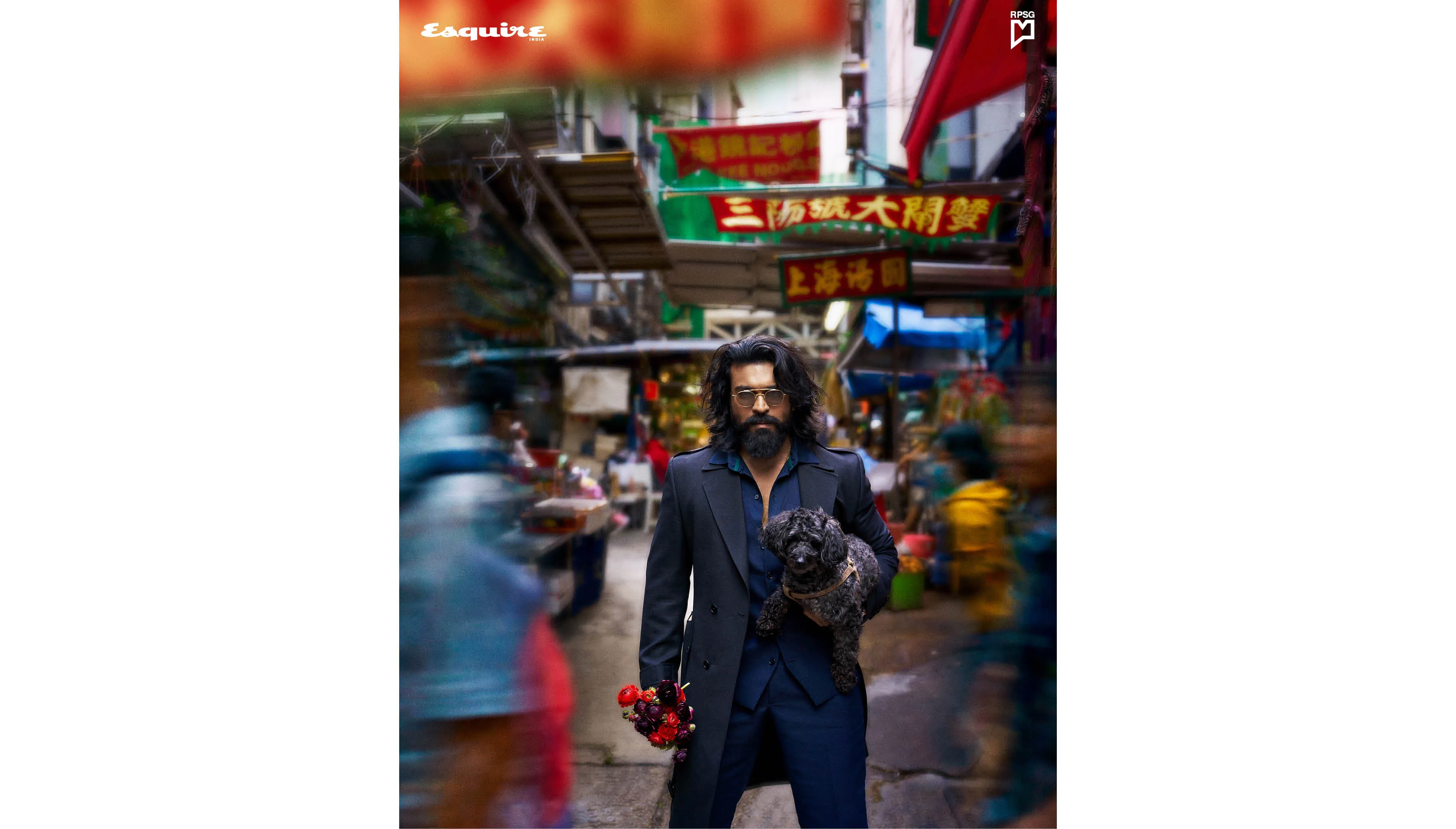
Ram Charan Master of His Course
Ram Charan’s Esquire India cover story explores fame, discipline, and staying grounded. The Mega Power Star reflects on work, life, and global success
Hong Kong does not do understatement. It rises, gleams, reflects and announces itself. The skyline is not so much a cityscape as a proposition: that scale matters, that ambition must be visible, that modern life is best lived in the superlative.
Inside the luxurious Rosewood Hong Kong, that same proposition is refined into something more understated but no less deliberate. The light is soft but exacting. The marble gleams without seeming to try. The silence feels expensive. It is the kind of space that makes most people instantly conscious of themselves. Which is why, when Mega Power Star Ram Charan walks into the lobby, what strikes you first is not his presence, but how effortlessly he wears it.
And he has no shoes on.
Not cautiously, not as if he is aware that this might seem unusual and certainly not with the faintest hint of apology. He is simply there: in a T-shirt, jeans, no shoes, carrying himself with that rare kind of ease which cannot be styled or taught. If you know, you know. The Ayyappa Deeksha—a vow of devotion and austerity observed by followers of Lord Ayyappa—is the reason. The ritual abstentions, the grounding (literal and otherwise) that come with it. But even with that context, what stays with you is not the explanation. It is the self-possession. In one of the best hotels and cities in the world, here is a man walking around barefoot without a care. It tells you something before he has said a word.
We sit down for coffee, and what begins as the sort of practical conversation that usually precedes a cover shoot quickly opens into something much more expansive. We talk, naturally, about films. But films are only the starting point. Within minutes, we are discussing the changing map of Indian cinema, how audiences move freely now between industries and languages, what the economy is doing to aspiration, how visibility changes responsibility. He is not speaking like a man who has rehearsed clever lines for interviews. He is speaking like someone who has genuinely reflected.
Later that day, when I meet him again for the clothes trials, the room is more crowded, the air a little busier. There are racks, fittings, conversations, decisions, a dozen moving parts. But he remains, in the middle of all of that motion, singularly steady. He is attentive to the clothes, attentive to the team, attentive to the mood we are all trying to create. He does not treat these details as trivial, nor does not overplay his involvement. He simply shows up properly. That quality turns out to be one of the recurring truths about him.
During the shoot, Charan matches the infectious energy of Hong Kong to the fullest and impresses the crew with his precision. In between shots, he takes moments to catch up with the team and, in one of those small, oddly human moments that often end up mattering more than the formally important ones, my rapport with him begins. We find ourselves talking about our dogs. Pictures come out. Stories follow. We are, for a few minutes, not editor and cover star, but just two people doing the universal dog-parent thing of insisting that the other absolutely must see this one particular photo because it captures the personality exactly.
Days later, when we reconnect over Zoom for the interview, that thread returns. Screens are turned. Our dogs are introduced to each other—yes, that happened! Rhyme, his cute Toy Poodle, enters the conversation, and so do my French Bulldogs, Alaska and Paris, sitting by my side.
“She’s like a feisty daughter,” he says about his pup. “Very, very conscious. She knows what she’s doing. She doesn’t let Kaara [Charan’s two-and-a-half-year-old daughter] go near the swimming pool. I’ve seen this so many times. She actually blocks her.” He says it with the amused respect of someone who has, in many ways, surrendered to another creature’s intelligence. “She can talk to you, she can sense you. Sometimes I’m a little wary of Rhyme. I don’t mess with her too much. I give her space.”
From there, as all good conversations eventually do, we move from the easy and anecdotal to the more essential.
What fascinates me about Ram Charan right now is not just the scale of his peak, but the thoughtfulness with which he inhabits it. There is global recognition. There are ambitious new projects. There is a home full of life and children and love. So I ask him, simply, which version of himself feels most real right now: the actor, the son, the husband, the father, the public figure. He does not choose one.
“I think the most real person is Ram,” he says. “Because all of these things you’ve spoken about—the husband, the actor, the son, the public figure—put together, that is Ram. Today Ram is nothing without any of these. There will be a huge void if any of these are tampered with.” He pauses, then adds, “I think I’m in one of the best phases of my life. It’s a complete phase. It’s a full phase. With RRR getting global recognition, I’m still digesting that slowly. The husband part… well, it’s been fourteen years. The kids part… I don’t know what I got into wanting three of them,” he says, laughing. “The house is full. I mean, it’s a complete life.”
What I find myself thinking about, though, is what this fullness feels like from within. From the outside, we’re quick to name someone else’s “good phase.” What does it feel like when you’re the one living it? “Everything is still coming into focus. The perspectives are changing. We are becoming more aware of how consciously we need to live. You cannot sail in every boat. You have to decide the few boats, otherwise the cost gets split.”
He also reveals how he has been thinking about time, about choices, about how to keep a life coherent while the world around it becomes more demanding. “Prioritising time… well, it’s not about having time, it’s about how well you are using your time. That has become the most important thing for me.” Was it not before? I ask him.
“Three kids nahi the,” he replies, smiling. “Dusre responsibilities nahi the. It used to be my work hours and my shoot, and now everything has to have meaning. My shoot should be meaningful. I have to give my hundred percent. The minute I come home, I should not act lazy. My daughter’s jumping, my wife needs something, there are family issues we have to address, there are fans’ issues we have to address too. So I have to not be foggy and be hundred percent present, every day.”
That phrase—not be foggy—feels like the key to so much of who he is at this moment.
Because if his life right now has expanded in any obvious way, it is through fame. And yet when I bring up a small conversation we had in Hong Kong—about how success tends to make everything louder and larger—he returns not to the bigness of his world, but to its deliberate contraction.
“Yes, fame makes everything larger because a bigger world is created with fame, obviously. But personally, before and even now, after everything, after fifteen years, I have made my choices and my world definitely smaller.
Charan grew up in a family where fame was not abstract. He saw it up close through his father [Mega Star Chiranjeevi] and uncle [Power Star Pawan Kalyan]. He watched not just the spectacle of success but its negotiations, its necessary boundaries, its costs.
“I’ve seen my father draw boundaries for himself so he could be present as a father every time. And these kinds of boundaries, these kinds of limitations, are very, very important for anybody in the entertainment industry.”
And then comes another crucial admission, one that explains the peculiar calm he seems to carry.
“I don’t tend to take myself too seriously. It’s been an instinctive part of my character for a long time. I am very focused and serious about the work at hand, the day, the situation. But overall, I have learned to detach. I’m not attached to my flops, my lows or my highs.”
This balance became even more crucial after RRR (2022), which was not just another successful film in his career, but a project that changed the scale at which the world saw him. I tell him exactly that: before RRR, the conversation around him was already large, but after it, something shifted. The world began to look at him differently. Did that recognition change how he thought about his career, especially with the added pressure of now representing Indian cinema globally? “Definitely there is a responsibility… maybe tenfold bigger. You’re not just representing yourself. You’re representing the film; you’re representing a culture you’re coming from,” he says, adding, “But we should not be carried away by the scale, or by trying to appeal to a global audience before the work even begins. We have to stay true to the film, to the work itself.”
He continues, “Thanks to social media, everything is so transparent right now. You cannot fake it till you make it. Day one, that one shot you have, that one closeup you have, you have to be completely honest.” That, he says, is what he strives for on set every day. If the work travels globally, if it reaches a larger audience, that is a bonus, a feather in the hat. But the work itself must begin closer home, closer to truth.
That same commitment to honesty extends to the physical transformations he has become known for. Transformations often spoken about in terms of spectacle, but which, for him, are rooted in discipline. His next film, Peddi, demands exactly that. He plays an akhada wrestler, a role that requires not just a physical shift, but a complete recalibration of the body: strength, balance, movement, instinct. When the first poster of the film dropped on his birthday last month, it created a frenzy—Charan, bare-bodied, visibly chiselled, a gada (mace) in hand, setting social media alight. The image travelled fast. But the question, as always, is what it takes to get there. I ask him what it means to inhabit that kind of physicality—not just to look the part, but to become it. “That gada was pretty heavy,” he says, smiling. “When I swung it, it pulled me down. You have to go with the energy—or it’ll break your back."
He goes on, “Preparation for a movie is a mental thing. It’s a lifestyle change that’s tailored to the char - acter. The only sanity I have is in being disciplined—day by day, week by week, year by year. If I lose that discipline, mera sanity chala jaata hai. ”
He pauses, then adds: “To perform anything, emotionally and mentally, your lifestyle has to be structured. I try to maintain that structure throughout the week and avoid distractions completely. I don’t arrive with too much preconceived preparation. Cinema today has to be fluid. I want to get into the skin of the game. That can only happen when you are coming a bit like an open page so the director can paint whatever he wants.”
The preparation for Peddi has been a long one— nearly a year-and-a-half in the making, including four to five months of dedicated akhada training under the same national coach who worked on Sultan and Dangal (2016). “He was extremely tough on us,” Charan says, amused. “I told him, ‘Sirji, main national ke liye nahi ja raha hoon.” When I ask him, on a lighter note, to rate his kushti skills out of ten, he says, “Char...” Then adds, with a grin, that his trainer would probably give him six or eight, but he wouldn’t. Ah, humility!
The first phase of Charan's life was about proving himself under the immense weight of legacy and expectation. That battle was real, and he won it. So, what comes next?
“It’s not about establishing,” he says. “It’s about dis - covering.” He’s discovering himself as a father, exploring new facets of himself as an actor, uncovering perspectives that feel deeper and clearer than before. “Probably the roles didn’t inspire me enough before, or the writing wasn’t strong enough… I don’t know. But right now, my perspective is very different, much deeper, much clearer. There’s hundred percent no void when I’m sitting in the car from the set to home. I’m happy. I can switch off, close that door and open another, because I have nothing to take back home.”
That idea—of not carrying dissatisfaction to the dinner table—becomes one of the most compelling arcs of our con - versation. He returns to it, and I return to it because it feels like the very heart of his current life. And that heart, quite literally, now beats outside him.
When I bring up something he had said years ago in an interview—that becoming a father “rebooted” something inside him—his answer is immediate and unexpectedly poetic.
“The purest form of happiness is outside the heart. Your part of the heart is pouring out and it’s right in front of you and you have to take care of your heart.” He goes even further back, to something both charming and revealing… that, in some strange way, a dog prepared him for this. Nurturing a pet during COVID, he says, initiated something in him that found its fullest expression when he saw his child being born. “It was like a volcanic burst,” he says.
Now, with three children, that joy has become a kind of household tempo.
“These heartbeats outside my heart have completely changed the rhythm of me, my family, the whole house. It beats on a different BPM,” he says. When the children are away, the entire house shifts. “The kitchen is like, kis ke liye khana banana sir, koi nahi hai” he says, laughing. “The whole house comes to a standstill.” The children, he tells me, are being raised in a deliberately unconventional, discovery-led environment—Montessori schooling, animals, ants, activity, wonder. He speaks about the joy of watching them find excitement in very small things. “I would like to take that hack from them… how easy it is to be happy in life.”
So, is Charan the fun dad or the strict dad? “I’m the rough kind of a dad,” he says. “The one who lets them jump, play dirty, climb, take risks. Their mother is the nurturing pole; I’m the one they come to when they want courage.”
And when I ask what kind of father he hopes they remember him as, his answer folds naturally back toward his own father.
"The biggest lesson we learn are from observing our parents. And I want to be a very, very present person first. And I want to be a present father.”
He speaks with the same fondness about his pets. “I don’t want to sound cocky, but they’re more loyal than humans,” he says, smiling, and then explains it further. Time, he adds, is too valuable. Energy too. Once you open yourself too much to the outside world, you never quite know how much of yourself is being depleted. “My pets and my core family… they’re my unit. I try to keep my world a little small, contained.”
That desire, for meaning over spectacle, explains the Madame Tussauds moment too. He is only the second public figure, after Queen Elizabeth, to have a wax figure with a pet. He admits he was initially hesitant, even a little shy and had not really responded to the museum. Finally, in mild frustration, someone approached his wife Upasana. Her solution was simple: tell him Rhyme might be included. That, she knew, would get him to say yes. And it did! The next month, he was in London giving measurements. “It was more meaningful for me, actually,” he says.
The word meaningful brings us, inevitably, back to the Ayyappa Deeksha, the barefoot vow that first introduced him to me in Hong Kong. I tell him I find it one of the most cerebral aspects of his life, not merely spiritual but formative. I had seen him at the airport in socks, on the move, at public events, in discipline, in black, in - habiting that vow without dilution. What drew him to it? His answer resists piety. “It was not spiritual initially,” he says. His father pushed him toward it when he was seventeen, as a way of disciplining his thoughts before he entered films. The practical benefits were immediate —fewer distractions, greater focus, more presence in daily life.
Over time, it became something more. “It has recentred me and reframed me… my thoughts and my lifestyle. It was an answer for many of my unanswered questions.” His father, he tells me, has undertaken it more than twenty-eight times. He himself has done it fourteen, maybe sixteen times. And yes, it challenges the notion of how a superstar is supposed to appear in public. But that is precisely why it is compelling. Because it is not trying to challenge anything; it is sim - ply committed. “It gives me a complete reset,” he says. “It gives me grounding. It gives me stability in my mental thoughts completely. And it helps me not get attracted to any vices or temptations in life.”
After a point, he adds, discipline becomes self-chosen. “You don’t have to listen to anybody. You have your own will and power. There is nothing that you will be fearing. And God is something I chose, maybe, to keep myself in check.” He is careful, though, not to make this prescriptive in a narrow religious sense. He speaks instead about structure, about how anyone can use such discipline as a way of recalibrating their life. He tells me about an atheist friend going through a difficult phase—divorce, addiction, chaos—and how he convinced him to try the practice not as devotion, but as restructuring. That friend is now in his fifth year.
Charan himself undertakes the Deeksha twice a year, around the turn of the year and again around Sankranti, ending one year strong and beginning the next the same way. If there is a more elegant metaphor for how he is trying to live, I didn’t hear it.
We circle back, finally, to legacy. Comparison has followed him since adolescence. In families like his, admiration and comparison often arrive together. So, when did he stop worrying about it?
Ignorance is bliss,” he says, smiling. He shares that he never internalised the pressure the way others might have. When people told him he would one day enter his father’s profession, he mostly assumed they were being kind. He never absorbed the full weight of what they were implying and perhaps that saved him. “I never took it upon myself."
What he inherited wasn’t anxiety; it was work ethic. “The first thing is showing up. On time. Always. Because if you don’t, somebody is losing money.” And then, simply, the work itself. “If someone is clocking fifty hours, you clock a hundred.” He tells me about how his father rose in an industry already filled with giants, and how that ascent came not from luck but from relentless effort. There is no sentimentality in the way he speaks about it. Only respect for endurance.
And when I ask what he wants his own children to take from the legacy they inherit, he is very clear, “They should find a purpose and they should create an impactful life,” he states.
Ram Charan seems to have brought the many versions of himself into a rare, hard-won conversation: the actor, the son, the husband, the father, the public figure, the private man, the star, the seeker. The world around him continues to expand. But at the centre of it, he is doing something both unfashionable and wise. He is making his world smaller where it counts. And perhaps for the first time in a long and very visible life, he does not merely look like a man in command. He looks like a man at home.
Credits
Chairperson: Avarna Jain
Editor: Rahul Gangwani
Creative Direction and Styling: Vijendra Bhardwaj
Photograpghy: Tarun Vishwa
Editorial Mentor: Saira Menezes
Managing Editor: Sonal Nerurkar
Deputy Editor: Mayukh Majumdar
Contributing Stylist: Mehak Khanna
Hairstylist: Aalim Hakim
Grooming: Gaurav Bhatte
Producer (India): Harsha Sinha | Elements Production;
Producer (Hong Kong): Carmen Cheng | Kidzfrmnowhere;
Producer’s Assistant: Meatding
Production Manager: Anson Ng
Production Assistant: Lui Hon Man, Lewis Wong
Photo Assistant: Fei Lung, Jeffkun
Styling Assistant: Nisham Limbu
Location (Boat): Aqualuna
Hospitality Partner: Rosewood Hong Kong
Destination Partner HONG KONG TOURISM BOARD
Esquire India Editorial: Saurav Bhanot, Prannay Pathak, Nitin Sreedhar, Abhya Adlakha, Rudra Mulmule, Riti Ghai, Kashish Mishra