
- Entertainment
- Style
- Lifestyle
- Food & Drinks
- Tech & Auto
- Culture

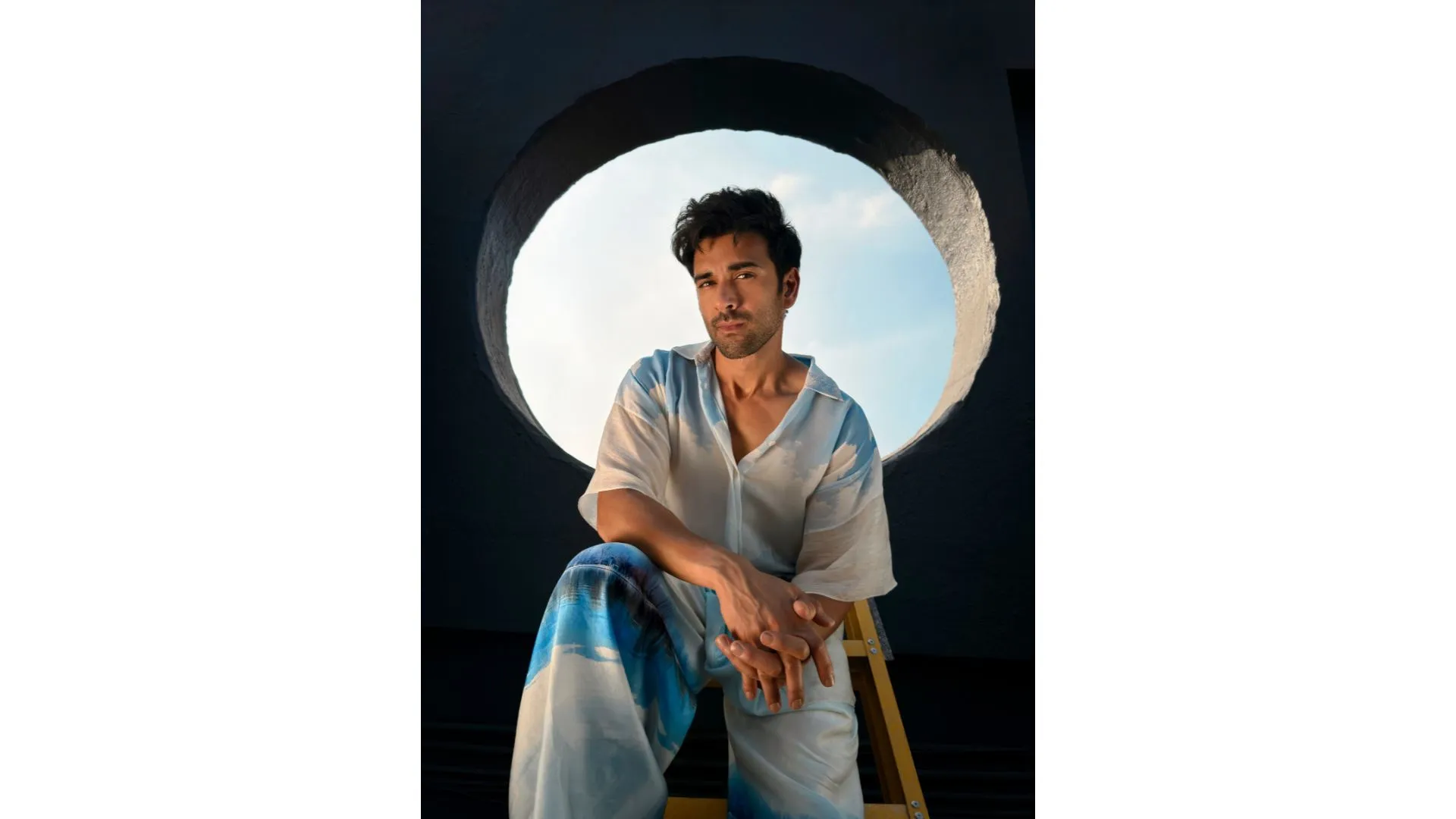
Pulkit Samrat arrives on set looking exactly like the kind of man you’d expect to see leaning against a motorcycle somewhere in South Delhi under the afternoon sun—hair slightly chaotic, jawline clean, posture loose. The industry may know him as an actor, but the vibe remains unmistakable: a proper, good-looking Dilli ka launda who hasn’t quite lost the charm of where he came from.
In person, he’s relaxed. Between outfit changes during the shoot, he stretches out on the couch, scrolling through his phone, occasionally running a hand through that deliberately messy hair.
“I like messy and I like waking up sexy,” he says at one point, shrugging when the conversation drifts to grooming.
It lands as a joke, but also not entirely. Pulkit Samrat’s appeal—on screen and off—has always been tied to that slightly unpolished confidence.
He has been around long enough now to understand the rhythms of the business: the early excitement, the unexpected hits, the inevitable disappointments, the slow recalibrations that follow. Yet sitting across from him, there’s none of the hardening that sometimes happens to actors after a decade or two in Bollywood. If anything, he seems curious about what the next phase might look like.
That curiosity probably began in Delhi.
Pulkit was born and raised in the capital, in a Punjabi family with no real connection to cinema. His family ran a real estate business, and acting wasn’t exactly the default career path.
Even now, years after moving to Mumbai, he still describes himself in the simplest possible terms: a Delhi boy who ended up somewhere unexpected.
“People connect with me because I’m a Delhi boy,” he says. “And the only other person people have said that about is Shah Rukh Khan. So if I’m getting called that along with him, I think it’s a blessing.”
His hometown shows up in the small details too. When asked what he misses most, the answer comes quickly: winter.
“That one-degree, two-degree weather,” he says. “And the food! Rajma chawal, chole bhature.”
It even shows up in his wardrobe. His earliest style influence, he says, was his mother, who loved the way Rishi Kapoor dressed in films.
“She was obsessed with those cardigans. The patterns, the classic sweaters.”
School uniforms did the rest. Delhi winters meant layers—cardigans, blazers, sweaters over shirts, and somewhere along the way, that became a go-to for Pulkit. Finding cardigans still excites him, he says.
Today, though, if he has to leave the house in a hurry, the formula is simple: black baggy jeans, maybe a linen white shirt or a charcoal one. The rest, he insists, is mostly unnecessary.
“I actually don’t like wearing clothes,” he says, laughing. “Most of the time I’m just in boxers at home. Maybe a vest. Unless Kriti tells me people are coming over.”
Kriti, of course, is actor Kriti Kharbanda, whom he married in 2024 after several years together. They met in 2018 on the set of Veerey Ki Wedding, and have since appeared together in Pagalpanti and Taish, which they seem to have navigated just fine. They got engaged in 2024 after five years together.
His relationship with fashion is similarly uncomplicated. If someone tells him not to do something, he’ll probably do it.
“Don’t over-accessorise and I’ll put more on. Tell me to accessorise and I’ll take everything off,” he says. “I just like breaking tropes.”
However, the one rule he never breaks: clean shoes. Slippers, floaters, whatever — but clean. "Nice and clean footwear is really important."
**
The professional journey that brought him here has been anything but straightforward.
After Pulkit moved to Mumbai in the mid-2000s, he took acting classes, knocked around for a few years, and eventually landed on Kyunki Saas Bhi Kabhi Bahu Thi — the soap opera that was on in more living rooms every night than any other show in the country. The role even earned him the Indian Telly Award for Fresh New Face.
Television fame can be sticky, though. Many actors remain trapped in that ecosystem for years. Pulkit chose to leave relatively early, trying his luck in films instead.
His film debut, Bittoo Boss (2012), cast him as a Punjabi wedding videographer. The film didn’t explode commercially, but it established Pulkit as a movie actor.
Then came Fukrey. Released in 2013, the film followed four scrappy Delhi boys chasing money through a series of increasingly absurd schemes. Pulkit played Hunny, the overconfident mastermind.
The film became a sleeper hit, then something bigger: a comedy franchise with a loyal fanbase. Over the years, Hunny has become one of those Bollywood characters audiences never quite get tired of revisiting. By the time Fukrey 3 arrived in 2023, the series had already cemented its place in pop culture.
Pulkit doesn’t sound particularly boxed in about it, though. "If somebody is known by their character and the love they've got," he says, "that's a good thing. More than people calling me Hunny, people connect with me because I'm a Delhi boy."
Jai Ho followed in 2014, with Salman Khan, and became his highest-grossing release at the time, collecting over ₹195 crore. Then came the rougher stretch — Dolly Ki Doli, Sanam Re, Junooniyat, Bangistan. Projects that struggled critically, commercially, or both. He talks about that period without drama.
"Once a film releases, it either works or it doesn't. That's the truth."
What he allows himself, when something underperforms, is one day. He sits with his family, his team, his acting coaches — Raghav and Sanjay, whom he describes as his teachers. They go through it together: a scene, a choice, something that might have gone differently. And then he moves on.
The only metric he keeps returning to is whether today was better than yesterday. "Never let success go to your head, and never let failure break you down," he says. "My only idea is that I've got to be better today than I was yesterday. It's as simple as that."
It’s a mindset that has quietly kept his career evolving. Over time, Pulkit has begun exploring roles that move beyond the comic persona of Hunny.
Taish, in 2020, felt like a turning point of a different kind. Directed by Bejoy Nambiar and released on ZEE5, it gave Pulkit a character named Sunny Lalwani — darker, more volatile, less interested in charm. He had wanted to work with Nambiar for years.
"It was a dream director on my checklist," he says. "Manifestation helped me reach there, and I made the most of it. I had a lot of fun on set exploring that character." He pauses. "That's probably the character I've loved playing the most."
That exploration continues with his upcoming Netflix series Glory, a sports crime drama that marks his first major lead role on OTT. In the series, Pulkit plays a boxer navigating the brutal world of competitive fighting, a role that demanded months of physical preparation.
"You cannot play an athlete," he says. "You have to be an athlete." So he became one, more or less. His current morning routine consists of a warm-up, kettlebell conditioning, HRV training, VO2 max work, and then finally strength training. Drew is the boxing trainer, with whom Pulkit will do pad drills, speed bag work. "It is very addictive," Pulkit says. "And it is very meditative." He does this on top of two days of steady-state cardio per week, one day of sprints and intervals, and regular strength sessions.
"People think it's only about rage. It is not. It is so mentally engaging." When he's in the gym boxing, he says, he doesn't think about anything else. He comes out de-stressed. "Workout is my caffeine. And boxing especially, it's also a great stress buster."
For someone working in an industry that runs on constant distraction, the mental clarity might be the real appeal.
There are other perks to acting that Pulkit still seems genuinely excited about. Travel, for instance. While filming Rahu Ketu, he found himself shooting in remote parts of Manali—far from the usual tourist trails.
“We were on one of the highest peaks there,” he says. “At five in the morning, you’d see nothing but mist and mountains. A full 360-degree horizon.” Moments like that remind him why he chose this profession in the first place. “You get access to places you would never see as a tourist,” he says. “And sometimes you get paid for it.”
Despite the laid-back humour, Pulkit is quietly ambitious. When asked what success looks like beyond box office numbers, his answer arrives quickly. “The day people stop comparing me to others and start comparing others to me.” It’s an unusually honest metric in an industry obsessed with comparison.