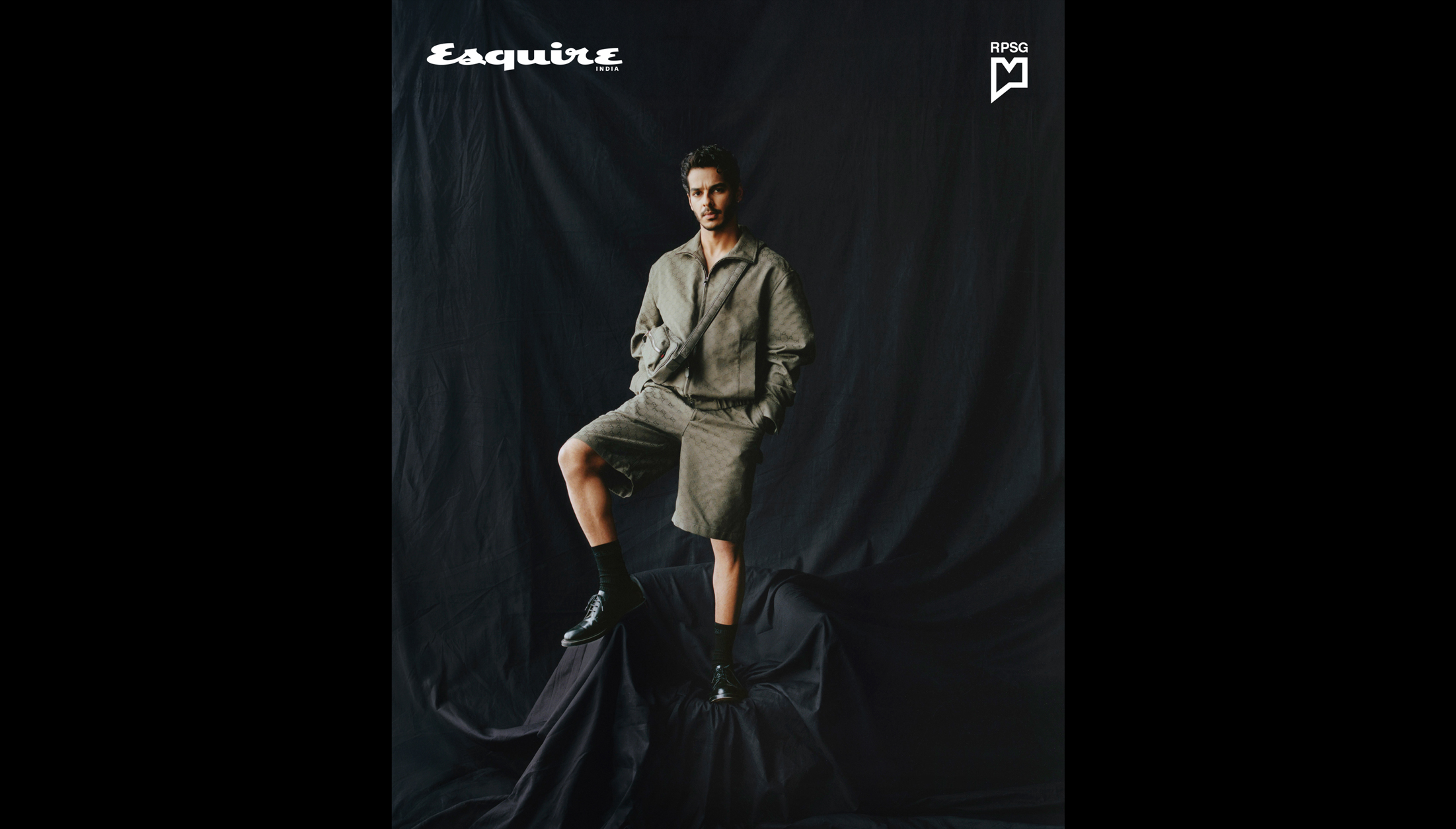
Ishaan Khatter Isn't Just Dressing The Part, He's Redefining It
From boyish breakout to global heartthrob, Ishaan Khatter’s rise has been calibrated, curated—and quietly complex. Amid a career crescendo, the actor opens up about fame, fashion, image-making and the rest
Ishaan Khatter plays a rustic police service hopeful in Neeraj Ghaywan’s Homebound. In the only clip available from the film—not even an official trailer is available yet—the camera chases two young men wearing sweaters, running anxiously down a foot overbridge trying to catch a train. Khatter—with Vishal Jethwa, his co-star in the film—looks nothing like whatever you’ve seen of him of late.
That’s because you’ve seen Khatter in a totally different mould of late. In 2025, he is the ‘it’ boy not only for Bollywood, but for a global viewership, especially after The Perfect Couple and now Homebound. His headliner act on The Royals is a libidinous follow-up to his press tours and 2024 tryst with Hollywood—not to mention the VMan parties and being styled by Alexander Roth. It’s a metamorphosis—from boyish screen ingenu to rakish pop charmer—unlike any other.
But it also raises the question: what image of the self does Ishaan form? How often does he look into himself and how often does he look at what others peer into him for? Esquire India chats with the actor on the artist’s interiority, the disquiet beneath his carefree swagger, ambitions, obsessions, discomfort and philosophy.
How important to you is this burgeoning image of the fashionable young star?
It’s important, as it’s a significant part of my self-expression and my evolution as a man and creative is also reflected by my sartorial choices. But I’m young, and an eternal learner, so I’m enjoying the exploration of it all. I’m not burdened by it.
That distinction is almost on the same synchronicity that two things he’s been in onscreen recently—The Royals and Homebound.
Does the buzz around the latter feel especially validating over The Royals?
Homebound is a very special film for me. Its beautiful reception at Cannes feels very personal. It’s a rare kind of effort that you don’t see often anymore, and I knew from the get-go that I had to be in it. As far as how it feels different, they are entirely different universes. The characters and the material couldn’t be more different, and you’ll see that when you watch Homebound. The Royals has been watched globally and made great waves on Netflix but Homebound has only played at Cannes so far. And so, I’m waiting for a wider release before talking about it further.
Much before you made your debut with Beyond the Clouds, you starred as a child actor in Vaah! Life Ho Toh Aisi! (2005) You were about nine then—but tell us about that first incident in your life that convinced you that you had to be an actor. Not in a starry-eyed way but in the way that the work really struck a chord with you…
To be quite honest, I was always starry-eyed but also very passionate. I knew it was my ultimate love, and as corny as it may sound, it felt like a calling. But if I had to really point out a moment of evolution—it was in my teens, when I became a bit of an autodidact for cinema in particular. I would watch as many as six films a day at film festivals or even at home, break them down with a group of cinephile friends and do retrospectives on my favourite artists.
What were you like as a child?
I was definitely very aware and empathetic. I must’ve been a handful because all I ever heard as a child and even into adulthood was that I’m an energiser bunny. Naughty but sensitive. Emotional to a fault sometimes but I think today I’m emotionally aware because I allowed myself to feel things deeply and didn’t shy away. I have day-oners for best friends, and very small social circle but I do my best to make connections and not be unapproachable. I loved music, dancing and films and wasn’t the sportiest kid till I was about 13—when I started doing Parkour and stuff. My best subjects in school were English language and drama. I was morally righteous even as a kid and I think pretty grown-up in many ways, and if I could do it over, I would cut myself some slack.
You’ve managed to carve your own path as something of a creative adventurer, away from the whole nepo narrative as we see it—starting out with a Majid Majidi film and then doing a BBC show somewhere midway between then and now. Tell us about that…
It came very naturally to me to go with those stories. I mean it wasn’t designed for impact, but that I followed my instincts and chose from the given opportunities in the moment, so I could express myself and represent the artist I wanted to be. I always want to create a path to stardom that is authentic, not manufactured.
Would you say that dance has proven liberating or helped transition into the performance of different parts?
I definitely agree that being a dancer is liberating. It has allowed me to express myself more freely and have more outer ease as a performer. I don’t know about it being instrumental as an actor in character transformation particularly because they are different crafts, ultimately, but it has surely had the largest impact on me as a performer in general.
What are you most uncomfortable with?
The invasion of privacy and blurring of lines can be intense. But with time, you learn to deal with it better.
You’ve had a very close point of reference in your family when it comes to performing, being in films and having the limelight thrust upon you—of course, in your brother Shahid. But then again, both of your trajectories have diverged especially with the public persona you’ve adopted with age. His is a more reluctant, brooding sort of fame. Yours is frothier, more out-there and more curated by the looks of it. How have you gravitated towards this cheery global outdoorsiness?
Yes, I’ve had the privilege of watching him from the wings, and I guess a lot of what I’ve learnt from it has been subconscious as well. But we’re both similar and yet different—and I don’t know about curated but my public persona is hopefully an extension of my real personality, and that can be different things at different times. But generally, I enjoy connecting with people and am curious enough to explore different avenues if an opportunity excites me.
What sort of things are you most obsessed with?
Stories, music, creativity, connection, travel and exploration, movement. Love.
Do you think ‘vanity’ and the serious pursuit of craft go hand in hand?
I think I’m lucky enough to have perspective from enough people outside the industry to recognise a certain level of vanity is pretty common in actors, haha! But as long as it doesn’t become a core defining quality of the person that you are it isn’t harmful, and I hope I don’t fall prey to it. I like to take my work more seriously than myself and I’d like to keep it that way. So, to answer your question, I think craft over vanity for longevity and meaningful work.
You’re about to turn 30 this year. Does that mean anything in terms of a shift in the work you're going to do hereon?
I haven’t thought on those terms, so no. Just gonna keep looking to grow further. Have you ever felt insecure or unsure about the way you look—or about your public image? I haven’t felt insecure to the level that it affects me or my choices in a big way but it’s normal to feel conscious sometimes. But never in front of a film camera. I try to look at myself objectively for my work.
What’s the kind of role you’d take up if you wanted to completely change the idea of Ishaan Khatter?
I think the emphasis can be on building the idea of Ishaan first because I’ve already done unexpected work, and my image as an actor has been defined by that. But if I had to answer that directly, I’d say I would explore a different language or film industry (like I already have done).
Styling and Creative Direction: Vijendra Bhardwaj
Photography: Bikramjit Bose
Fashion Team: Komal Shetty , Assisted by: Ifrah Kadir
Hair: Aditya Shah
Grooming: Nalini Ferns
Bookings Editor: Varun Shah
Artist Reputation Management: Jio Creative Labs
To read more stories from Esquire India's July 2025 issue, pick up a copy of the magazine from your nearest newspaper stand or bookstore. Or click here to subscribe to the magazine.