
- Entertainment
- Style
- Lifestyle
- Food & Drinks
- Tech & Auto
- Culture

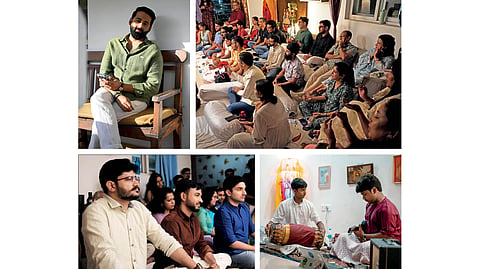
IT’S A LATE WINTER EVENING IN FEBRUARY, AND the air is fragrant with jasmine, agarbatti and ittar. A small group of around thirty people has gathered in a living room in Delhi’s Vasant Kunj. Some men slip a coil of jasmine around their wrists or accept the dab of ittar offered at the door. Others cradle the flowers politely before setting them aside as the music begins. The rituals are small, but they establish the mood.
Most are meeting for the first time, but a shared curiosity binds them. Seated cross-legged on gaddas, perched on low stools and sofas or leaning against the walls, they wait for an evening of Hindustani classical music to begin. It is a baithak in every sense of the word.
Twenty-three-year-old Prabhav Pathania is among them. An assistant manager at a car company in Delhi, he has chosen to spend his evening here, part of a growing cohort of young men for whom Hindustani classical music is still a discovery. For the next two hours, they will surrender themselves to the rhythmic plucks, soaring vocals and intricate melodies of a live performance.
“[Baithaks] have a deeper sense and connection to nature, the divine or something greater which I feel isn’t possible to experience if I’m sitting 100 metres away from the artist,” Pathania explains. “When I go to such gatherings, I get to meet people who I’ve something in common with, and [to] make connections that I value.”
Pathania and men like him could easily have been at a bar nursing an overpriced Martini or Old Fashioned, or lost in the sweat and chaos of a techno night. Instead, they are choosing to spend their evenings listening to Hindustani classical music—ragas, ghazals and even the occasional Bollywood classic—at ticketed baithaks and mehfils, intimate gatherings that bring performers and audiences into the same room. They come to uncover the layers behind the music, ask questions and experience a kind of closeness that sprawling concert venues rarely allow.
In many ways, these house concerts are the contemporary expression of a tradition deeply rooted in Indian culture. Long before the Mughal era, trained vocalists performed in intimate gatherings under the patronage of kings, nobles and connoisseurs. The setting has changed, but the format has endured: performers and listeners still share the same room, close enough for conversation as much as performance.
What has changed is the nature of patronage. Instead of a single benefactor underwriting an evening, audiences now sustain it collectively. A host curates the experience, but it is those who buy tickets (which cost anywhere between ₹1,500 and ₹15,000 for two hours), show up, listen intently and engage with the music who keep artists—and the ecosystems around them—alive. The modern patron does not commission the performance; he participates in it.
“The mehfil is not a trend. It is a return,” says Anubhav Jain, co-founder of Ibtida Ek Mehfil. Over the past six years, the platform has reimagined India’s shared heritage through curated experiences celebrating poetry, music and the performing arts in intimate settings.
Ustad Fareed Hasan Khan of the Delhi Gharana has been performing at baithaks for more than 15 years, across Delhi, Goa, Mumbai, Jalandhar and Ahmed - abad. “Hindustani classical music has always thrived in intimate settings rather than grand stages. Today, it has reached the homes of people who cherish it,” says Khan, whose forefathers performed for Bahadur Shah Zafar. “The best headphones are our ears; the best mi - crophone is our vocal cords,” he adds.
For Pathania, that intimacy is precisely the point. Small-scale concerts keep the music free from the demands of spectacle and allow artists to remain true to the spirit of their craft. “Attending these baithaks feels like contributing, however modestly, to a legacy of cultural stewardship,” he says. “Showing up is a statement that certain traditions and forms of knowledge deserve a place in the present, not just reverence in the past.”
According to Chinmay Mhatre, being part of a culturally active crowd and regularly seen at musical gatherings is enough to be mistaken for a connoisseur. “There’s inevitably a little social flex attached,” says the 34-year-old Mumbai-based stand-up comedian and regular baithak attendee.
The modern mehfil also has its own social codes. For some, it doubles as a date-night spot or is as much about the possibility of a meet-cute as the music itself. Some hosts admit they’re often asked which gigs attract the most attractive girls. Then there are the self-appointed poets, using the interval to recite their sher-o-shayari that never quite found an audience on Instagram.
But the performance ends where the music begins. As Mhatre puts it, “It’s about respect and gratitude towards the performers. We’re losing the culture of ghazals—these gatherings are one of the few avenues to keep them alive and relevant.” In the end, everyone— whether they came for the music, the social cachet or simple curiosity about our cultural past—is asked to do the same thing: sit still and listen.
Perhaps that is why so many young Indian men are finding their way to the baithak. At a moment when modern life rewards them for performing, networking and consuming, it asks for something else entirely: to pay attention.
Host Sukanya Banerjee of the Delhi-based Upstairs With Us, who has been curating ticketed living-room concerts with her husband since 2018, believes the appeal lies in rediscovering a tradition that exists outside the mainstream. “We usually think of these as events men attend only as compliant partners to their wives or girlfriends, or because they’re hoping to meet someone,” she says. “But the reality is that so many wonderful men come by themselves, or with their wives and children, because they want nothing beyond listening to good music and having a good time.”
In an intimate room where, unlike the three-minute pop hit, a single note can linger for minutes, the expectation is simply to be present. There is no VIP enclosure, no mosh pit, no pressure to document the evening. In a way, it is almost a rebellion of sorts against the swiperight speed of modern life. You sit, you listen and, if you’re lucky, you leave having heard something new. A night spent there becomes as much a lesson in sensitivity, patience and respect for craft as it is an evening of music—qualities that matter as much to character as career wins or material trophies.
For the new class of patrons, listening intentionally to ragas and ghazals is a form of cultural exercise that translates into other areas of their aspirational lives— how they hold conversations, appreciate effort and engage with people and ideas that require time to understand. They want to anchor themselves in something they feel emotionally connected to and are increasingly open to finding meaning in continuity rather than fleeting trends.
Where aristocratic men once sustained musicians with wealth and influence, today’s audiences sustain them with something else entirely: their time, their curiosity and their attention.
To read more stories from Esquire India's July 2026 issue, pick up a copy of the magazine from your nearest newspaper stand or bookstore. Or click here to subscribe to the magazine.