
- Entertainment
- Style
- Lifestyle
- Food & Drinks
- Tech & Auto
- Culture
AI generated summary, newsroom reviewed
Ever since African-American musicians first carried the genre into Bombay and Calcutta's ballrooms in the 1920s, and Goan players trained in Western harmony and made it their own, jazz in India has moved in cycles: it dominated the dance halls through the '60s, nearly vanished by the turn of the millennium, and is now being rebuilt, room by room, by people who lovcd the genre too much to put in the effort to bring it back.
What ties these places together is the intent of the creators and their passion for jazz. Some are reviving decades-old institutions, others are betting on jazz as an entirely new draw, but all of them treat the music as the reason to show up. Here's where to eat, drink, and most importantly, listen:

Park Street's jazz history runs straight through Trincas, and the restaurant's music credentials go back to 1959, when the Puri family took over what had until then been a tearoom, and by the late '60s it had built a reputation as one of Calcutta's proving grounds for live talent, a place hotel scouts would visit specifically to find performers before sending them up the circuit to venues like the Grand. Usha Uthup spent a decade there in the '70s before becoming a household name; Biddu passed through in the mid-'60s before his disco years; bassist-turned-bandleader Willie Walters, who'd played the city's jazz circuit since its heyday, became the connective tissue between that era and the present one. When third-generation owner Anand Puri took over just before the pandemic, he leaned into rebuilding the Sunday jazz slot around Walters' quartet in 2021 at a time when the city had barely a handful of musicians left who could actually play the instruments. It's a small, telling detail that when Louiz Banks—jazz royalty finally played Trincas for the first time in 2024, it felt like an acknowledgement: proof the city's other great jazz room was still standing. Three years on, the Weekend Jazz Lunches are now a fixture rather than a novelty. Four live sets a day across the week, a packed Sunday slot, and a city whose jazz scene has visibly grown around it.
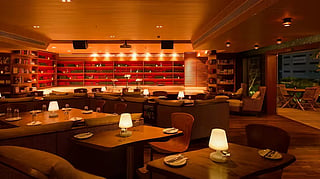
Hidden behind a garden path and a working hotel kitchen inside The Leela Palace, ZLB23 opened in early 2023 as India's first five-star speakeasy, built around a fictional Prohibition-era backstory and Kyoto-inspired restraint. It didn't set out to be a jazz room specifically, but live jazz, alongside occasional reggae, eventually became central to how the place sets its ambience, and the low hum that runs underneath the velvet drapery. ZLB23 also featured on Asia's 50 Best Bars list at No. 31 in 2025, becoming arguably India's most decorated cocktail address, with a jazz trio or quartet often playing to a room of first-timers and regulars alike.
The building at the heart of Morjim village dates back to 1955, when it was a working rice mill serving the village, before Goa's post-liberation economy moved past it and the structure sat derelict for decades. Architect Raya Shankhwalker restored it in 2016, keeping the original brick, wood and rusted iron intact. He reopened it first as a café before adding a bar and, eventually, Saturday night jazz. Goan musicians were foundational to Bombay's mid-century jazz age, and Shankhwalker has spoken about wanting to bring that history back to a Goan village room rather than leave it confined to Bombay's old dance halls. Today, young Goan players and long-stay international musicians share the same small stage most Saturdays, turning the old walls into one of Goa's most talked-about listening rooms.
Windmills started as a homebrewer's hobby. Founder Ajay Nagarajan was brewing beer in his kitchen in the US before training formally at Chicago's Siebel Institute. This turned into a more ambitious project when he partnered with Total Environment's Kamal Sagar, who had long wanted a venue built around live music. The result, opened in Whitefield, was India's first combined microbrewery, design library and dedicated jazz theatre, its bookshelves doing quite the double duty as acoustic insulation for the stage.
High above Lower Parel, on the fortieth floor of the St Regis, Asilo relaunched as the highest rooftop bar Mumbai has to offer, with Santorini-leaning, Mediterranean-inspired design and food from a Josper oven. The venue offers live music, and Jazz@38 is its most deliberate bet yet. A nightly 8 PM slot is built around The Bombay Jazz Club, the city's longest-running jazz curation outfit. Founded by Dee Wood and Rajesh Punjabi, the collective has been instrumental in keeping jazz a central feature of Mumbai's otherwise restless, ever-changing music scene, pulling in a rotating cast of players, vocalists, saxophonists, and drummers trained everywhere from Whistling Woods to the Conservatorium van Amsterdam.
Arjun Sagar Gupta grew up on a diet of Louis Armstrong, thanks to an early CD from his brother, and carried that fascination through an unlikely detour (a small bakery-supplies business) before opening a modest café in Basant Lok in 2012. Three years later came a proper jazz club in Safdarjung Enclave, built with the hushed, wood-paneled intimacy of New Orleans' old listening rooms, at a moment when Delhi's live-music infrastructure barely existed. A decade later, that stubbornness has compounded into three venues, thousands of shows, and a guest list that included Herbie Hancock and Chick Corea.
Book ahead if you want to sit and listen. The Safdarjung Enclave original still leans hardest into jazz, with the other two (Gurgaon, Eldeco Centre) mixing in funk, blues and hip-hop on any given night. Shows typically run in the evenings with sets timed close together, so it's built for a full night out instead of background music over dinner.