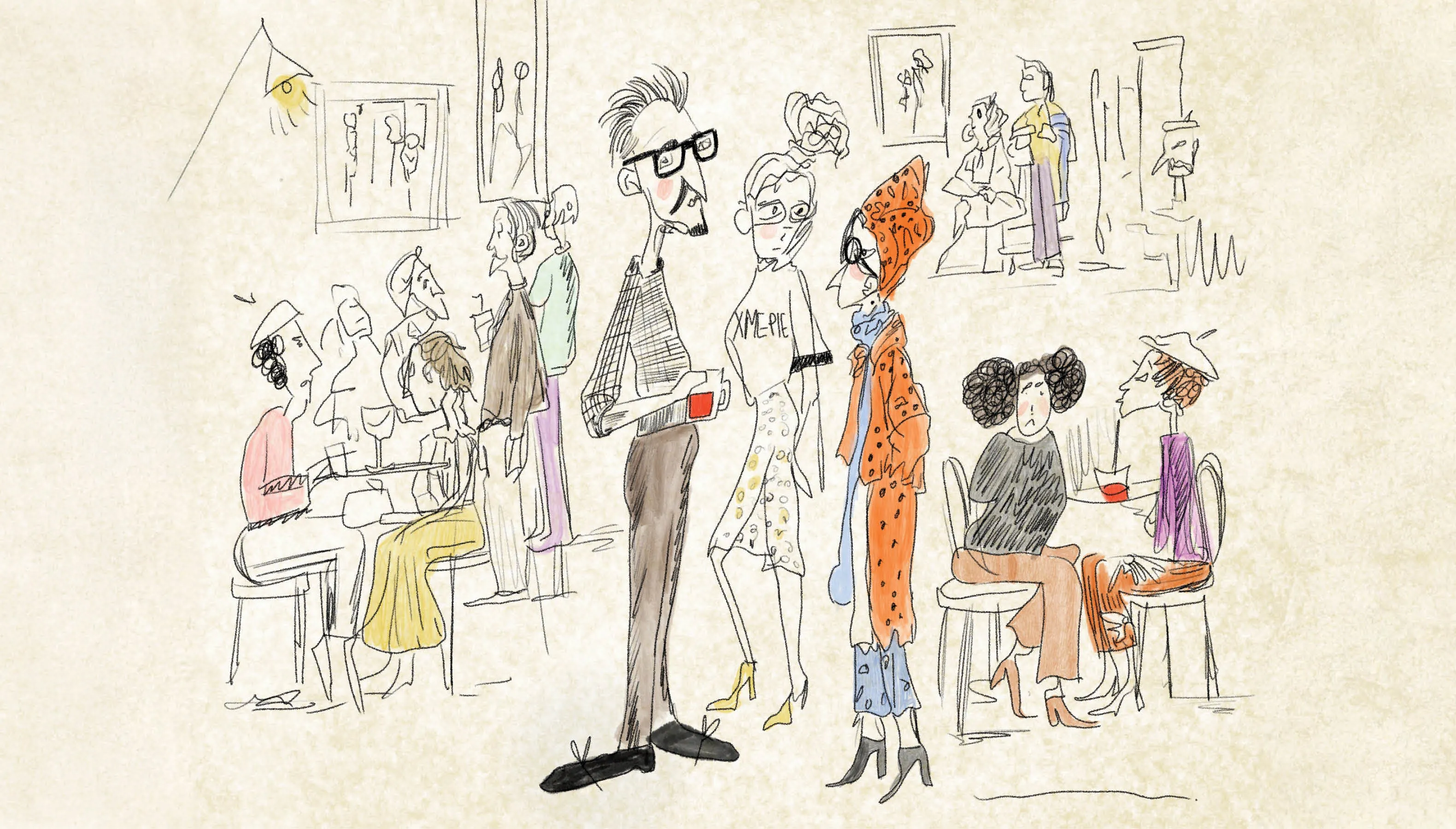
The Art Party Playbook
Art season has its own institutions and the guest lists are tight. Here’s how to score an invite
AT THE FIRST EDITION OF THE INDIA ART FAIR after the pandemic shut the world down, I was introduced to the inner workings of the art world. As a newly minted freelance features writer, I assumed this meant browsing booths, speaking to artists about their work, to gallerists about their vision and to collectors about what they covet ed. All of which, of course, was true. But I soon discovered another, perhaps more important, and certainly more interesting, dimension: the art party.
It began when a lunch-hour talk in the auditorium—a private event I slipped into thanks to my press pass— broke off into mini round tables, the conversation migrating to wine glasses and a proper seated lunch. After all, what better way to fuel a discussion on esoteric subjects than with a refill?
In the evening, I made my way to a friend’s more inti mate showcase, an IAF Parallel in Okhla. There was more art, more booze and more conversation. But the fun didn’t end there. Along with an eclectic group of art enthusiasts and collectors, I embarked on a round of art parties. A few stops later, with the same migrating crowd in tow, we found ourselves at the imposing gates of a farmhouse, trying to enter what was billed as the weekend’s most exclusive party—armed with a forwarded WhatsApp invite and boat loads of confidence. Known simply as The Art Party, it was hosted by collector Gaurav Karan for the who’s who that descend on the capital during art season. Inside, digital art played across large screens, museum-grade works dotted the house and lawns and a well-heeled crowd, including the son of Britain’s former Prime Minister, Boris Johnson, milled about. It was the height of post-pandemic bliss, with the art seeming almost a by-product.
In the years since, this party and many others like it, have become an institution of art season. These gatherings are hardly new; they’re the social machinery of the art and design world. Here, networks expand, allegiances are rein forced and taste is put on display. Even Shalini Passi made her fabulous TV debut for Netflix, dressed as Cleopatra, while hosting the grand MASH Ball for art lovers.
At this year’s India Design ID, Klove Studio founders Prateek Jain and Gautam Seth hosted an after-hours soirée to announce their collab oration with the Embassy of France in India and Business France for the second Art de Vivre à la Française in New Delhi. The gathering, according to Jain, was meant to turn an announcement into a shared experience. Seth adds, “Bringing designers, architects, collectors and media into one room creates visibility that lasts. Most importantly, it helps us build genuine relation ships. Conversations that begin face to face often grow into long-term collaborations."
This is also the case for Pallavi and Abhinav Khandelwal, a power couple in Delhi’s art and design fraternity. “As individuals deeply rooted in the creative world—I in the realm of art, and Abhinav [Managing Director of FCML] in architecture and interiors—we see our parties as a celebration of imagination, design and expression,” says Pallavi, an art consultant whose annual affair, timed around the India Art Fair, brings together like-minded creative professionals.
Bhavna Kakar, founder of the gallery LATITUDE 28, began hosting her famed TAKE parties in 2009 during the India Art Summit, before it evolved into the India Art Fair. The first doubled as the launch of the art magazine she has since edited and published, held at the nightclub Agni at The Park to position the publication as one with bold, rigorous content.
“The party was never just a party. It was about creating anticipation, community and shared ownership,” she says, proud to have built a platform where meaningful encounters begin.
WORKING THE ROOM
From a business standpoint, these gatherings have become essential spaces for dialogue, exchange and quiet discovery.
Tarun Khanna, art advisor, collector and founder of 108 Art Projects, plans his gatherings around projects and initiatives across the country that align with his values. In addition to his annual India Art Fair party, this year he extended support to the Kochi-Muziris Biennale, drawn by the conversations it fosters. “The main event can feel overwhelming to some, so our gatherings attempt to soften that experience. For many who travel from different cities and parts of the world, it offers a chance to encounter work in a more intimate, private setting,” Khanna explains.
An unhurried engagement and access to informal spaces around the ecosystem is exactly what a young collector needs when forming relationships with industry insiders and learning about trends and their own personal style. Entrepreneur and avid collector Siddharth Somaiya agrees. “The youth represent the future of collecting and creating opportunities for them to participate early on helps build long-term engagement with artists, galleries and institutions. When relationships begin early, they tend to evolve into deeper trust over time and collecting often grows from those sustained relationships rather than isolated transactions,” he says.
Yet access isn’t easy to gain. Most hosts consciously curate their strict and thoughtfully put-together guest list. Kakar, for example, invites people from different walks of life such as architecture, design, fashion and publishing. She recalls, “There is a now-legendary story about actor Abhay Deol; and even a well-known modernist artist having to wait at the entrance because they hadn’t RSVP’d.” She’s quick to point out the discipline at the door was never about exclusion. “It was about protecting the integrity of the room. When the mix is right, no one feels out of place and conversations flow, connections happen organically,” she says.
T he question that naturally follows then, is how to gain access to these parties? Not every one can sashay in with confidence and a bit of charm. Kakar advises sustained engagement. “If someone is on my radar through curiosity, commitment and thoughtful collecting, they are invited. I am also open to trusted recommendations,” she says.
Khanna encourages sharing your collection and inviting people to experience the works you live with, saying, “When you open that vision to others, you contribute to the larger discourse and organically become part of the fraternity you seek to access.”
Hosts, gallerists, artists, designers and creative professionals benefit equally from widening their circles. Somaiya summarises, “From an eco system perspective, nurturing young collectors is also a way of investing in continuity. While established collectors may have greater purchasing power, younger audiences may bring a different energy,” he says. The challenge, he says, is balancing the present with the future—ensuring seasoned collectors help cultivate the next generation so both can coexist. Amen to that!
To read more such stories from Esquire India's March 2025 issue, pick up a copy of the magazine from your nearest newspaper stand or bookstore. Or click here to subscribe to the magazine.