
- Entertainment
- Style
- Lifestyle
- Food & Drinks
- Tech & Auto
- Culture

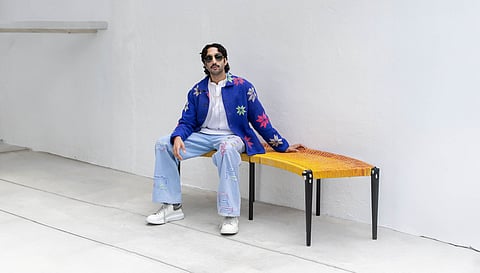
On a video call from Los Angeles, Art Gallerist Rajiv Menon cuts a striking figure in a Karthik Research indigo jacket
with a green undertone and bold prints, layered over a crisp Rajesh Pratap Singh white shirt and jeans from the South Asian-owned Houston-based label, Glass Cypress. The entire fit is by South Asian designers—yet it slides seamlessly into the LA landscape.
“I don’t think anyone’s going to look at me and say, ‘Oh, he’s wearing something foreign,’” he says. “It all integrates perfectly. Our creatives are thinking about global culture—that’s what makes it work.”
The jacket—custom-made for him ahead of his first gallery popup in Silver Lake—embodies a larger mission he shares with the designer: bringing South Asian visuality to the world. “It’s not your typical all-black gallery-owner uniform,” he says. “I wanted to do something different, to push against that. This was a deliberate way to introduce myself to a new public—show them who I am and what I stand for.”
Earlier this year, the 36-year-old made a bold statement with the opening of Rajiv Menon Contemporary (RMC), his permanent gallery focused on showcasing contemporary art from the South Asian subcontinent and its diaspora. After time spent in New York, Miami and London, choosing Los Angeles was a conscious move.
“I was very conscious of the way that Los Angeles was becoming a major global hub for South Asian culture because of Hollywood,” he explains. “Both on and off screen—in executive suites, writing, costuming—South Asian people are really active, powerful in the shaping of popular culture. Yet, the visual arts were being left out of that conversation. It felt like a great opportunity to bring art into dialogue with other visual mediums, to create a space that people who are really changing it could be part of.”
For Menon, who was born in Texas and raised between the US and Kerala, his work is driven by a clear idea: culture isn’t frozen in time. “South Asian art—and culture more broadly—is often framed only through tradition in the West,” he says. Having visited some of the best museums around the world, he’s seen how their South Asian collections are focused on antiquities. “You’d get the impression that South Asian people went extinct, because there’s no engagement with them now, and that simply isn’t the case with other parts of the world.” But it’s not just the Western gaze. “The diaspora itself is very guilty of this as well. Whether it’s fashion or art, there’s this notion that our culture is rooted in our traditions, our heritage,”
he says.
Modernity is still too often treated as a Western trait, while South Asian culture remains boxed into the past. The people caught in that false divide—what he calls a binary—often end up upholding it themselves.
AT THE HEART OF MENON’S CURATION LIES A BELIEF THAT culture is dynamic—alive, breathing and always evolving. At RMC, there’s no room for nostalgia-laced kitsch. The LA gallery isn’t just about hanging art on walls—it’s a stage for artists “entering a larger cultural dialogue beyond just South Asia… genuinely trying to create; dealing through the act of making itself.” The vein running through the newly opened space, showcasing contemporary South Asian artists like Tarini Sethi, Viraj Khanna, Bhasha Chakrabarti and Anoushka Mirchandani, is open, intentional and accessible—but never simplified.
Khanna’s embroidery work is described as “breakthrough both in India and the West. He collaborates with karigars to
develop tapestries that fuse images of contemporary consumer culture and aspirational life in India.” Meanwhile, Tarini Sethi’s practice “is rooted in Indian art history. She draws from many painting styles to create these really fantastic images of gender-fluid, multilimbed bodies in harmony with nature. Through this, she challenges how we understand the Indian past and offers a new language that imagines a utopian future—one where the body itself becomes a site of liberation.”
Thinker, painter and scholar Bhasha Chakrabarti’s work explores big ideas like colonialism, power and the body. “She presents them in stunning, aesthetically compelling ways that I genuinely believe are contributing to our overall sense of global scholarship.” Anoushka Mirchandani’s work focuses on the emotional experience of displacement.
“She’s given a visual language to a universal feeling—that of being out of place.” The gallery is part of a larger mission: to get people to physically engage with art in an age where most things are viewed on screens. “I was thinking a lot about how creators on Instagram and TikTok were becoming voices of cultural authority in a way that I found very troubling,” he says.
Aesthetics and taste, he believes, are too often sidelined in favour of what’s trendy or easy to consume—especially within diasporic or minority communities “hungering for visibility,” as he puts it.
A physical space like his gallery pushes back against the flattening effect of digital media. “Creators, many of whom I know, work very, very hard. But a single medium can’t speak for an entire culture,” he says. “I felt it was really important to counterbalance all the centrality that influencer culture was taking.” So, is it responsibility or rebellion? “I think it’s both—and it’s good,” he says.
A FRIEND ONCE TOLD MENON THAT TASTE IS A MUSCLE —something you have to grow, develop and cultivate.
Although he grew up in Houston surrounded by its vibrant art scene and practising artists on both sides of his family, it wasn’t until he was 21, studying for his PhD at NYU, that he truly developed the maturity to fully appreciate it. “I quickly just found a lot of joy in stumbling into galleries and discovering new stuff and just immersing myself within that world,” he recalls.
Starting out in literary studies, and fueled by a love for reading, Menon’s approach to aesthetics took root. “When I think about how I evaluate art, I kind of think of it almost like the way I would evaluate a novel. Like, what’s the composition look like? What’s the prose look like? But instead I’m thinking about it visually. What do the brushstrokes look like? What does the overall image look like?”
Living in New York, he found inspiration in the way people dressed and presented themselves, reflecting on how to translate
personality through clothing and style. “A lot of my understanding of my own personal aesthetic has come from self-knowledge —a deeper understanding of myself and what gives me joy,” he shares.
Among the shows that made a deep impact on him is Salman Toor’s exhibition at the Whitney in 2020, one of the first he saw after lockdown. “It was like a breath of fresh air. The sense of longing, alienation, and the pulse of joy and pleasure he communicated on canvas really showed me what was possible,” he recalls. Another meaningful experience was the 2023 Lucian Freud retrospective at the National Gallery in London. “Obviously he’s one of the greats, but to see the work all together in that capacity and to really go on that journey moved me in ways that I couldn’t describe.”
Both shows were pivotal for Menon, inspiring him to start his own gallery. “I saw that art, and I really felt changed by those experiences. I think good art and a good exhibition can have that effect,” he reflects.
Determined to create a similar experience for others, at his gallery, Menon makes a point of spending time with visitors, discussing what they’re seeing, what the artist is communicating, and how the work fits within the broader cultural context. “My gallery isn’t just a retail space. I’m not simply selling art. I’m placing it within culture and within the audience’s imagination,” he explains. “I truly believe anyone who spends some time with me here will leave with a sharper understanding of South Asia.”
While he has faith in people’s ability to grow and learn, Menon is realistic: art isn’t for everyone. “I’m not trying to make a blockbuster film. I’m aiming to build a deeply engaged audience,” he says—one that genuinely connects with the art. “I believe our impact ripples through every form of visual culture—fashion, creative direction, graphic design, set production. It spreads. And it’s my job to nurture that small, focused audience to help this culture thrive,” he says, signing off.
To read more stories from Esquire India's May-June 2025 issue, pick up a copy of the magazine from your nearest newspaper stand or bookstore. Or click here to subscribe to the magazine.