The Modern Creative's First Canvas
Esquire meets three creators whose stories echo Apple’s new belief - that brilliance begins with a flicker
Anyone who existed on the internet in the early 2000s knows how pervasive Steve Jobs' 'connecting the dots' passage was. You couldn't escape it, and nor did you want to—especially if you were a student. It was a journey into the mind of a legend, long before podcasts and memoirs made them so accessible to us. Jobs was talking about how dropping out of college helped him drop in on a calligraphy class where he learned, amongst other things, the bewitching science of typography—which, a decade later, he incorporated into the first Macintosh computer.
It's been 20 years since that stirring speech, but Mac's latest ad campaign still celebrates that idea. Or at least the underlying philosophy of it - that everything great starts as . . . well, nothing.
A quick sketch on an airsickness bag on a Paris-London flight can lead to the creation of fashion's most coveted handbag.
An accidental overdose of aldehydes can give birth to the most famous fragrance in modern history.
Apple's latest campaign, 'Great ideas start on Mac', is a tribute to that sense of possibility - directed by Academy Award nominee Mike Mills and narrated by the late Dr Jane Goodall. The film opens with a slow zoom into a MacBook sitting on a cluttered desk, the blinking cursor at its centre. The message is simple but powerful: every story you love, every invention that shapes the world, every idea you wished was yours, began as nothing - "just a flicker on a screen asking a simple question, 'What do you see?'"
The Musician
"For me, since I’ve been a Mac user for nearly all my adult life, every idea has started on a Mac. I wouldn’t have gotten into music production, or music college, or the experimental crossroads of music, video, and tech. I also personally feel your surroundings and the tools you interact with greatly impact your work, and interacting with a reliable, trustworthy, and beautiful piece of tech that lives in your bag results in great ideas," says Aaron Myles, a multi-disciplinary artist who is known for creating immersive audiovisual experiences that blend sound design, interactive visuals, and live performance.
He still fondly recalls his first Mac - the year was 2012 and he was 16. It was a big upgrade from the Celeron Windows computer he had. He was immediately hooked on GarageBand, and once he had exhausted every feature of that software, he pleaded with his dad to get him Logic Pro. Today, his work has been showcased at the prestigious India Art Fair and the Mumbai Light Festival.
Beyond its famed user interface, Myles has stuck with a Mac because creative software runs better on it. He believes that creativity demands flow—and friction is the enemy.
“Nothing is more annoying or frustrating than fighting with the machine that you’re working with when you’re in that creative flow. I guess that’s why creatives prefer Mac because you don’t have to worry about things not working—the reliability of it allows you to work without worrying,” he adds.
The Architect
Rahul Bhushan, noted eco-architect and the soul behind the Himachal-based collective, NORTH, which champions Himalayan techniques like Kathkuni and Dhajji Dewari, agrees.
“I think I can speak for many creative individuals when I say that the user experience across all Apple devices—Mac, iPad, iPhone, and all their operating systems—is far superior and incredibly easy to use. In my own work, and even among the artists and creative individuals on my team, we use Apple devices for all sorts of things - from filmmaking and presentations to doodling, note-taking, and brainstorming,” he says.
While studying at a university in Himachal, Bhushan often took his Mac out into the meadows to think, sketch, and ideate.
“The first thing I did on my Mac was transfer my sketches and ideas from paper to a digital space. And since then, my Mac has been with me through everything - planning, research, design—it’s always been an essential part of my process,” he shares.
For him, it’s not just about documenting the past - it’s about bringing that wisdom into the present and innovating with it.
“When it comes to craft, there is a very thin line. We know precisely what must come from the hand and where technology can help, i.e. in documentation, drawing high-level 3D models and interactive designs. At the end of the day, tools have always evolved - just like architecture and knowledge have evolved. We can’t use the exact tools of the past, but we must honour the essence of the craft while using the innovations of today,” he adds.
The Filmmaker
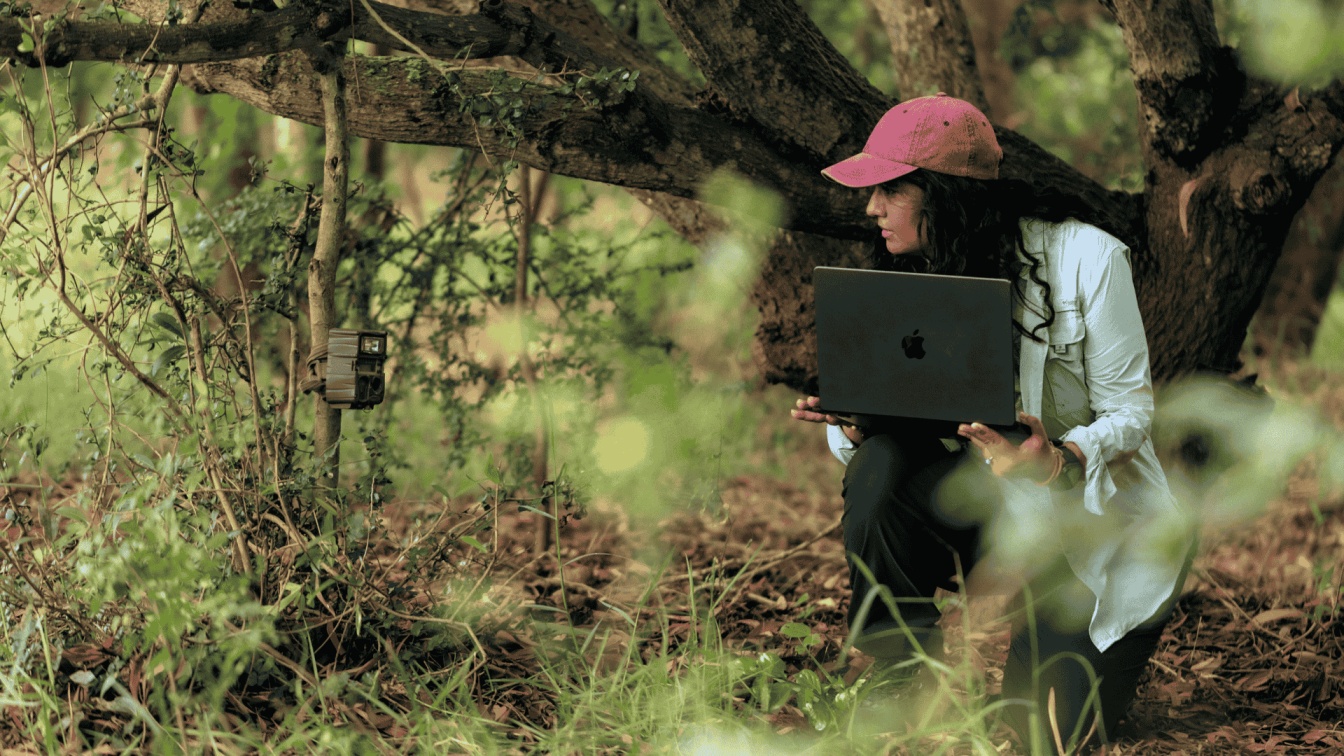
Academy Award-winning director Kartiki Gonsalves still remembers her first Mac. It was at the very start of her career in 2006. She was pursuing a post-graduate diploma in photography, and she “absolutely loved the black Mac.”
“It was amazing because I was able to transfer my images from my camera onto my Mac and then do the postproduction for it in Photoshop, which ended up being my main software at the time,” she says.
Years later, one evening in the hills, she sat on her Mac with a cup of tea by her side. She remembers the light being soft, golden and “absolutely gorgeous”.
“I started sketching in my head, not with the intention of creating a company, but to capture a feeling. And that feeling was the interconnectedness of all life—the colours and rhythms of nature that I'd grown up with,” she says.
That sketch became the seed of her production company, Earth Spectrum, which seeks to tell stories that illuminate our connection to the natural world.
“My Mac became my creative companion right from what I was trying to bring out with this company, and to where it is now. So, from early editing of short films and piecing together the identity of what Earth Spectrum would stand for, I think every project has started the same way - a moment of reflection and infinite possibilities of storytelling that come alive through my Mac,” she shares.
On the Earth Spectrum website, there is a quote which goes: “Tell me the facts, and I’ll learn. Tell me the truth, and I’ll believe. But tell me a story, and it will live in my heart forever.”
Of all the quotes in the world, Gonsalves was drawn to this one because it reminded her that it is emotion that drives change. Facts and data are important because they keep us informed. The truth grounds us. But it is the stories that move us.
“A story told with honesty and empathy can reach places that information alone never could. It can also make someone halfway across the world care about an elephant, a river or a forest that they've never, ever seen before,” she says.
And the Mac - tool of the creative, gadget for the inspired - helps her share her vision with the world. “From the first frame to the final edit, turning lived moments into something that can live in people's hearts forever . . . it is the Mac that drives all of this and puts it together,” she adds, signing off—perhaps already moving on to another blank page and a blinking cursor.