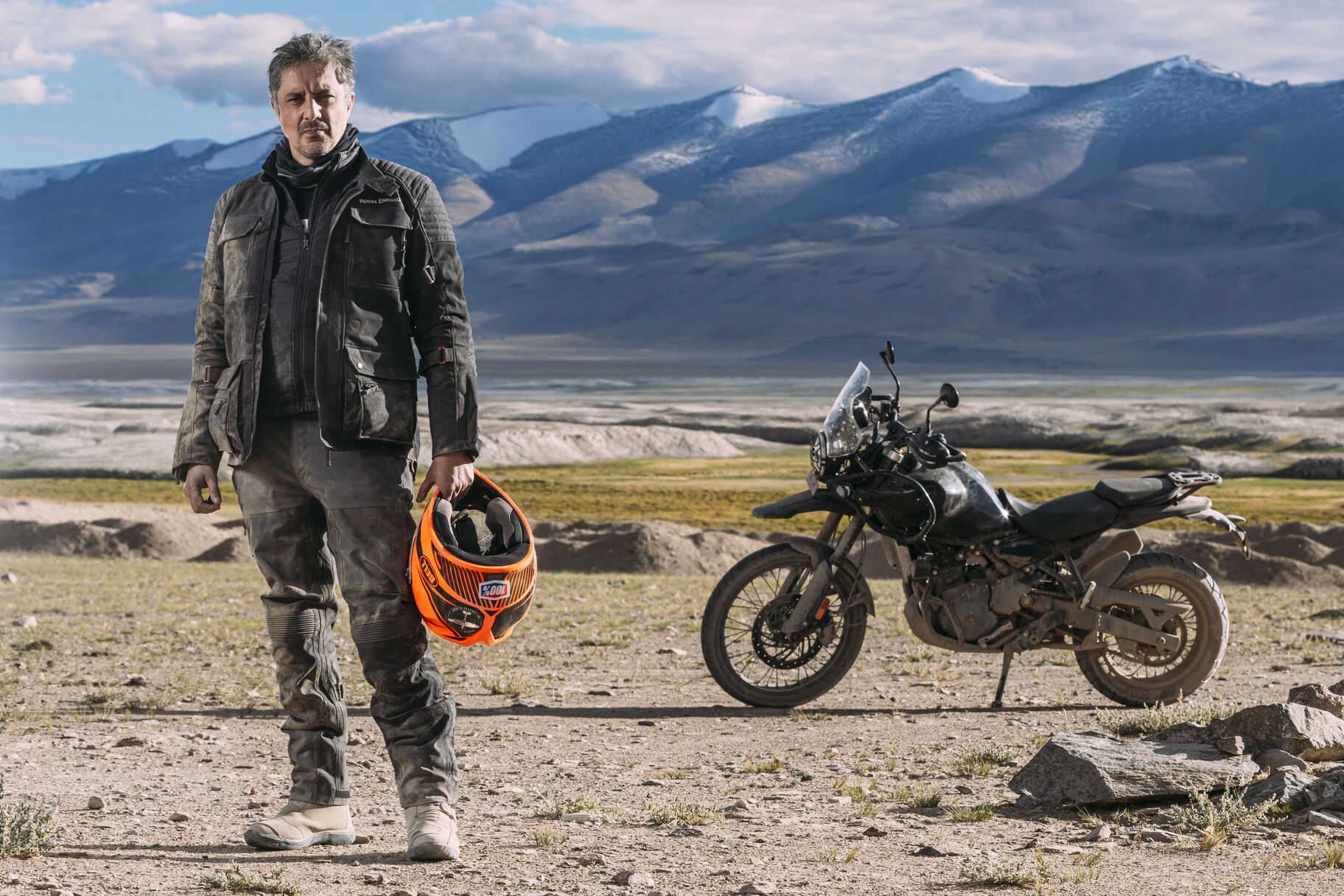
Royal Enfield’s Chief Brand Officer Mohit Dhar Jayal On Motoverse, Riding Culture, and Upcoming Bullet 650
Ahead of the Bullet 650’s launch in 2026, Royal Enfield’s Mohit Dhar Jayal explains how Motoverse 2025 previewed the brand’s next chapter
Every November, Goa becomes something else entirely. The beaches still exist, the sunsets still perform on cue but threaded through the palm-lined roads is a deeper, low-frequency pulse. The unmistakable thump of Royal Enfields rolling in from every direction.
What began decades ago as a loose rider pilgrimage called Rider Mania has now evolved into Royal Enfield's annual biking event, Motoverse, is a cultural epicentre of global motorcycling. And in 2025, it also became the stage where Royal Enfield quietly pointed to its future by unveiling its much-anticipated range of new bikes including the Himalayan Mana and Royal Enfield Bullet 650.
For Mohit Dhar Jayal, Chief Brand Officer at Royal Enfield, who spoke exclusively with Esquire India shared that Motoverse has never been about spectacle alone. “Practicality drives massive motorcycling usage in India,” he says, “but it’s passion that has created India’s motorcycling culture.” That distinction matters. In a country where two-wheelers are often appliances, Royal Enfield has long occupied a more emotional register, one shaped by geography, memory, and a desire to explore.
“The thump of the Bullet triggered some primordial urge,” Jayal reflects. Riders headed to the Himalayas, to the coast, and everywhere in between. Over time, those solitary journeys turned into clubs, subcultures, and rituals most notably, the annual ride to Goa. Motoverse is the modern expression of that instinct. It is a gateway into a way of life that blends motorcycles with art, craft, music, and sport.
Motoverse 2025 drew over 40,000 people, filling open fields with custom builds, classics, and mud-splattered tourers that looked like they had stories to tell. Yet despite its scale, Jayal insists the festival’s most defining quality is its lack of artifice. “It continues to be a phenomenon created by the community, not just a show for the community,” he says.
That spirit was best illustrated by the weekend’s most talked-about moments. Global artists Hanumankind and Diplo were on the lineup but they didn’t arrive as distant headliners. They rode in. Diplo, in fact, had spent the previous week riding a Himalayan 450 through India’s Northeast before landing in Goa and playing an unannounced set at the Garage Café. “If the headliners are riding and partying with the tribe,” Jayal says, “it creates a very special and very spontaneous kind of energy that can’t be manufactured.”
That spontaneity is Motoverse’s secret sauce. It’s why custom builders share space with factory engineers, why first-time riders find themselves in conversation with global veterans, and why the unveiling of a new motorcycle doesn’t feel like a corporate launch but a communal moment.
The 650: A Glimpse of What’s Next
Against this backdrop, Royal Enfield chose Motoverse to unveil its upcoming 650 motorcycle that will lunch in the first half of 2026, signalling not just a new product, but a continuation of its philosophy. While the technical details are still under wraps ahead of the official launch, the intent was clear. It
The intent behind the new Bullet 650 aligns with what Jayal calls Pure Motorcycling. “It’s not some corporate tagline,” he says. “It’s a fiercely held belief.” In an age of increasingly synthesised experiences, Royal Enfield sees its motorcycles as a tactile antidote machines that prioritise the relationship between human, machine, and terrain. The upcoming 650, unveiled amid the dust and music of Motoverse rather than under studio lights, felt like a natural extension of that belief.
As motorcycling conversations evolve embracing technology, performance metrics, and lifestyle branding, Royal Enfield remains anchored to a simpler question: why do we ride at all? For Jayal, the answer hasn’t changed in 2025. The joy of riding is visceral and unfiltered. It’s sensory. It’s freedom.
“On our motorcycles,” he says, “you will find that perfect balance between human, machine and terrain. And you will be free.” It’s a statement that resonates deeply at Motoverse, where the absence of rigid programming allows riders to rediscover that joy on their own terms whether through a sunrise ride, a late-night conversation, or the first time they throw a leg over a bike they’ve only seen online.
Moreover, Motorcycle culture has long been wrapped in ideas of traditional masculinity, but Motoverse 2025 told a more nuanced story. The crowd was visibly more diverse, with a growing number of women riders and first-generation motorcyclists. Jayal sees this not as a shift engineered by branding, but as an inevitable truth of riding itself.
“The road and the bike don’t give a damn who you are,” he says. “They demand your attention and your respect.” In that sense, motorcycling is a great equaliser, one that values mastery over machismo. It’s meditative rather than performative, philosophical as much as physical.
Royal Enfield’s role, he believes, is simply to remove barriers. The rise in women riders is something the brand celebrates, with practical steps like expanding riding gear designed specifically for women already underway.
Motoverse remains, as Jayal puts it, “the main stage of global moto-culture.” But more importantly, it’s a reminder that at its heart, riding is still about people coming together—drawn by the same low-frequency pull that started it all. And if the future of Royal Enfield looks anything like what was unveiled in Goa this November, that pull isn’t getting weaker anytime soon.