The Neo Frame Jumping Hour Is a Rare Change of Pace for Audemars Piguet
The Neo Frame Jumping Hour is a bold new step for Audemars Piguet
Most new watches from Audemars Piguet arrive with expectations already baked in. We know the silhouette, we know the audience, and we know, roughly, how the conversations will go.
Interestingly, the Neo Frame Jumping Hour doesn’t quite fit that pattern. It’s rectangular, handless, and launched as the starting point of a new collection.
Now, Audemars Piguet doesn't do new collections often. The last major one—Code 11.59—had a rough start back in 2019, and the brand's been working to prove it ever since. So when AP says it's launching something entirely fresh, you pay attention.
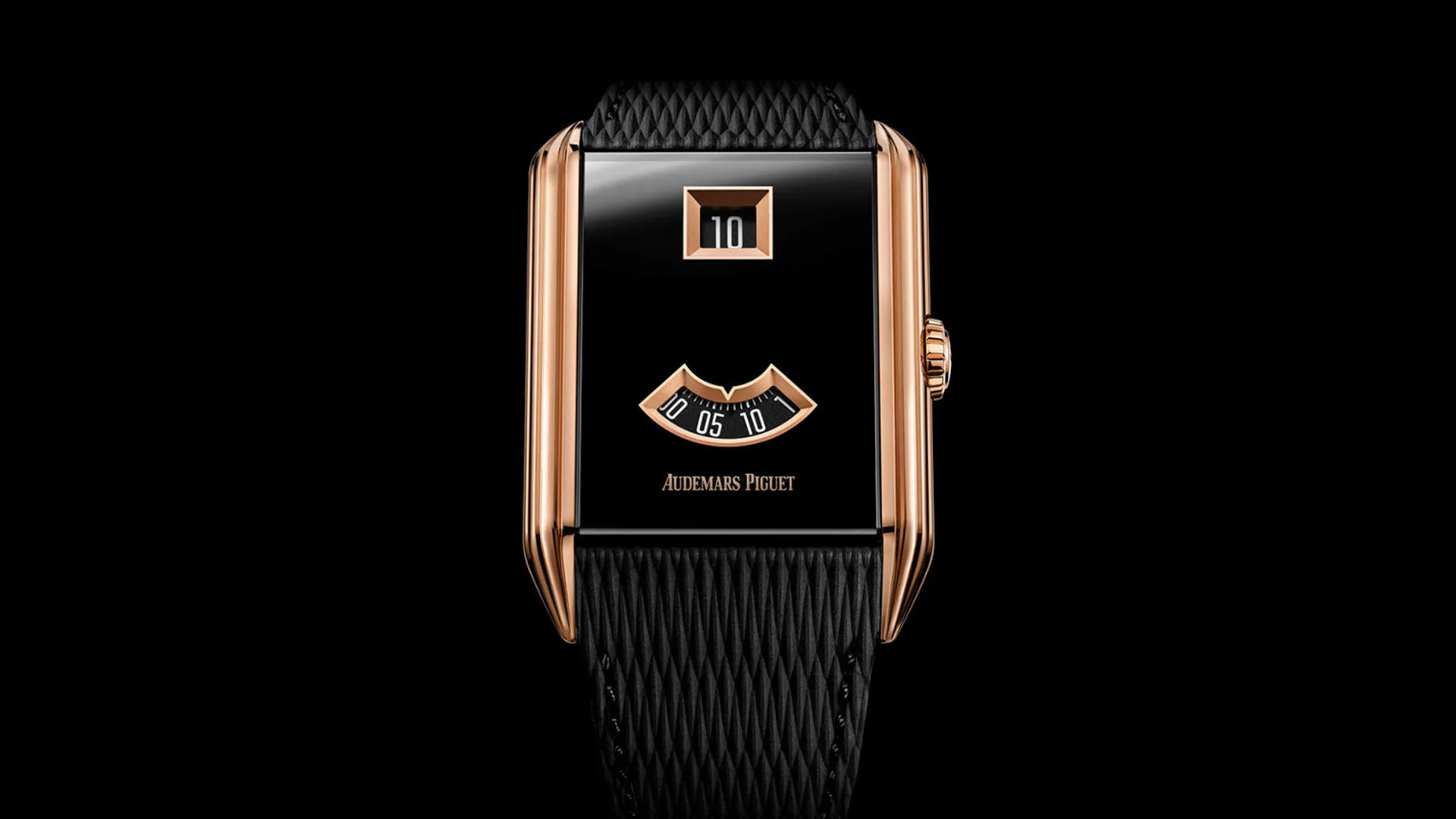
Stripped back, this is a jumping hour watch. Time is shown through two apertures: hours jumping at 12, minutes trailing at 6. That format is suddenly everywhere, but Audemars Piguet isn’t borrowing the idea so much as returning to it. The brand made hundreds of jumping hour wristwatches between the 1920s and ’50s, at a time when there was no fixed rule for how a watch should look or be read. Rectangles, squares, apertures—it was all still in play.
The specific reference point here is a 1929 AP wristwatch, one of just 14 made, now mostly known to collectors rather than the wider market. The Neo Frame keeps its long proportions and its clarity, but updates everything else. The case is rendered in 18k pink gold and measures 34mm across, 47.1mm lug-to-lug, and 8.8mm thick. On paper, that sounds assertive. On the wrist, it wears closer to a modern Reverso than anything oversized, helped by a flat caseback and short, angled lugs.
The front is where the watch draws a clean line between past and present. There’s no metal dial at all. Instead, a black PVD-coated sapphire crystal sits flush with the case, with the apertures cut directly into it. The exposed edges are intentional, not decorative, and they force a more complex construction underneath. The sapphire is bonded to the dial plate and mechanically fixed into the case.
Legibility, often an afterthought in jumping hour designs, is handled properly. The apertures are large, the numerals bold, and the contrast high. You glance once and move on. It’s functional in a way many vintage-inspired pieces aren’t.
Inside is calibre 7122, the brand’s first fully in-house automatic jumping hour movement. It shares its base architecture with the calibre 7121 but has been adapted to handle the instantaneous hour jump using lightweight discs and a shock-absorbing system. The specs are solid rather than showy, which suits the watch.
What the Neo Frame Jumping Hour does well is restraint. It doesn’t chase nostalgia too hard, and it doesn’t try to out-design its own complication. Whether it becomes a long-term pillar or remains a quieter corner of the catalogue is still an open question. But as a first step, it’s a reminder that Audemars Piguet can still step outside its comfort zone—without making a fuss about it.