The Best Watches To Come Out Of The Stone Dial Trend
The most striking dials out there
Stone dial watches have been everywhere for the last couple of years, and the trend shows no signs of slowing. What started as a niche revival of Andy Warhol’s favourite watches has become a defining design language, with brands using natural materials to bring colour, texture and individuality to their timepieces.
At its core, a stone dial is exactly what it sounds like: a dial crafted from a thin, carefully cut slice of semi-precious stone, polished to highlight its natural patterning. Malachite, lapis lazuli, onyx, tiger’s eye and aventurine remain the most commonly used, prized for their colour saturation and visual drama. While meteorite and mother-of-pearl are sometimes grouped into the same conversation, traditional stone dials are defined by mined minerals that require painstaking work to be machined, drilled and finished without cracking.
But that did not intimidate watchmakers from jumping into the bandwagon. Piaget, being at the forefront of the trend, formalised what were till now called Andy Warhol watches (because of the artist's penchant for them), offering multiple precious stone dial customisations. Meanwhile, Omega has integrated malachite, lapis lazuli, aventurine and meteorite into familiar lines like the Seamaster 300 and Constellation, and Hublot has explored a broader palette through limited Classic Fusion releases using stones such as pink jasper, jade and turquoise.
Everyone wants a piece of semi-precious stone right now, and below, we compiled our favourite pieces.
Rolex Oyster Perpetual GMT-Master II
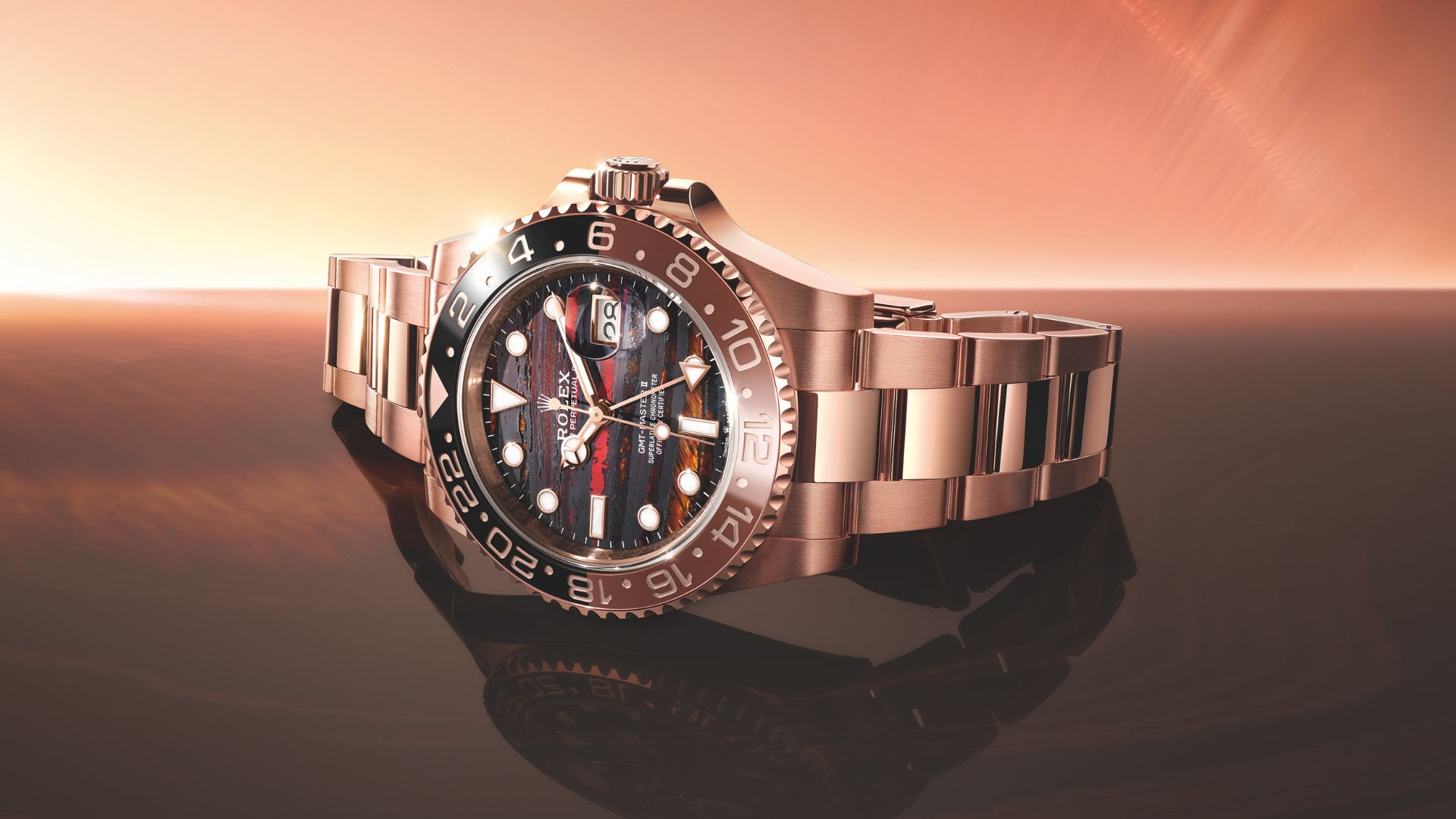
While the debut of the Land-Dweller dominated headlines this year, it was this GMT-Master II that captured many collectors’ attention. The Rolex Oyster Perpetual GMT-Master II in 18k Everose gold stands out for its tiger iron dial, marking the first time the brand has used this rare metamorphic stone. Composed of tiger’s eye, red jasper and hematite, the material creates natural variations of golden and orange tones, ensuring no two dials are alike. Sourced from limited deposits in Western Australia and South Africa, tiger iron adds both visual depth and genuine rarity to the watch.
Gerald Charles Maestro 2.0 Ultra-Thin
The Gerald Charles Maestro 2.0 Ultra-Thin elevates the idea of a stone dial through lapis lazuli, a metamorphic rock prized for its deep blue tone and natural inclusions. Flecks of pyrite introduce subtle golden shimmer, while veins of calcite create soft white streaks, ensuring each dial has its own visual identity. Achieving this effect is painstaking: every dial is cut from a 5 mm thick slab and polished down to just 0.55 mm over the course of roughly 24 hours, using a mix of hand and machine finishing.
Powering the watch is the ultra-thin automatic Manufacture Calibre 2.0, a three-hand movement offering a 50-hour power reserve. It features a central oscillating mass and is finished with the brand’s new 25th Anniversary logo, balancing technical finesse with the expressive character of natural stone.
Audemars Piguet Royal Oak Selfwinding
The Audemars Piguet Royal Oak Selfwinding’s vivid blue-green turquoise surface, marked by subtle natural matrix patterns, creates a sharp contrast against the 18k yellow gold case and bracelet, amplifying the Royal Oak’s architectural lines.
Housed in a 37 mm yellow gold case with 50 metres of water resistance, the watch is powered by a selfwinding movement offering a 60-hour power reserve. The dial displays hours, minutes, central seconds and a date, pairing everyday functionality with the unmistakable allure of a stone dial crafted for collectors drawn to distinctive design.
Cartier Santos-Dumont Watch
The Cartier Santos-Dumont appears in a striking red iteration defined by its carnelian stone dial, bringing warmth and intensity to one of the maison’s most enduring designs. The rich, natural hue of the carnelian introduces a bold visual shift while remaining anchored in the watch’s early-aviation heritage, housed within the instantly recognisable Santos-Dumont case.
Crafted in platinum, the 43.5 mm x 31.4 mm case offers 30 metres of water resistance and houses a mechanical movement displaying hours and minutes. Finished with a semi-matte brown leather strap, this stone-dial Santos-Dumont balances classic Cartier elegance with a contemporary material twist.
Zenith Chronomaster Sport Meteorite
The Zenith Chronomaster Sport Meteorite leans into material-driven drama with a dial cut from genuine iron-nickel meteorite, ensuring every piece carries a pattern that can never be replicated. Composed primarily of iron with traces of nickel and other elements, the meteorite is acid-etched after slicing to reveal its distinctive Widmanstätten patterns, a web of crystalline lines formed over millions of years in space. The grey-toned dial provides a textured backdrop for the Chronomaster’s signature three-sub-dial chronograph layout.
Powering the watch is the El Primero 3600, beating at a high-frequency 5 Hz and equipped with a silicon escape wheel, a stop-seconds mechanism and a 60-hour power reserve. The result is a watch that pairs Zenith’s chronograph pedigree with the raw, unrepeatable character of extraterrestrial material, where precision engineering meets cosmic history.
Piaget Andy Warhol Watch
The Piaget Andy Warhol High Jewellery watch is defined by its opal dial, a stone prized for its dramatic play of colour that flashes with blue and green. Long favoured by Yves Piaget himself, opal is notoriously difficult to work with, making the creation of a dial large enough for the 45 mm cushion-shaped case an impressive display of the maison’s gemological mastery. Each watch begins with the selection of a single exceptional specimen, a process that can take over a year.
Framing the dial are three rows of baguette-cut sapphires, adding structure and intensity without overwhelming the stone’s natural movement.
Omega Seamaster 300 Malachite
The Omega Seamaster 300 reflects the brand’s measured approach to the stone-dial movement, integrating malachite into one of their most iconic Seamaster lines. The green malachite dial, marked by fluid, organic banding, introduces visual depth while staying restrained enough to suit the Seamaster’s tool-watch DNA. Each dial is naturally unique, adding character without turning the watch into a purely aesthetic object.
Housed in a 41 mm yellow gold case with a ceramic bezel and 300 metres of water resistance, the watch is powered by a self-winding Omega Co-Axial Master Chronometer movement offering a 60-hour power reserve. Rather than chasing spectacle, Omega uses stone as a considered design choice, folding it quietly into a collection built on precision and performance.