FOR YEARS, MENSWEAR ARRIVED ON INDIAN runways like an afterthought. Polite, predictable and always playing second fiddle. While womenswear commanded the spectacle, men simply dressed to support the story but never to lead it.
Cut to 2026, something has unmistakably shifted.
When the Boys’ Club opened Lakmé Fashion Week x FDCI, it wasn’t just a scheduling decision, it was foreshadowing how menswear was going to be this season. Clearly, something has changed; whether this is a passing moment or a deeper recalibration remains to be seen. But one thing was clear this season: the details were doing the talking.
Accessories, in particular, emerged as the real power move on the runway.
Arch-shaped bags from Countrymade’s ‘Cenotaph’ collection; Vivek Karunakaran incorporates temple jewellery with menswear to complement the jewel-toned collectionCountrymade
For Vivek Karunakaran, the change feels both inevitable and overdue. Indian menswear, he believes, has never been more ready for risk. “Men are willing to experiment and move out of their comfort zone and that’s such a welcome change. It finally allows you to think beyond just shirts and trousers. That was the trap menswear in India was stuck in.”
That expanded mindset extends to jewellery, a category long burdened by rigid gender codes. Karunakaran admits even his jeweller was surprised by how seamlessly pieces originally designed for women translated onto menswear looks.
“The jewellery was essentially conceptualised for a woman, but it just sat so naturally on a menswear look,” he says. Temple jewellery, paired with the jewel tones of the collection, introduced a heritage-led, vintage sensibility.
‘Cenotaph’ meaning an empty tomb, was built around questions of memory, legacy and manufactured history. “Today, we’re watching history being created in real time. This is what will go into textbooks twenty years from now and I think that should bother each and every one of us,” he says. That unease translated into form. Arch-shaped bags referenced historic structures across the world.
“When you look at these structures in the present, you’re only engaging with what’s left behind,” he explains. “There is no future in them. That’s why the collection talks about the past, the present and the remains.”
Elsewhere, accessories operated with a quieter confidence, speaking in nuance rather than spectacle.
Dhruv Vaish leaned into scale and ease, sending out oversized leather bags, low slung belts and duffles softened with scarves.
Payal Pratap's debut menswear collection reflects a subtle turn inward. Denim finds itself married to crochet, patchwork and block prints while the tie is reimagined not as an accessory but as an extension of the shirt itself.
At Payal Pratap, the tie was rethought altogether. Rather than standing apart as an accessory, it mirrored the fabric of the shirt, reading as a seamless extension of the garment itself.
The same idea resurfaced through a different lens at the sustainability forward Gen Z label CRCLE, where the tie appeared in reworked discarded suede with crochet edges to align with the brand’s ethos of continuity and reuse.
Whimsy, however, was not far behind.
CRCLE, the Gen Z label that puts sustainability at the forefront of its design philosophy, interprets the necktie in reworked discarded suede with crochet edges
It took centre stage at Anurag Gupta’s showcase, where a hat shaped like a shoe blurred the line between object and ornament, signalling the willingness to explore transformation of unconventional materials into wearable forms.
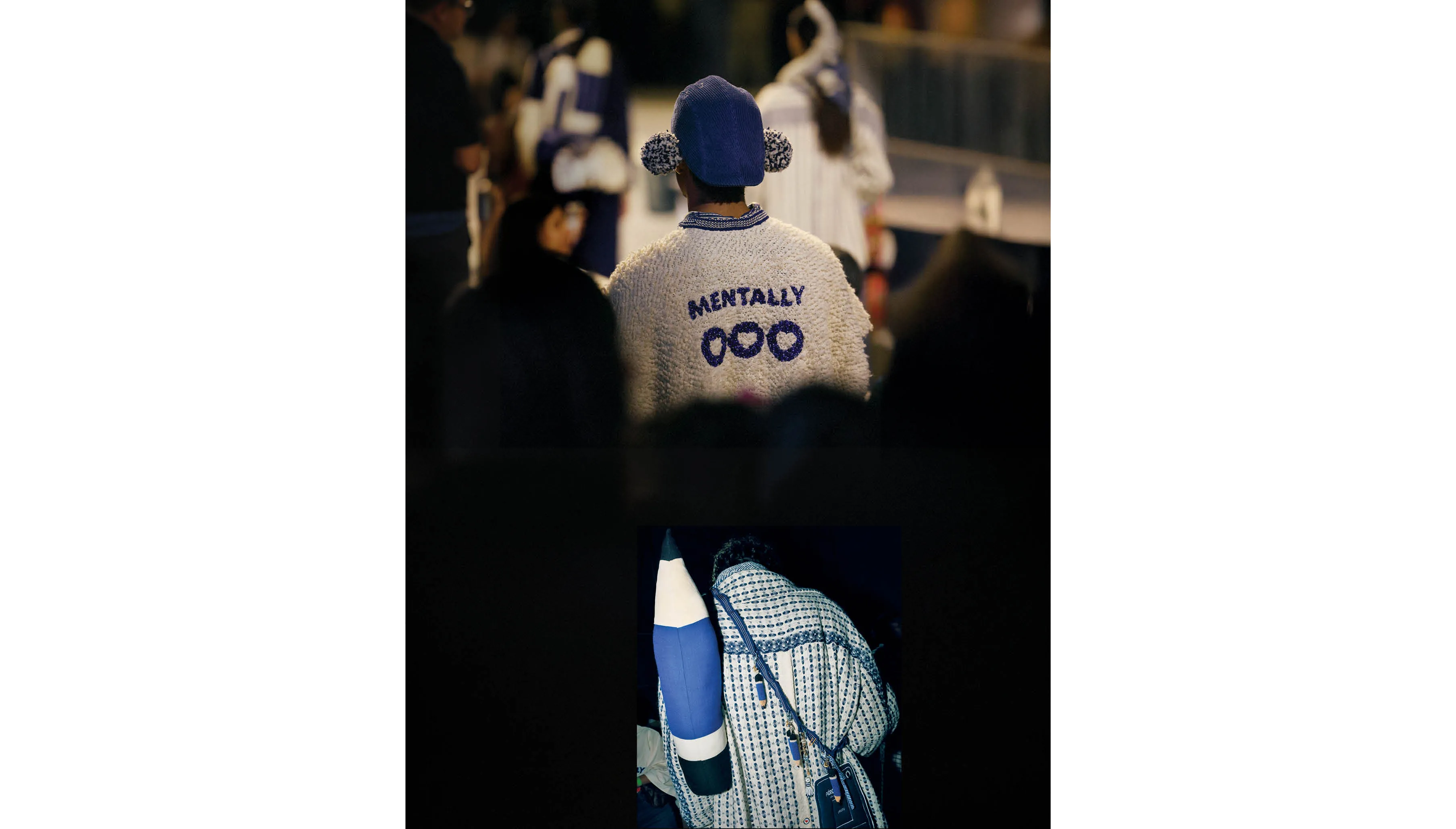
That spirit carried through to the season’s closing moments at péro. Under the theme ‘Out of Office’, the brand dismantled workwear codes with deliberate irreverence. Men walked with notebook and pencil shaped bags, wore whimsical hats and styled ties into bows, transforming symbols of routine and discipline into gestures of humour with a knowing wink to modern work culture.
Kartik Research makes its India runway debut with a focus on handmade processes, built through layered silhouettes, clashing textures and patchwork clothing. The brand’s signature aesthetic was elevated by beaded chains peeping out of pockets, doubling as neck chains and belts.
Indian menswear has moved past caution.
This season, it loosened its tie, picked up a bag and stepped forward. And it turns out, menswear looks far better when it stops supporting the story and starts leading it.