Kartik Kumra Returns to Fashion’s Big League With 'Raag'
Kartik Kumra unveiled his FW26 collection at Paris Fashion Week 2026
Kartik Kumra's come-up reads like fashion's most improbable underdog story. Economics degree from Penn, zero fashion school, started Kartik Research in 2021 with five grand he'd saved flipping Yeezys on the side. The brand's whole thing was taking Indian craft techniques and making them cool for a generation raised on Supreme drops and Raf Simons archives. Kantha embroidery on chore coats. Mirror-work on trousers. Hand-dyed cottons in colours.
Recently, he has also opened a flagship store in New York in 2025 and has now dressed actor Paul Mescal and rapper Kendrick Lamar in his designs.
Just weeks before the show, New York's newly inaugurated Mayor Zohran Mamdani wore a Kartik Research tie to take office—a quiet endorsement that felt monumental. "He's been following the brand for a long time, before he became the celebrity that he is today," Kumra said backstage.
And now, six months after his Paris debut sent ripples through the menswear world, Kartik Kumra has returned to the City of Lights (or was it Love?) with something to prove.
This year, Kartik showed up to Paris Fashion Week with a problem most 26-year-olds don't have: the President of the United States had just tanked his business model.
Last August, Trump slapped a 50% tariff on Indian exports. For a brand built on the backs of 300 artisans hand-stitching kantha jackets in Bengal and block-printing linens in Rajasthan, this wasn't some abstract policy talking point.
"They're looking at me for some policy inclination," Kartik said backstage after his Fall/Winter 2026 show in Paris yesterday, "and I'm like, 'Dude, I'm just as clueless as you are.'"
“It’s a little scary, because 20 to 30 percent of their business is just wiped out overnight,” he admitted.
So, what do you do when the rug gets pulled? You make a collection about rugs. Or at least, about the people who make them.
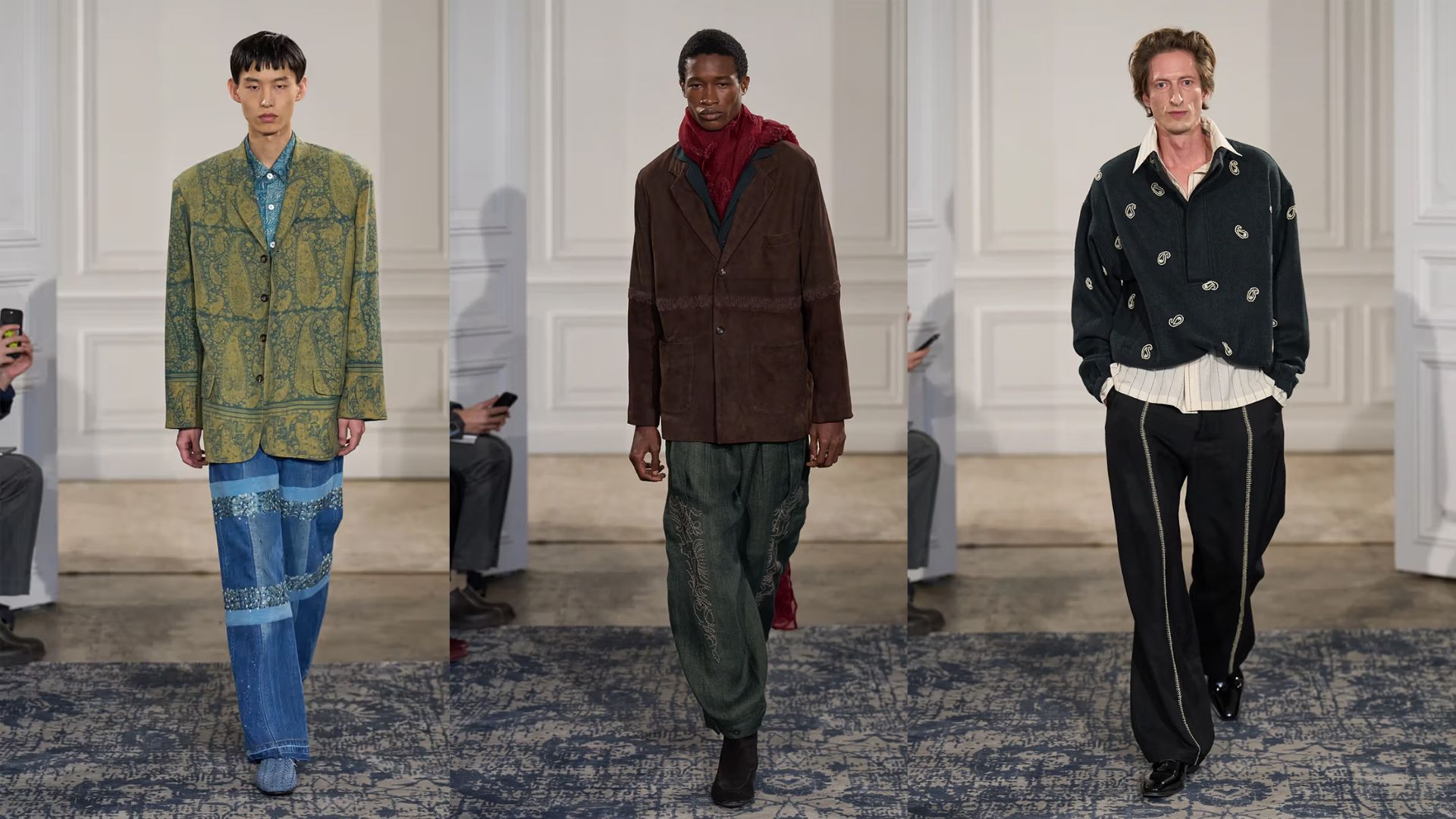
The Fall/Winter 2026 collection, titled "Raag," pulls its name from an obscure 1970s artisanal label out of Ahmedabad that used to dress Robert Rauschenberg. Kumra got rare access to their archives and came back with a collection that felt like soft power in fabric form. There were stone-gray kantha tuxedo jackets with floral embroidery creeping up the shoulders, barn coats covered in glittering vines that caught the light, and a beautiful oversized pistachio linen suit.
The styling was effortless as ever—olive green marbled paisley jacket over an indigo-dyed shirt and patchwork jeans so heavily embellished they could've been wall art. Block-printed Harrington jackets paired with those louche linen suits. A sweatshirt with delicate white paisley embroidery. And then the closer: a fully embroidered coat that must've taken weeks to make. Kartik has dipped his hands into both casual and occasion wear, and also decided to boldly embrace embroidery that were once viewed as feminine.
Here's the thing, though: this wasn't just Kumra showing off. In a season where Dior, Dolce & Gabbana, and Pharrell's Louis Vuitton have all cribbed notes from Indian craft, Kumra's doing something more urgent: He's building an economy around it. Every gold-sequined petal on tailored trousers, every hand-loomed piece of raw linen, is a small rebellion against a world that increasingly doesn't value human hands. His whole collection was also an act against the idea that craft is disposable, that the people who spend their lives perfecting zardozi embroidery or kantha quilting are interchangeable cogs in a supply chain.
Men’s fashion is finally catching up to what Indian craft has always known: that embroidery is power, not ornament. Kartik already knows it. Instead, what Raag proves is that he’s not just there to participate, but to shift the conversation.