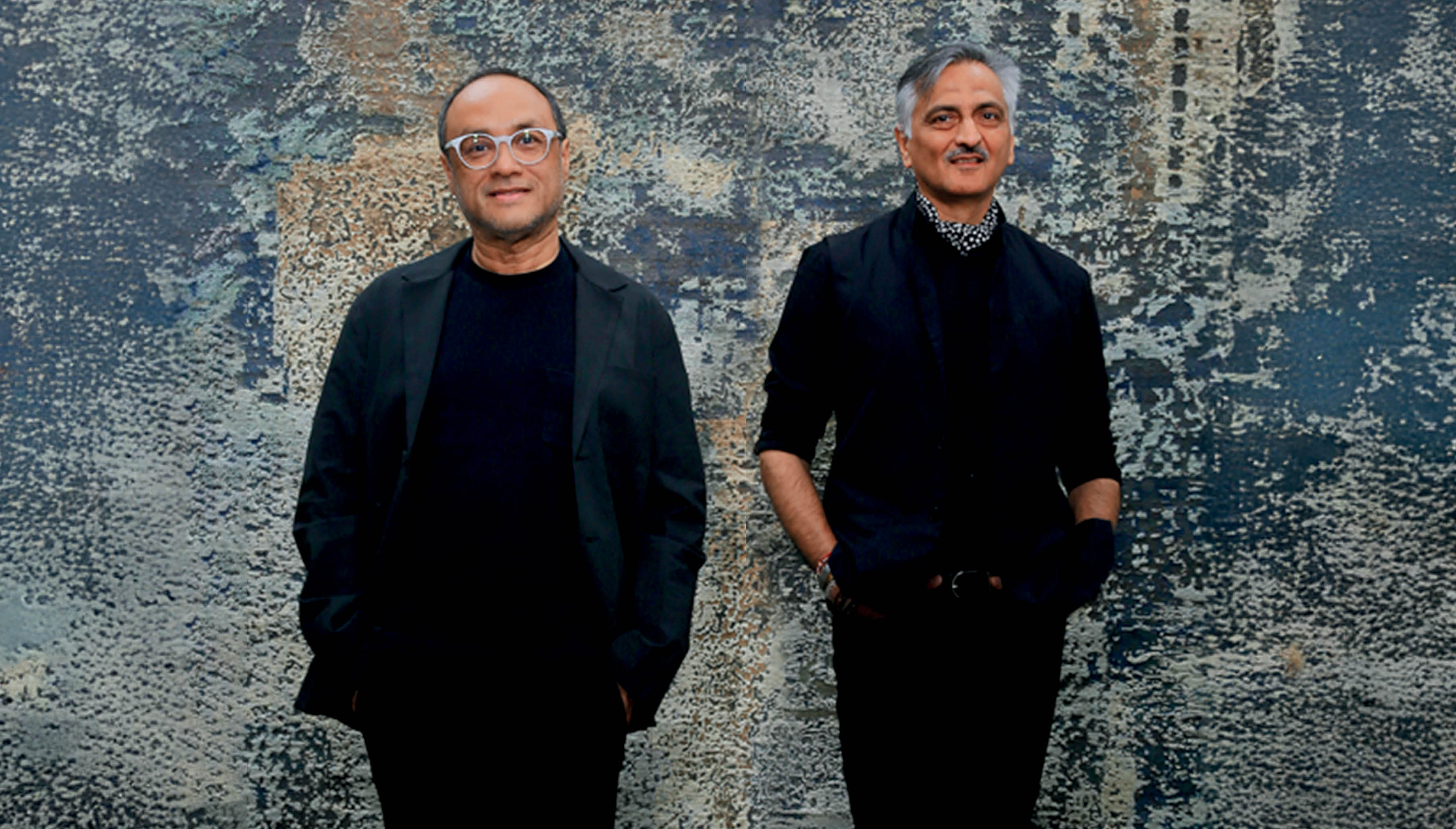
Inside 30 Years of Creative Partnership with David Abraham and Rakesh Thakore
For over 30 years, David Abraham and Rakesh Thakore have defined a menswear language that’s pared-down, gender-fluid and rooted in Indian craft—held together by a creative partnership built on trust and shared values
WHAT BEGAN WITH A SINGLE BLUE SHIRT, TUCKED INTO THE CHRISTMAS CATALOGUES AT BROWNS in the mid-’90s, has grown into one of Abraham & Thakore’s most significant expansions. Now backed by a joint venture with Reliance Brands Limited (RBL), menswear has become a staple on their runways and in their collections.
The shift, they say, has been seismic. “Men are dressing better. They are more experimental. Younger men, especially, have a more flexible approach. They are not tied up in traditional definitions of gender and they are breaking those rules,” says David Abraham, who does most of the talking when Esquire India visits the duo at their studio in Noida. The label’s co-founder, Rakesh Thakore, listens intently, occasionally chiming in—the two often finish each other’s sentences.
They belong to a generation of Indian designers whose work and personal journeys have grown alongside the rise of Indian fashion. In 1992, when the homegrown scene was just beginning to blossom, the NID Ahmedabad graduates launched their eponymous label. Kevin Nigli, the brand’s third partner and creative lead, joined soon after.
Abraham & Thakore (A&T) built their identity by pushing against the grain—with a distinctive aesthetic that was minimalist and monochromatic, gender-bending (before the term became commonplace), and deeply rooted in Indian craft traditions.
In 2024, the trio took over creative direction at Satya Paul, unveiling their first collection this year. “What drew us in was how revolutionary and provocative his work was for its time,” Abraham says of balancing such distinct aesthetics. “When handloom saris dominated, he brought in silk and explosions of colour. Mills were making such saris, but he created what became the first branded designer sari.” While there are no plans for Satya Paul to branch into menswear, they’re exploring woven and leather accessories for men.
From a label that stocked almost exclusively overseas in its first decade, the brand’s partnership with RBL has expanded both its retail footprint and its offerings—most notably in home goods and menswear, which they describe as a major success. More than three decades on, the duo remains anchored in their friendship, their love for fashion and a shared belief in the power of change. In conversation with Esquire India, they talk about dressing the modern man, innovations in handloom and why they continue to believe in the joy of fashion.
Abraham & Thakore has been known for its womenswear. How has it been to design menswear, and what makes it different?
We’ve been very pleased with the response to our menswear. We started in a very small way, but it has become an important and big part of the business .While it’s not restrictive, menswear is more contained. It is getting more colourful, adventurous and experimental but all that happens on one side. In a business context, we work within fairly defined parameters for men.
Some elements will always remain—the shirt, trousers, classic silhouettes. There may be play in details and proportion, patterns, print and colours but it is all within a structure. We also bring in elements from womenswear and adapt it to masculine [parameters]. That’s why it is interesting. We enjoy it so much as designers because it’s always more challenging to work within constraints.
Indian fashion has grown over the years and changed how we style ourselves. How have Indian men evolved in their ways of dressing?
THAKORE: People started changing when they started watching MTV. They became more aware of fashion, more conscious of it. A lot of influence came from the North East—young people who dressed up and owned their style.
ABRAHAM: And that continues. Men are dressing better. They are more experimental. Younger men especially have a more flexible approach. They are not tied up in traditional definitions of gender and they are breaking those rules.
We have seen this earlier. We are old enough to remember when The Beatles were wearing bell bottoms, their Sgt. Peppers look, or the hippie movement. Men have broken rules before and then they went back. Now, with the new fluidity of gender roles, will it continue? Difficult to tell, but that’s just fashion. It’s a flex, a moment in time.
What does it mean to design for men today, in terms of their identity formation?
Men are more complex and layered. They are willing to have conversations on gender, hierarchy. They are also challenged by women whose roles have changed—all over the world and in this country—in the workplace, in households. A lot of men may still be demanding and patriarchal in their ways of thinking, but many men now understand that they are not just wage-earners. They have to accommodate different roles.
We are designing for a changed man. A white shirt is a white shirt is a white shirt. But the attitude to the white shirt is shaped by these changes. Everything affects fashion.
Handlooms are a big part of your design vocabulary. How does it extend to your menswear, especially in everyday shirts?
The shirts that we do are quite easy— because they are more casual. We do have people who wear them for work. But we wouldn’t attempt a Savile Row-type shirt, certainly not with handloom. Trousers and bottoms can be challenging too. Handloom has developed over hundreds of years for non-stitched clothing. It’s by nature more fluid. But a lot of designers now use handlooms and their inputs are also going back to weavers. So, these textiles are changing in response to stitched clothes.
We have a handloom weaver who does shirting for us and we have introduced Tencel in handloom cotton. It gives the fabric a different feel and a softer, polished look. We have also used Tencel with Ikat and made brocade jackets.
Conversations on handloom and crafts often revolve around womenswear. What is the space for menswear in this discourse?
There’s certainly a huge interest in occasion wear. If you look at any brand, from the likes of Manyavar to the most elevated designers, sherwanis and jackets have incredible embroidery, brocade. If not for the man sitting in a lawyer’s office in his navy-blue suit, there is definitely space for handloom in traditional clothing. It is also unique and original—even though Indians have taken a lot of colonial tropes, in the construction for example, we have reinvented it and made it our own. And this is not happening anywhere else in the world.
We’re also introducing occasion wear. In our stores, men come in looking for clothes to wear to a wedding or a dinner— we must give them something, too.
You have been exhibiting many artists at your store. Do you have any favourites?
We showed the works of Mangala Bai Maravi, a Godna artist from the Baiga tribe, and found a rare synergy with her tattoo art. She comes from a family of generational tattoo artists; when people were no longer getting the tattoos done, she started transferring them on paper. There was also a show with the Sri Lankan artist and architect Tilak Samarawickrema. Architecture has always interested us, and Sri Lanka, especially for Geoffrey Bawa. We are always interested in art, irrespective of whether it relates to our work. We recently saw an exhibition of Company Paintings at the DAG [Delhi Art Gallery] which was fascinating.
What do you do when you aren’t working?
THAKORE: I enjoy gardening. I think I get that energy from my parents. We grew up on a farm in Africa—it was mixed between flowering plants, fruits and vegetables, cows and all sorts of animals. Even after we moved to India, we were always surrounded by plants. I’ve inherited that. The gardenia is a favourite.
ABRAHAM: I love fiction. I’ve always read a lot but stopped some years ago— the phone, my tablet, television were eating into my reading time. I have gotten back to it in the past year and recently finished Our Evenings by Alan Hollinghurst and Andrew O’Hagan’s Caledonian Road. I listen to podcasts on my walks, usually about history, politics or the news. I’ve been listening to Bella Freud’s Fashion Neurosis, and she speaks to interesting people. And I am hooked to YouTube. I have subscribed to a bunch of travel vloggers who keep making videos of where they go, their lives, what they eat. It’s a way of travelling vicariously.
Both of you travel a lot. Are there any places or cities that you find inspiring?
ABRAHAM: Which is your favourite, Rakesh?
THAKORE: Egypt, I suppose.
ABRAHAM: Yes, Egypt. We went there at different times. Rakesh had visited earlier, and it was more glamorous with a cruise on the Nile. I visited later and it was more city-centric, but I fell in love with Cairo. We also took a trip to China last year which was fantastic. And we were in Palermo and Naples last Christmas and New Year. We visited Pompei, which felt a little like Egypt.
THAKORE: We do travel together as well—our last trip together was to Udaipur.
You have helmed A&T for over 30 years. What is the key to an enduring partnership?
There’s actually three of us, with Kevin. How do we survive? Because we don’t agree with each other. It’s a relationship, like being part of a family. We agree on some things, but we are articulate when we don’t. And we eventually come to see each other’s point of view. We have studied together and our batchmates are still our friends. We still have lunch with our faculty. We have been interested in similar things–aesthetics, design—we share the same interests and values. We like clothes, we enjoy travelling, and we like beautiful things. We don’t give enough credit to it, but beauty is always inspiring. It elevates us.
We now see Indian designers increasingly make news in international markets and red carpet events. Abraham & Thakore had a major international presence in its early years. What is the importance of an international presence—and really, what makes this validation significant for India?
It isn’t anything that bothers us terribly, maybe because it feels a bit like we have been there done that. For the first ten years, the brand was selling almost exclusively overseas. It wasn’t much of a choice, because we weren’t selling here. And we were successful because we were placed very well in retail stores.
The need for Western validation is always going to be there, at least in our lifetime. We are seeing a shift, but the West has a history of centuries of control through education, language, colonisation, how they shaped all our cultures and the media. The digital space and the Internet space is controlled by American organisations. We do live in their reality and we don’t see that changing in a hurry. In a sense, they shape opinion. Having said that, it’s fantastic to now see Indians at the Met Gala or the Oscars, and Indian designers participating in these events. Validatissssson drives it, but we are also now citizens in a world stage.
What does fashion mean in the world today?
We live in fragile times. There’s a sense of uncertainty in the world. Fashion gives us a sense of control when it feels like we have less and less of it. Dressing up can feel reassuring—to wake up in the morning, open our closets and decide what we wear. Every choice we make defines our identity. It’s a protective cover. There aren’t many people dressing up to make themselves feel bad. We do it to make ourselves happy. We will always believe in the joy of fashion.
To read more stories from Esquire India's August 2025 issue, pick up a copy of the magazine from your nearest newspaper stand or bookstore. Or click here to subscribe to the magazine.