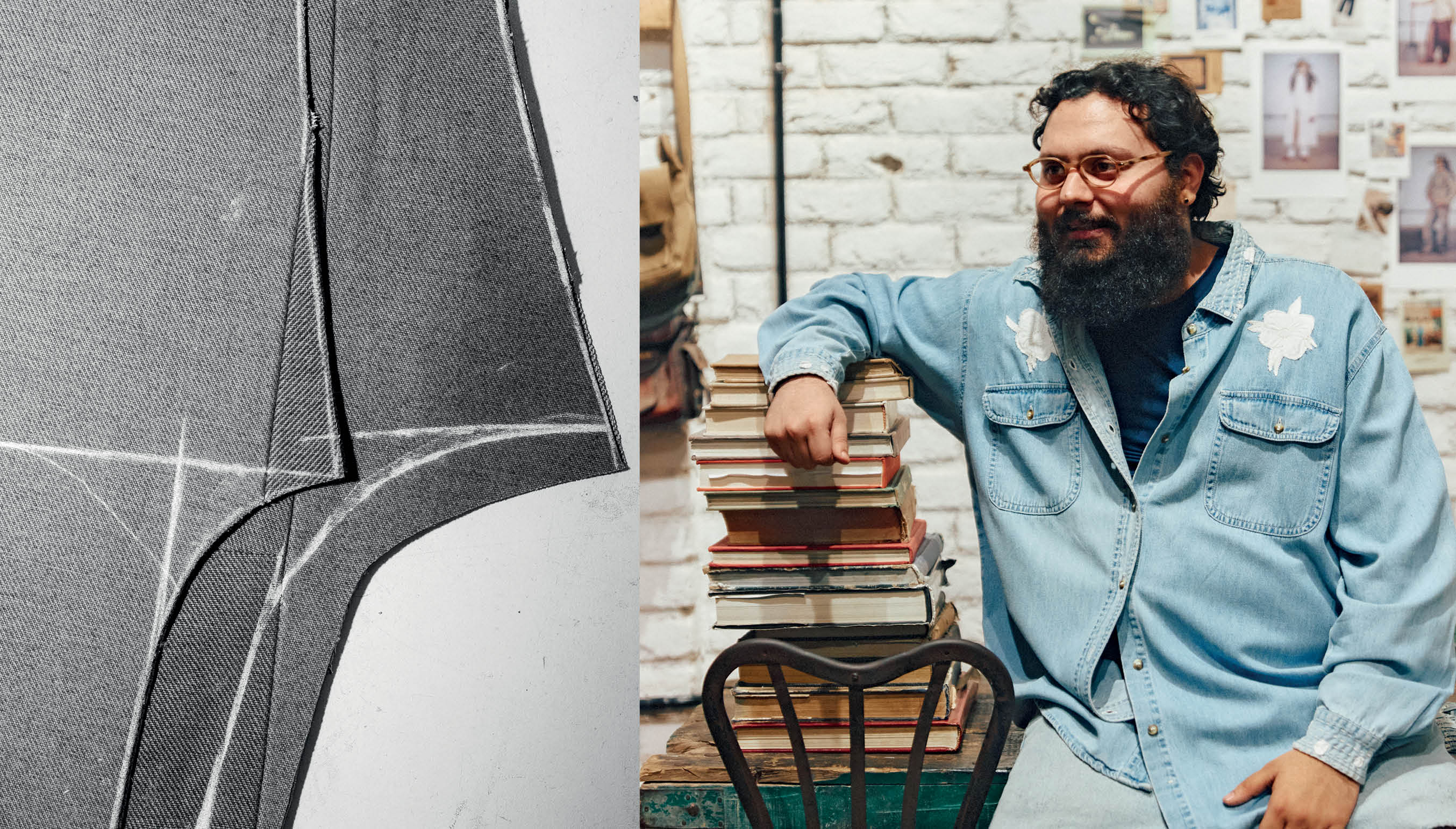
In Conversation With: Rkivecity Founder Ritwik Khanna
Khanna on keeping it real, the art of revival and Rkivecity as the new blueprint of cool
SUSTAINABILITY IS A WORD FASHION SEEMS TO HAVE RUN into the ground. Everyone’s “green,” everyone’s “conscious,” and it all comes with a glossy finish until you take off your glasses. Which is why Rkivecity feels like such a refreshing paradox. It doesn’t scream sustainability. It’s just a new-age brand being run with intention, one day at a time. Think reconstructed suits, upcycled kurtas and a vibe that feels more street than sanctimonious.
It is Ritwik Khanna’s playground for anyone that cares about the life a garment has lived and all the lives it’s yet to live. A hunter for stories, he sees potential where most people see trash—an old denim, a vintage sari, a jacket that refuses to be forgotten.
Khanna grew up steeped in style. His mother ran a kids’ clothing shop where he was drafted as a mannequin, learning early on how clothes move, how details matter and how presentation sells.
The influences piled up from professors, family and subcultures but what really stuck was authenticity.
By his own admission, Khanna is not here to romanticise forests or give you a glossy sermon about saving the planet. He’s here to make real, lasting things that people actually want to wear. As he likes to say, Rkivecity is for owners, not buyers. It’s for people who want to live with their clothes, watch them age and let them gather stories. Maybe that’s why Pacho (Sawai Padmanabh Singh), fondly called the Maharaja of Revival, has become one of the brand’s most visible faces.
But the ethos goes beyond royalty. It’s in Ritwik himself, scouring vintage shops for old books, watches, wood, furniture, anything with a past worth reviving. That obsession with revival is the brand. Not glossy, not pretentious, just alive and honest.
Let’s start with you—who is Ritwik Khanna? What is he like and what does he do?
Growing up in Amritsar, a city steeped in textiles, and having family in textile development, shaped me early on. My boarding school at Mayo College in Ajmer was another defining chapter. The culture and the campus, with its 19th-century Indo-Saracenic architecture, was unlike a typical school. There was horse riding, carpentry, golf, multiple uniforms and rituals that made you experience life in different ways. Moving to New York after that to study fashion business was a sharp shift, from an all-boys boarding school to the chaos and energy of the city. That contrast taught me a lot. Who I am today is a mix of these different lives I have lived, from Punjab to Rajasthan to New York and now Delhi. At the core, I am just someone who loves things that last, and values design, history and preservation.
Every good origin story needs a spark. What was yours?
I always wanted to do something in fashion. The textile connection came naturally, but the spark began at fashion school in New York. Dressing well there was not about Zara or H&M, it was about individuality. That drew me to vintage clothing because it was unique, high-quality and still affordable. A jacket that would cost $400 or $500 new could be found at a vintage store for a fraction of the price.
I discovered thrift warehouses in the US, something we never had access to in India. Walking into those spaces and finding fashion from different decades opened my eyes. In New York, I also saw how deeply people connected with what they wore. I remember my roommate stopping someone on the street just because he recognised an old Supreme T-shirt. That depth of cultural conversation around clothes was completely new to me. In India, growing up, being well-dressed meant chinos and polished shoes. Handloom and crafts were never seen as cool back then.
That experience led me to think more seriously about secondhand markets, textile waste, and the larger cycle of consumption. I was shocked at the scale of waste and how much of it was still good material. It pushed me to study where these clothes come from, where they end up and what happens when textiles are broken down just to be sold as recycled fabric. In that process you lose the patina, the age, the history of the garment. That never sat right with me, especially because Indian culture has always been about craft, preservation and creating things meant to last.
Since you were into thrift culture and sustainable consumption even before starting your brand, what are some pieces that you still have and treasure?
One of my favourites is a Margiela denim jacket painted white that I found for around $40. I also treasure my first pair of Japanese denim—a pair of Levi’s made in Japan—and some vintage workwear shirts like Carhartt and Mossy Oak. At one point I collected a lot of vintage pieces from Margiela, Raf Simons and Junya Watanabe. Some were for wearing, some just to hold on to because they were beautiful. Eventually, I sold most of that collection to raise the money to start Rkivecity. That experience shifted how I looked at clothes. Earlier I believed in keeping things forever, but letting go taught me that clothes don’t have to be permanent to have value.
Denim is such a universal fabric, worn by everyone from the working class to rock stars and CEOs. What makes it the perfect fabric for reinvention?
Denim has always been part of our identity. For me, it is a democratic language. In India, when women first started wearing jeans, it was seen as a sign of modernity. Across the world, from Japan to Peru, everyone relates to denim. It is like a shared language that cuts across class and geography. It also lasts and carries age and memories in a way few fabrics do. Everyone a pair of jeans they refuse to part with because they have lived in them. That emotional bond, combined with its durability, makes it the perfect fabric to work with.
Would you ever think of expanding beyond denim?
Of course. In our last collection, denim was only about 20 percent. The larger goal is garment-to-garment reconstruction. Think of your closet—everything you do not wear right now is not waste, it is potential. India is uniquely positioned for this because repair and tailoring are accessible here in a way they are not in most parts of the world. You can walk in at your local darzi and have a blazer refitted or a garment altered. That infrastructure already exists, which makes reconstruction easier to imagine at scale. The real problem is our dependence on virgin textiles, especially polyester, which is cheap, not built to last and will never decompose. Overconsumption has created textile wastelands. You cannot ignore it, so the only way forward is to create solutions.
Fashion markets sustainability, often with a glossy finish. How do you approach that tone?
Our approach is simple—rewear, repair, reconstruct. If you can rewear a garment, do that. If not, repair it. If that’s not possible, reconstruct it. Keeping items in the supply chain as long as possible is enough. Sustainability, for us, is not a marketing slogan. Most consumers aren’t going to decode the materials or processes behind a shirt. What draws people to Rkivecity is that the pieces are cool, sexy and make them feel individualistic. I grew up around textiles, so I understand the real impacts of the industry. The chemical washes, dyeing, labour conditions. Those issues are rarely visible to the average consumer, and the industry often hides them. Our focus is on solution-building rather than marketing. Sustainability is important, but it has to be embedded in practice, not just advertised. People care more when it’s tangible, creative and meaningful.
Why focus on menswear? Are men becoming more attentive to their style beyond the usual T-shirts and sneakers?
I believe men have always cared about how they dress. At Mayo College, we researched how uniforms and menswear evolved over time. Historically, aristocrats, royals and even farmers dressed carefully, from the way they draped a dhoti to the fabrics they wore, everything was regionally set to keep you comfortable and appropriate for the occasion. Style was always there, even if ornamentation on men’s garments was lesser than that in women’s wear. Today, men are exploring beyond the classic white T-shirt and jeans, though that combination remains iconic. Fashion is about lifestyle and individualism. Some men wear a double-breasted jacket with trousers and Oxfords. Others could wear a white T-shirt and jeans their whole life. Both are equally valid expressions of style. Fashion is about the choices you make and how you live your life.
What’s the end game? Is it a global status, a niche but unshakeable audience or a complete cultural reset?
I think it is India’s time to lead a completely new movement, which we call re-manufacturing. It is about setting our values straight and bringing people back to the idea of owning things for a very long time. It is shifting culturally. It is also about having an unshakeable audience. I think it is all three. We are in this beautiful space where we can upcycle an old sari or an old shirt from America, into a kurta. The idea is largely applicable. It is about shifting a mindset. I am not trying to sell a product based on a narrative that does not exist. In fashion, people often live in a fantasy world. They say the forest inspires them, the sky inspires them, the romanticism of fashion inspires them. Of course, there is romanticisation of age and romanticisation of material. But the larger good and the larger ideas matter much more.