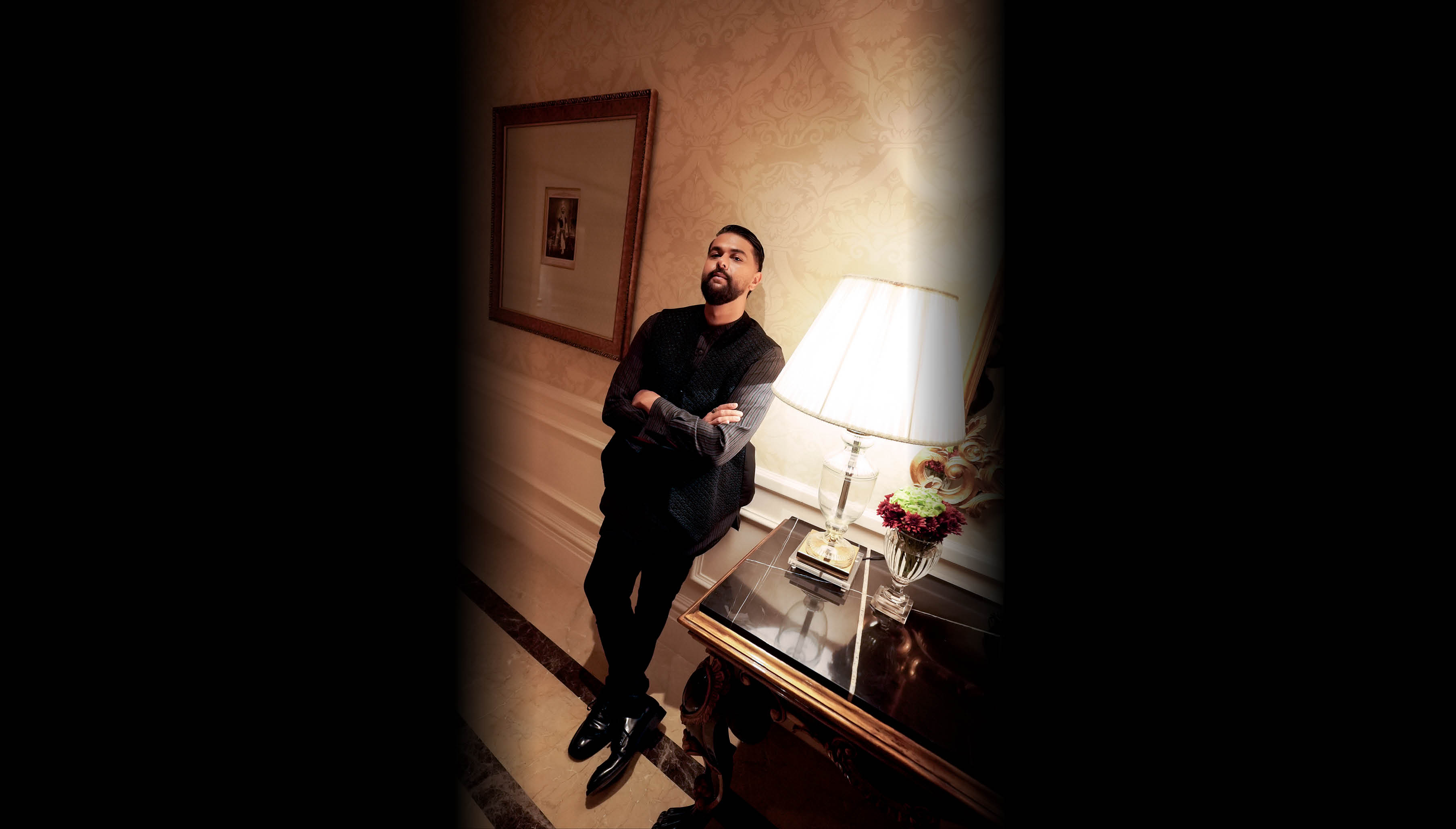
Designer Kunal Rawal Is Rewriting The Rulebook Of Indian Menswear
Designer Kunal Rawal is here for men who move, celebrate and express
Picture a massive room teaming with fabric. Mountains of colour, texture and possibilities piled high. In the middle of it, a young and impressionable Kunal Rawal and his sister invented a game where they’d leap onto these fabric peaks, shut their eyes and try to guess the material beneath their hands.
That childhood ritual became the spark, an early fascination with how cloth transforms into clothing. Growing up around his father’s garment factory only deepened that obsession, giving him a glimpse into how fabric becomes fashion.
Years later, Rawal would turn that instinct into a defining menswear career—most recently shaped by Rawalgarh Di Jugni, his second collaboration with Akshay & IP, and a first-of-its-kind music video that unveils 90 new looks, filmed at the timeless Alila Fort Bishangarh. “To me, fashion has always permeated film, music and culture. They feed into one another, so expressing that rhythm through music felt like a natural extension of our world,” Rawal tells Esquire India as he reflects on his journey, his entry into the craft and the universe that fuels his work.
What were some of the challenges you had to face while entering the menswear domain?
I was trying to find my place in the occasion wear world, and the kind of work that was doing well in the market at the time wasn't my aesthetic at all. Entering this very established space with my point of view was a huge challenge. I was already going against the odds with menswear, and then I walked in with a completely different visual language. But I backed myself completely.
The first groom that we styled from head-to-toe was Shahid Kapoor, and that’s when the real shift happened. Aesthetically, it opened the door to a completely new language for men's occasion wear. The sherwani had twice the panels to give it a closer fit; we removed the shoulder pads for the first time and made the length almost mid-thigh, at a time when the style was still boxy and long. No jewellery, just a small, modern safa with one kalgi, and that too only for the ceremony.
I was pushing an idea I deeply believed in, and in many ways, it felt like a quiet rebellion against the usual choices.
Colour feels like its own language for you. Is that psychological or instinctive?
Colour is something we give a lot of love and attention to. This is the first season we are putting charcoal out so unapologetically. I am a sucker for luxe grunge tones that you do not usually see in men’s occasion wear. In a room full of three hundred reds and bright tones, charcoal is what stands out. We lean into colours like charcoal, olive, washed mushroom and steel grey. For evening wear, mulberry is our answer to a woman's hot pink, a deep, saturated dark male equivalent. Wine is a brand colour, and we do sixteen navies and fourteen wines because men love these shades, but they are rarely explored in depth.
Indian occasion wear comes with its own rulebook. What did you learn about this ecosystem that challenged your perspective?
There is a lot of me questioning things respectfully. The idea of a shubh muhurath, for example, is that nobody moves without it. Or the idea that black is apshagun [unlucky]. I knew I could not fight the belief entirely, so now I work with a super dark navy that still feels modern. Understanding these unspoken rules became my entry point into this world. Once I understood the industry from the inside, it brought a freshness to what we do. And above all, I believe groom wear has to be timeless. Those wedding pictures will sit in your home forever. They can’t feel dated in a few years.
Even with embroidery, we push what feels enduring. This season, we are doing oxidised work inspired by how zardosi was treated for decades by the old ateliers and how the Maharajas used to wear it. They let it oxidise, age and develop depth over the years.
Run me through your creative process.
I ask myself if I would wear it. Is the colour too candy? Can I tweak it? Will it hold its relevance ten years from now? I want every piece to survive time because I see our work being passed down. That is why we repurpose groom wear free of charge. The work has to live many lives; it’s meant to stand the test of time. Personalisation is central to that idea. We build pieces that can evolve. I see so many grooms returning a few years later to adjust the length or break their sherwani into our signature deconstructed version. It becomes a sleeveless jacket with a kurta or a bundi you can wear separately. Every iteration creates a memory marker. That is what excites me. The idea that a groom can say this is what I wore for my wedding, then I changed it again when my child was born, and now you will wear it for your moment. That journey is beautiful. I still wear my dad’s tartan shirts and a leather jacket he gave me.
From couture to composition, you’ve always worked with rhythm and emotion. What made you want to express that rhythm through music, and how did Rawalgarh Di Jugni take shape in that process?
To me, fashion has always permeated film, music and culture. They feed into one another, so expressing that rhythm through music felt like a natural extension of our world. With Rawalgarh Di Jugni, we imagined a universe abundant in vibe, character and everything that defines the Kunal Rawal label. This season, that universe actually began as a music piece we composed. Our Jugni is a playful, firefly-like character, free, confident and complete on her own.
Rawalgargh is a bold, new chapter for us, as we push our design philosophy further by reinterpreting our codes of occasion wear through new hues, silhouettes and surface techniques. Rawalgarh Di Jugni became the ideal medium where film, sound and fashion converge into one immersive narrative.
You’re one of the few designers pushing the boundaries for groom wear. What is the secret to making something ancient feel contemporary, maybe even a little rebellious?
One of the most exciting things we’ve done for groom wear is the introduction of magnetic stoles. As a brand, we’ve been quite structured, and while I love drapes, I’ve never been able to enjoy them fully because drapes demand constant adjusting and a part of your attention is always pulled away.
Today’s weddings aren’t about standing upright with perfect posture and a static stole draped around your arm. Our body language is different, and clothes need to respect that. The magnetic stoles are made for people like me. You put it on and it stays exactly the way you wore it, from the moment you leave home. It took us a while to crack it, but we’re finally there. The stoles come with a belt attachment so you can use them with or without a belt, and they simply don’t move. You can be yourself without fussing over your outfit.
Would you say these reinventions are born out of frustration and the need to fix it? Or wasit the desire to challenge function?
It felt inevitable that things had to shift. With occasion wear, I wanted to understand rituals—why a coconut is tied to the groom’s waist in one community or certain colours are taboo. Once you understand the meaning, you can design for it in a modern, functional way. That is why we personalise so much with hidden pockets for ceremonies, design choices shaped around specific customs, pieces created to be re-worn.
Over time, this curiosity also turned tongue-in-cheek. I started adding prosperity markers into garments, a hidden evil eye, a tiny coconut tucked somewhere in the embroidery. I love the details you discover on your own. That is why we add so many elements inside and outside the outfit, whether it is the sweat absorbent lining, glow-in-the-dark details. Everything is designed to feel functional, personal, rooted in meaning and yet fully modern.
If not a fashion designer, what would you be?
My love for fashion, especially menswear, has always been too strong for me to imagine a life outside it. If I wasn’t a designer, I’d still be somewhere in the fashion world, modelling or films. But for me, everything starts and ends with fashion. More specifically, menswear is the space I’ve always been obsessed with.
To read more stories from Esquire India's December 2025 issue, pick up a copy of the magazine from your nearest newspaper stand or bookstore. Or click here to subscribe to the magazine.