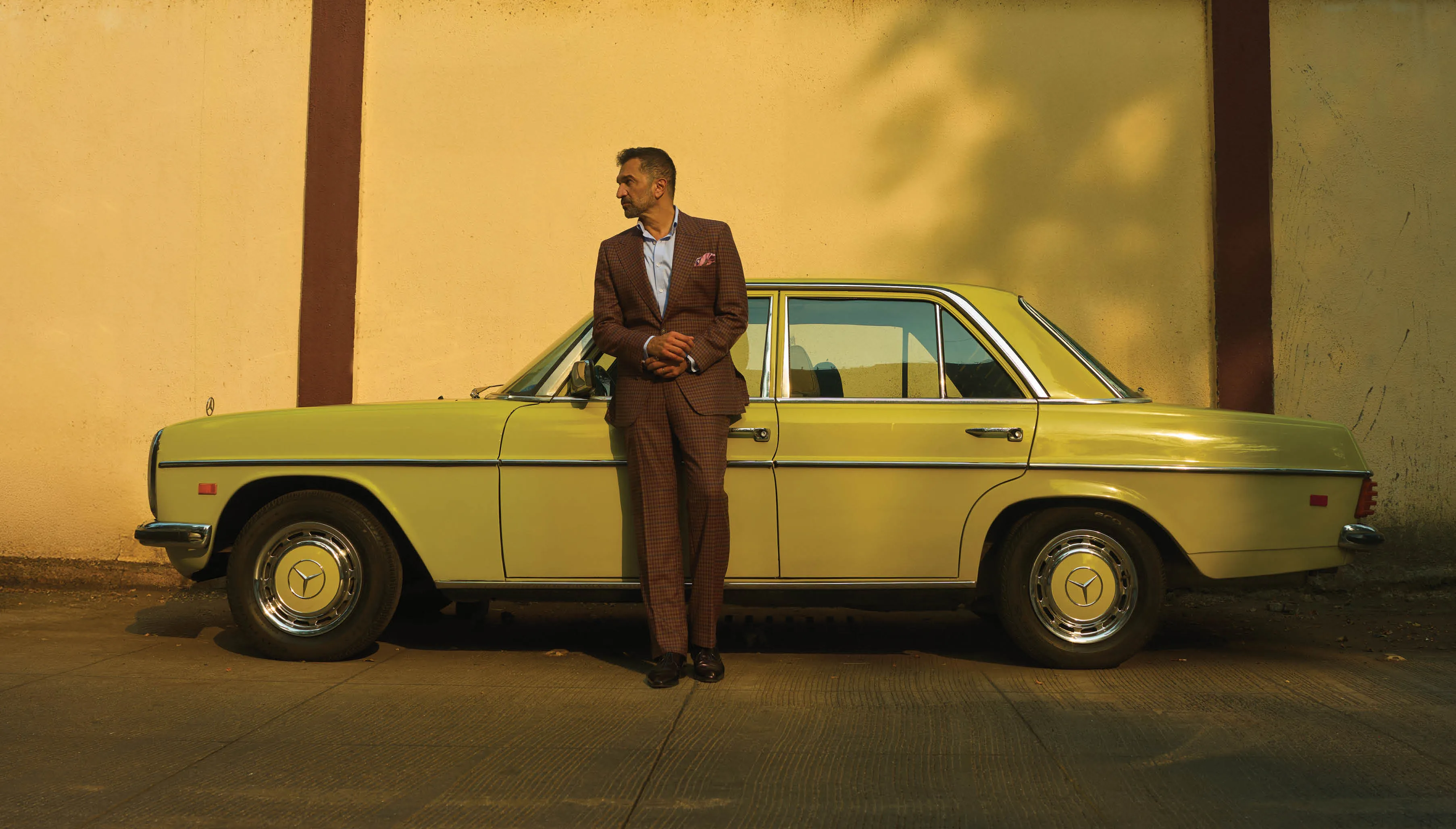
FOR DECADES, ATUL KASBEKAR HAS SHAPED THE VISUAL vocabulary of fashion and glamour in India, from the legendary Kingfisher Calendar to high-profile campaigns for global luxury brands, building an unmistakable signature along the way.
The mastery he brings to photography mirrors the way he lives and dresses. His personal style is deliberate and disciplined: sharply tailored separates, minimalist silhouettes elevated by understated detail, and an old-world sophistication that never sacrifices modern ease. For him, every piece—from a bespoke blazer to a handcrafted shoe—is a considered gesture.
In a candid conversation, Kasbekar—who has expanded his footprint into OTT and big-screen storytelling with Ellipsis Entertainment—takes us inside the principles, obsessions and subtle provocations that define his personal style and creative philosophy.
TRACKSUIT BY PUMA X PALOMO; WATCH VACHERON CONSTANTIN OVERSEAS CHRONOGRAPHColston Julian
Was there a moment you first fell in love with clothing and menswear?
An unexpected masterclass once came from a chance chat with MF Husain saab. He told me, “Artists should appreciate the arts in all other fields to enhance their own.” I took that seriously… Since then, I’ve found inspiration as easily in a tailor’s chalk line as in a gallery. The cut of a bespoke suit, the patina on a handmade shoe; these are not indulgences. They are expressions. Some people collect art. I prefer to wear it.
You’ve made some compelling style statements over the years— what inspires your unique approach to fashion?
Form follows function. Always has, always will. I dress to move, not to pose.
Yes, I had a fleeting affair with the skinny suit. We’ve both moved on. I’m a fabric snob—unapologetically so. Texture, weight, integrity—that’s where style begins. I admire houses such as 11.11/ eleven eleven and Brunello Cucinelli for marrying craft with conscience. Sustainability and fair wages aren’t trends; they’re standards. A wise man once said, “If you want to be fashionable, get fit first.” Brutally accurate. Fortunately for me, I’ve been the same waist size for three decades—which makes life and tailoring considerably simpler.
And logos? If I can read it from across the street, it’s not for me.
Luxury should murmur, not scream.
TRACKSUIT BY PUMA X PALOMO; WATCH VACHERON CONSTANTIN OVERSEAS CHRONOGRAPHColston Julian
Your watch collection is truly one of a kind. How did your journey into horology begin?
Somewhere in Switzerland or Japan, a master craftsman is obsessively machining tiny metal parts so they align perfectly and measure time with near-maniacal precision. It’s irrational. It’s unnecessary. It’s magnificent. That to me again is art. Every gentleman should wear a proper timepiece. Not because he needs to know the time, but because he respects it. And if you’re checking your wrist for emails? We seriously need to talk!
Do you think style becomes simpler or more intentional with age?
It doesn’t get simpler, I feel it gets more edited and perhaps precise. In one’s youth, style is more exploratory and as you age, it’s more elimination. Perhaps better pieces than many.
You've gone from shooting fashion to fronting fashion—how do you play with fashion and make it work for you?
At one point, I’d shot practically every menswear brand out there. T he street gossip was kind—“No one shoots menswear better than Atul.” The truth is, I just like good clothes and would be U aware of what could look good. And if I accept an invitation, I respect the dress code. It’s a radical concept called manners. What I never understood were some of my visual-arts brethren who dress exactly the same for a gallery opening, a black-tie dinner, or a grocery run. That level of uniform works—if you’re Steve Jobs or Mark Cuban. Until you’ve built an empire in a black Gap turtleneck, behave!
In what ways has your relationship with wearing suits matured or evolved—whether through bolder colour selections, softer construction, or a more personal expression of style?
Personally, I’ve done the full syllabus—one button to four button, bandhgalas, sherwanis… the works. I’ve now settled into a softer construction, minimal shoulder padding. Any more structure and I start looking like I’m about to trial for the Rugby League. The one-button has become my default—even over the two. There’s something about it that lengthens you, sharpens you. Makes you look more athletic than you have any right to be. Take Daniel Craig as Bond for example; almost exclusively one-button suits. The man looks taller, tighter, like he was assembled in an MI6 laboratory and calibrated for martinis and mayhem.
BLAZER BY SYNGMAN CUCALA; TROUSERS BY STUDIOUS, TOKYO; T-SHIRT BY KOMMY KOMMYColston Julian
LEATHER JACKET BY JOHN VARVATOS; TAILORED PANTS BY DOLCE & GABBANA; HIGH-TOP SNEAKERS BY NIKE X TRAVIS SCOTTColston Julian
LEATHER JACKET BY JOHN VARVATOS; TAILORED PANTS BY DOLCE & GABBANA; HIGH-TOP SNEAKERS BY NIKE X TRAVIS SCOTTColston Julian
How has your personal style evolved over the years?
At this point, most of my clothes are bespoke. I’ve given away every off-the-rack designer suit I owned, bar the first one I ever bought. Sentimentality trumps minimalism. And thankfully, it still fits. Feels like a quiet victory! I’m particularly fascinated by Korean and Japanese design. Someone like Yohji Yamamoto doesn’t “design” clothes—he engineers them. The construction, the balance, the restraint. It’s more geared towards “observing the architecture.” I respond to that. I also like making things my own. An embellishment here, a hand embroidery there, custom shoes shaped precisely to my foot. I enjoy that slight deviation from the expected. True luxury, to me, is individuality.
Are there any designers who inspire your style choices?
Plenty. My suits are made by Paul Jheeta, the first Indian on Savile Row, proper old-school precision with modern ease. The boys at Tenassi are exceptional. Gabbana have consistently got it right for me over the years, there’s an unapologetic masculinity there that works. And Raghavendra Rathore seems to enjoy seeing me in his bandhgalas. The admiration is mutual. There’s a wonderful store called Syngman Cucala in Barcelona and I inevitably leave with more than I planned each season. The Studious chain in Tokyo is always a pleasure; sharp, curated, intelligent. Back home, 11.11/ eleven eleven is a favourite. And the polo tees from Rare Rabbit are a reliable casual staple.
Any look from the ’80s or ’90s that you’d like to bring back?
Higher rise trousers. Single pleat. A longer jacket, single button. It’s a vertical cheat code. Mercifully, they’re both back and long may they stay. It elongates the body, feels comfortable and aligns perfectly with my “form follows function” philosophy.
DENIM SHIRT CUSTOMISED WITH SASHIKO EMBROIDERY BY MARSIL EXPORTS; CORDUROY PANTS BY SYNGMAN CUCALA, BARCELONA; SANDALS BY RAJESH PRATAP SINGH; WATCH HUBLOT BIG BANG TITANIUM; SUNGLASSES BY ETNIA BARCELONAColston Julian
DENIM SHIRT CUSTOMISED WITH SASHIKO EMBROIDERY BY MARSIL EXPORTS; CORDUROY PANTS BY SYNGMAN CUCALA, BARCELONA; SANDALS BY RAJESH PRATAP SINGH; WATCH HUBLOT BIG BANG TITANIUM; SUNGLASSES BY ETNIA BARCELONAColston Julian
What would you never ever wear?
It would be a hard pass on big fat logos screaming across my chest or my bag. I’ve never felt the need to audition for approval by wearing a billboard…
What are you currently on the hunt for?
I’m constantly refreshing my accessories—cufflinks, pocket squares, the small details that quietly do the heavy lifting. If you happen to have a favourite piece languishing in your grandfather’s private stash, do let me know. I’m always happy to assist with its relocation. My wife maintains there should be a custodial sentence for men who own more footwear than their partners. If that legislation ever passes, I fear they’ll throw away the key in my case!
If you had to wear one outfit for the rest of your life, what would it consist of?
A pair of those Barcelona trousers and a linen shirt should do it. Assuming, of course, that the rest of my life is spent somewhere tropical—which feels like a sensible plan. (Grins)
One thing from your closet you’ll never throw out?
A Hugo Boss blazer I bought years ago from an outlet near Stuttgart. My first truly “expensive” purchase. I remember how considered that decision was. It wasn’t impulse—it was aspiration. If I’m lucky, I’ll pass it down to my son. Clothes can carry stories. That one certainly does.
Words by JEENA J BILLIMORIA
Photographs by COLSTON JULIAN
Styling by KOMAL SHETTY
Hair and Grooming by ISHLEEN SETHI
Location Courtesy by KASPERS
ARTIST PR: NIDHI & MIHIR PR CONSULTANCY
To read more stories from Esquire India's March 2026 issue, pick up a copy of the magazine from your nearest newspaper stand or bookstore. Or click here to subscribe to the magazine.