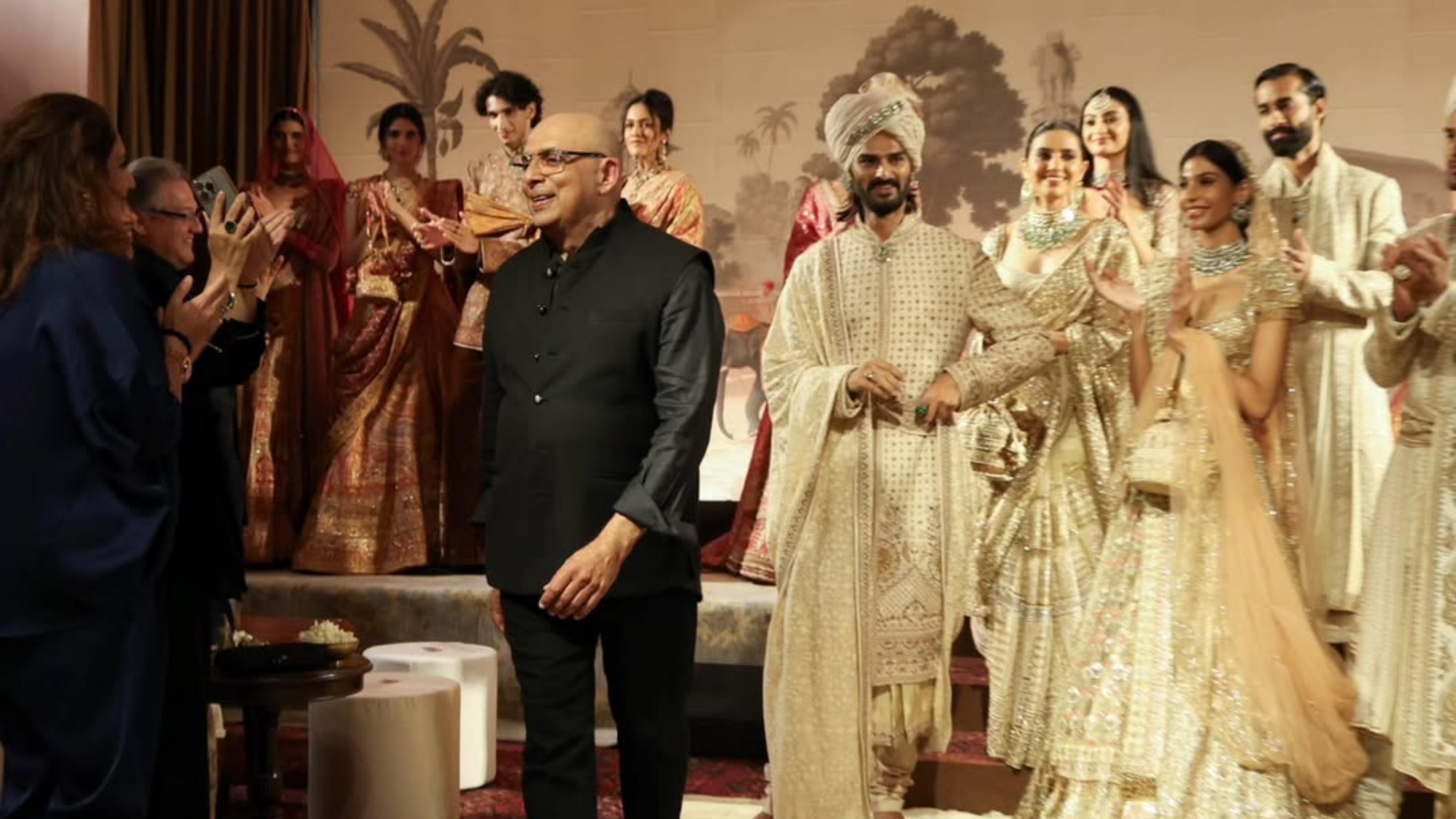
Tarun Tahiliani’s Idea of Luxury? Clothes That Let You Dance
The couturier on why the Indian wedding needs less weight - and more soul
“What endures is never loud. It lingers like a memory—measured, luminous, and true. In its quiet, you meet yourself."
This is how Tarun Tahiliani’s collection note begins. He’s just showcased his Couture and Bridal 2025 collection and the ongoing India Couture Week in New Delhi. The silhouettes are sculpted but fluid. The embroidery isn’t overpowering—pearls, crystal, and resham perform their quiet magic.
Tahiliani imagines a couple who don’t just look good for their inevitable wedding film or for the meticulously curated visuals that will no doubt go up for months after their wedding, but also a couple that can feel good in their ensembles. What does ‘beautiful’ mean if one cannot move in it, dance in it or laugh from the core of one’s being? Is a too-tight bustier really worth it? Is the heavily weighted sherwani truly a necessity? Not in Tahiliani’s world.
In his latest collection, titled Quintessence, every detail is meaningful.
Excerpts from our interview with the designer—
In your own life, what are the quietest things that have shaped you the most?
Well, to begin with, I had a mother who loved to dress—and whatever her means were, she always looked great. She was a modern Indian woman, the first woman engineer in Bombay, and I grew up in a privileged home where she had access to the best. But what stayed with me was the idea that looking good wasn’t about how much money you spent; it was about how you carried yourself and what you did for yourself.
I remember buying my first pair of Armani pants on clearance while in college. I didn’t even know much about designers then, but I could feel the difference. I cherished them—just as I did when I first saw Asha Sarabhai’s clothes, or many of our Indian designers. Later, I got my first Brunello Cucinelli sweater, and it wasn’t about the label - it was how it made me feel. That’s what made it a luxury. And because of that feeling, you wanted to look after it.
I still have things I bought in 1991 that I use and love. I think if we all shopped like that—more consciously, more emotionally—we wouldn’t be putting 92 million tonnes of clothing into landfills.
You’ve said before that movement is essential to beauty. Was there a moment when that truth came alive for you?
Yes, I remember wearing a dhoti once, and the tail fell off. I thought, “Oh my God, I can never do this again.” And then I thought, why not make a structured version, like a trouser? That’s how structured draping was born.
People who wear a sari or a dhoti every day—it becomes second skin. But for our generation, and those after me, it’s not the case. That’s why we use stretch, structure, and clothing that evolves with technology and fit. Once you get used to that kind of ease and movement, you can’t go back.
I’ve seen brides who couldn’t walk, who were crying, cut up, even bleeding—and that’s not what we’re meant to do as designers. Movement is part of beauty. Without it, clothing becomes costume.
If you had to describe your own ‘quintessence’—the purest part of who you are—what would it be?
I’d say a dreamer. I live in my head, and it’s never boring. It’s quite a fun trip, most of the time.
In a world often drawn to spectacle, how do you navigate the tension between showmanship and sincerity?
Honestly, there’s more projection and showmanship than ever before—Instagram, red carpets… people prancing around looking like clowns, if I may say so. So, I’ve recoiled. I’ve chosen to do the opposite.
That’s just where I’m at in life. I told my studio years ago I won’t play that game, but I’ll be here every day at 8 am to work on technically beautiful clothes. Aesthetics are subjective, but what we make can’t be faulted. That’s the commitment.
The partnership with Aditya Birla brought management and structure—and with that, we’ve been able to take things to the next level. There’s real confidence now. But I don’t come to work for scale—I come for the joy of creation. It’s evolutionary—one discovery leads to the next.
We’ve launched OTT. Couture has found its focus. We’re not trying to straddle too many worlds anymore, and that clarity gives way to greater creativity. Same with menswear—we brought in international pattern makers and trained our masters in classic tailoring. Now we apply the same fit, comfort, and refined proportions we do in womenswear - but with embellishment.
No one dances more than guests at Indian weddings. And I’ve always loved what my late friend Rohit Bal said - that Indian men were the original peacocks. Somewhere along the way, we became bland—stuck in some post-colonial, Victorian straitjacket, wearing a stiff safa on our heads. But men are celebrating themselves again - embracing heritage, looking after themselves, being fit, and I think that’s amazing.
Technology, tradition, tailoring - all these worlds are colliding in the most exciting way.
For the bride or groom who wears Quintessence, what is the feeling you hope stays with them long after the moment has passed?
That it was worthy of their most special day—that they felt as special as, hopefully, their hearts did.