- Entertainment
- Style
- Lifestyle
- Food & Drinks
- Tech & Auto
- Culture

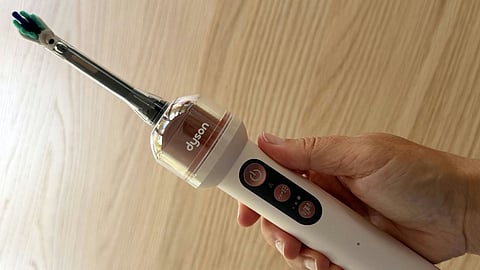
Folks have spent the last few years weaving AI into the fabric of everyday life, almost as if it had become an extension of their own body. Oh, that's a bit exaggerated. But an AI-powered toothbrush comes close to it. The Dyson CameraJet is that toothbrush. The company's first electric toothbrush with a camera to target and precision-floss gaps.
Priced at $499 in the US (and AU $799 in Australia), the device is built around a 100,000-pixel macro lens camera tucked into the brush head, one that streams a live feed of the inside of the user's mouth to a connected app.
But is it needed at all? Don't we have good dentist to help us care for dental care?
Dyson is not alone here. MOVA beat it to market by a few weeks with the Fresh 20 VISION, a toothbrush that costs half as much, carries a camera with triple the resolution, and throws in bone-conduction audio guidance for good measure. Between the two, oral care has become an unlikely new battleground for AI-powered gadgetry.
The CameraJet's core trick is something Dyson calls Gap Optical Targeting. The camera captures 28 images a second while the brush is in use, and its machine learning model scans those images for gaps between teeth. Within 100 milliseconds of spotting one, the device fires a precision jet of mouthrinse directly at it, while the brush head itself oscillates a thousand times a second at constantly varying angles. The reservoir holds Dyson-branded mouthrinse, refills itself in three seconds on the charging dock, and Dyson maintains that none of the footage is recorded or stored anywhere, on the device or in the cloud. The full set, in Ceramic Ultra Blue or Ceramic Pink, comes with a travel case, a charging dock, spare brush heads, and Dyson's own toothpaste.
The pattern here keeps recurring almost before anyone can blink: AI getting sold for tasks people have managed perfectly well without it. Reading a five-page paper, writing a text message, drafting an email that says what one means, have each at some point in the last few years been reframed as tasks too difficult to trust to a person alone. Brushing one's teeth now joins that list, which is crazy because one would think one would have mastered the art of doing something they do first thing every morning for as long as they can remember. Apparently, we need help for that too. The pitch of the CameraJet rests on the suggestion that people cannot know how thorough their brushing is without a camera and an algorithm to confirm it for them. Manual flossing and a decent mouthwash have worked for generations of functioning adults. Or maybe the explanation is simpler than any of that: people have convinced themselves that time is precious enough that anything promising to save it also improves the quality of life by default. Is that true? People have always been more capable than they give themselves credit for. It's also worth pointing out how much of everyday speech has already picked up the cadence of AI.
AI has spent years reshaping the words coming out of people's mouths before ever setting foot inside one. Maybe the brand simply wanted to be first at something, and by most accounts it succeeded. But it might also just be a new form of self-doubt about an old, perfectly functional habit, priced at $499.
The CameraJet has not launched in India yet. Dyson has not announced a date, and its India website currently only lets buyers register for updates. Once it does reach Indian shelves, dental hygienists have already shown genuine enthusiasm for it online, and anyone chasing a flawless set of teeth, or simply curious about what is happening in the back of their mouth, will likely find real value in watching it in real time. The backlash on Dyson's own Instagram, full of people asking why a toothbrush needs a camera at all, ran alongside an almost equally loud contingent asking where to buy one. The device works roughly as advertised, and Dyson spent close to six years developing it before bringing it to market. Whether it earns a permanent place in the morning routine, or ends up as another expensive gadget abandoned on a bathroom shelf, is a question every one of its $499 buyers will answer for themselves within a few months of owning one.