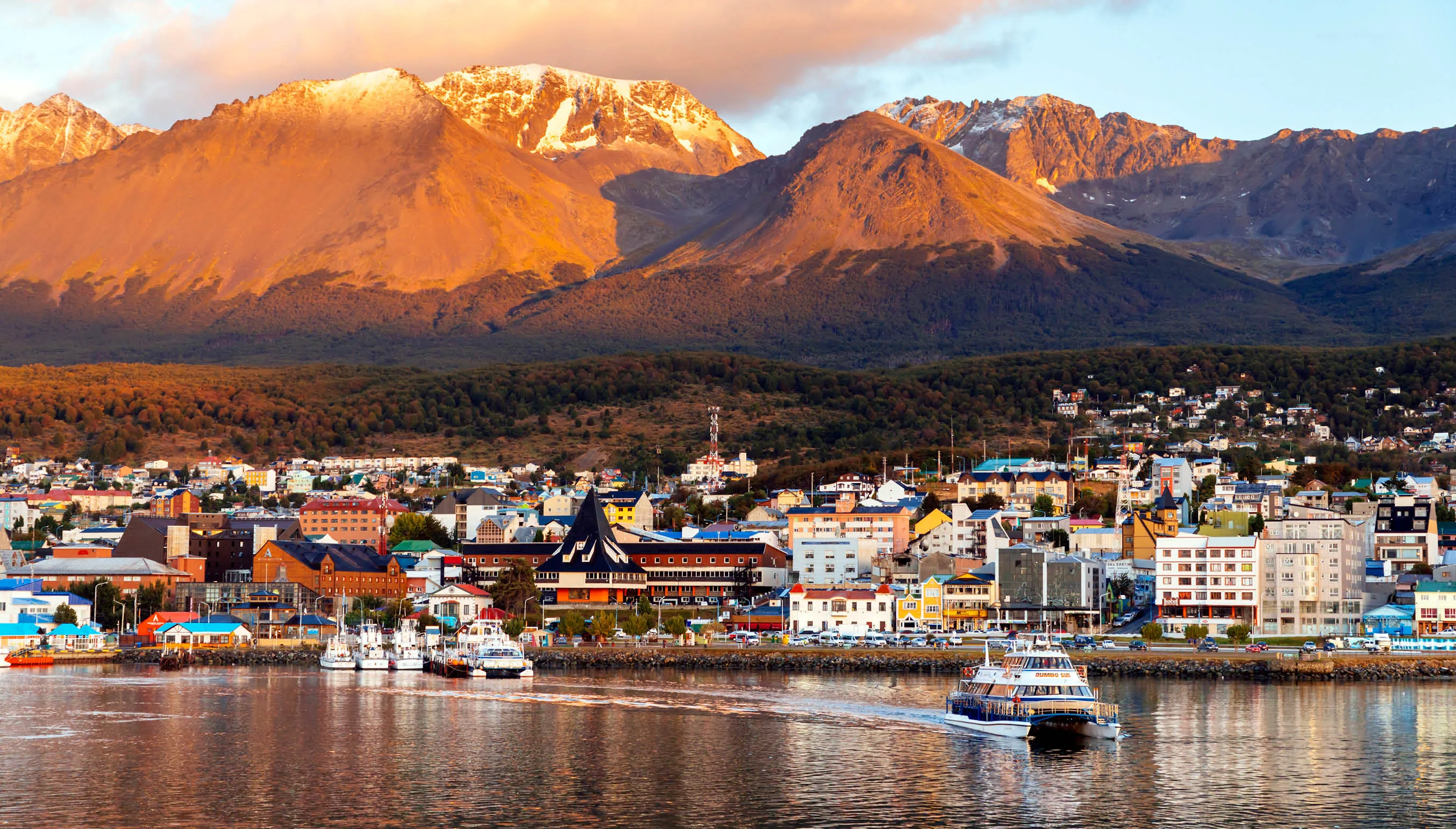
Ushuaia: What Goes On In The Southernmost City In The World
A writer saw it with his own eyes
When I arrived at the end of the world, the first thing I saw was a Hard Rock Café.
Where were the fires that Ferdinand Magellan saw on his explorations—which led him to name this region Tierra Del Fuego? As a young travel writer, I heard of the windswept port city of Ushuaia in an almost mythic register everywhere. Capital of the Land of Fire, it was exalted in the diaries of Bruce Chatwin for its ‘end of the world’ status.
I landed at 54°48′S 68°18′W on a chilly late summer night and a Fiat Cronos came to pick me up. Having thrown my bags at the hotel, I headed downtown for a taste of its famous king crab. I instead ended up at a bodegón serving local comfort delights, for vegetable and ricotta cannelloni with bolognaise and chilled Coke and Fernet Branca.
Morning in Ushuaia brought an otherworldly dawn with cracks of sinuous lights. I couldn’t wait for the last bite of my perfunctory breakfast and rush out to see what Fin Del Mundo looked like. If it even knew the fantastical impositions those elsewhere on the planet had thrust upon it. The best way to do it was by taking a walk along the Beagle Channel on Avenida Maipú.
It was a windy Sunday and as soon as the sun rode up a bit higher, residents started showing up for their morning runs and cycle routes. But with the austral summer slowly leaving the region, the conditions in this city, situated on the glacial slopes of the Fuegian Andes, had grown unforeseeably cold.
In addition to its remoteness and inaccessibility, this punishing weather must have been the reason President of Argentina Julio Argentino Roca started a prison colony here in 1896. Designed for recidivists and military convicts in the model of the panopticon, the prison—as well as much of the neighbouring town precincts—was built by its inmates and operated as a national prison between 1902 and 1947. Almost in an inversion of the concept of the sanatorium, the penitentiary in its days was conceived to weaken the hardened criminal tendencies of its inmates, which included the anarchist Simón Radowitzky.
The alternating blue and yellow stripes of the scrubs, found on souvenirs as well as resin figures on landmarks and streets, is a constant reminder that these prisoners, beleaguered by harsh cold and difficult terrain, built modern-day Ushuaia. Alongside, of course, the Museo Marítimo y del Presidio. Any historical exploration in Fin Del Mundo concludes at the pavilions of this museum that was born inside the erstwhile Prison of Ushuaia. Andrej, a Brazilian traveller of Ukrainian origin, went about relating a legend about how an inmate, starving and lost in the Patagonian wilderness, started fires so that he could be found and rescued.
And indeed, the frigid winds that blow in from the Beagle Channel can tame the boldest spirits, as I found prancing along the shore promenade in search of some lively frames. Before the frostbite could get to my fingers, I shifted to Plaza Islas Malvinas, where a band prepared for a performance and the provincial map was being unfurled for hoisting. It was here that the nonchalant end-of-the-world turned up with a performance.
Buses awash in the bright blue of the Argentine flag drew history nerds as well as travellers keen to make good use of cameras slung across their necks. Humming up and down the hilly road, it was an old-fashioned double-decker with tartan seats and multilingual seatback audio guide. We passed the Old Government House, the Saint Christopher Shipwreck, the municipal cemetery, the quaint Italian Quarter, hopping off at Monte Gallinero to savour panoramic views of the settlements further into the city. At Laguna Del Diablo—Devil’s Lake—we descended again to enjoy pristine views with Cerro Cinco Hermanos standing guard. A cool water body surrounded by peat bogs, it peeked from gaps in dense alpine thickets.
Later, Fabrizia, owner of a shop in the downtown where I stopped by to pick up a bottle of Tres Plumas, regaled me with tales told around town about the storied water body. A lake that freezes over in the killing Patagonian winter for local Fuegians to go ice-skating, it has claimed several pet animals and people in the past. Despite all the legends around fugue states after disappearances, ‘taken’ stories, figures in the mist—I found a local chilling out at its banks with her two cavorting huskies.
Back in the downtown, in its gear stores and countless souvenir shops flooded with fridge magnets, dulce de leche jars, penguin plushies, prison-themed onesies and yerba mate gourds, Ushuaia seemed to be in an endless enactment of departure. Close to one lakh travellers undertake Antarctic expeditions each year via Ushuaia. So, if you’re a visitor to this city, chances are that everyone else milling about, too, is trying to make the most of the End before onward travelling onward.
Before I, too, joined their ranks in leaving, I decided to see something that had to do with arrival, for a change: a general store started by Luis Pedro Fique—the first Argentine to settle in Ushuaia, when the region was inhabited only by a handful of Anglican priests. A low, corrugated-metal structure painted in a chalky blue, with a green pitched roof, emblazoned with the sign ‘El Primer Argentino’, the store burned down in 1946.
But around the same time, Prefect Fique had a coastal walkway built in his honour here. Stretching 600 metres in the Beagle Channel, the footbridge is something most day-trippers don't get the chance to do, but probably should. I was told that completion and beautification of the walkway will be carried out in the coming months. Because even at the end of the world… things are always only getting started.
The author was in Ushuaia by an invitation from Ibex Expeditions for an expedition to Antarctica.