Space Tourism: If Katy Perry Can Go, Can I Fly Too?
Space travel is no longer just for astronauts. Esquire India breaks down the ultimate high-flying getaway
When Katy Perry blasted off to Space recently, she carried 300 bracelets to inspire future generations and a real-life daisy as a reminder of what makes Earth special. Part of an all-female crew on the NS-31 mission, the American singer and songwriter even sang Louis Armstrong’s ‘What a Wonderful World’ in zero gravity.
Blue Origin’s NS-31 mission, which included Perry and five others on the suborbital flight, didn’t actually win over public opinion. Guardian columnist Zoe Williams quipped that “most of them weren’t obvious astronaut material.”
But the launch got people talking about our pale blue dot once again. Who all have been to space? What does it take—to quote Tim Wolfe’s incredible book on pilots and astronauts—to have “the right stuff” to be up there? Could a regular Joe be among the stars one day?
Billionaires Richard Branson, who owns space tourism company Virgin Galactic, and Jeff Bezos have done it. William Shatner did it too—in true Star Trek style. To the edge of space and back. Welcome to the Space Tourism Club, everyone.
But a lot has changed since American investment manager Dennis Tito went to the International Space Station (ISS) in April 2001, funding his own trip to become the first so-called space tourist. We are now in the realm of commercial space tourism, which is slowly reaching its apogee.
A total of seven private crewed flights took off in 2024. The feeling of being in space, even if it is brief, is unmatchable for some. “The Earth looks bright and brilliant, and even more so against the matte black of space. Being in space and looking down at our planet feels like an out of body experience—like someone has grabbed you and ripped you from your body and you are a soul looking down on yourself,” says Sirisha Bandla, the Indian-origin commercial astronaut and vice-president of government affairs and research operations at Virgin Galactic, who flew on the company’s first fully crewed mission in July 2021.
“Everyone’s journey to space is unique, so each experience will be different,” says Bandla. “But I truly believe anyone who goes will return with a shifted perspective on life on Earth,” she adds in an email interview with Esquire India. As commercial spaceflight blurs the lines between science, luxury and spectacle, what’s really driving this cosmic pursuit? We set out to answer all the questions you’ve been too curious—or too confused—to ask.
Who Is Taking People To Space? If Katy Perry Can Go, Can I Fly Too?
Yes—If you can afford it (more on that later).
The seven flights in 2024—operated by Blue Origin, Virgin Galactic, and Elon Musk’s SpaceX—ranged from a few minutes to three or four days in duration.
Founded by Amazon’s Jeff Bezos, Blue Origin is one of the biggest names in the space tourism market and has been flying humans to space since 2021. Blue Origin’s New Shepard uses a suborbital rocket system built for human flight. At the top of this rocket sits a pressurised crew capsule, which is propelled into space by a reusable rocket booster. The vehicle is fully autonomous— there are no pilots involved.
Once the capsule is hurled towards space, the booster lands back vertically. The capsule thumps back on earth with the aid of parachutes. Since its maiden flight in 2021, Blue Origin has flown more than 50 passengers to the edge of space.
Branson’s Virgin Galactic uses a system of two manned aircraft to fly people to space. A mothership carries the actual spaceship through the atmosphere and then releases it at an altitude of 50,000 feet. A hybrid rocket motor ignites to give the spaceship a further boost to keep climbing and reach the apogee, at more than 284,000 feet, before gliding down back almost like a shuttlecock and landing on a runway.
In April 2024, SpaceX successfully launched the historic Fram2 mission, the first human spaceflight mission to explore Earth from a polar orbit and fly over the Earth’s polar regions. The privately funded mission was conducted using SpaceX’s Crew Dragon spacecraft.
US-based Axiom Space has successfully conducted multiple private crew missions to the ISS. Axiom Space's Ax-4 mission is also scheduled to carry Indian Air Force pilot and astronaut Shubhanshu Shukla to the International Space Station. Shukla will be India’s second astronaut to go to space since 1984.
There are other Chinese companies that have announced plans to enter the space tourism market.
Is It Actually ‘Space’?
Technically yes. But there is a thin line. During the 11-minute journey in the Blue Origin capsule, travellers soar past the Kármán line (100 km/62 miles), the internationally recognised boundary of space, experiencing several minutes of weightlessness.
The FAI (Fédération Aéronautique Internationale) uses the Kármán line to define the edge of space. Other organisations, including NASA and Federal Aviation Ad - ministration, use 80 km (50 miles) as their definition. A Virgin Galactic flight lasts about 90 minutes, with only 3–4 minutes actually spent in space.
Can I Call Myself An Astronaut?
This is still debatable. The FAI does say you’re an astronaut if you’ve crossed an altitude of 100 km above Earth.
However, astronauts go through years of intensive training before they can fly and spend much more time in space. Compared to that, space tourists and “commercial astronauts” spend a very brief time in space and only a few days—in some cases months—of train - ing and fitness checks. That said, you do experience weightlessness and get to see stunning views of Earth from space.
For the 2021 mission, Bandla trained for a couple months ahead of time with the others while also per - forming a role in testing out the cabin and experience for future customers. The spaceflight readiness training also includes weightlessness preparation, G-force readiness, emergency procedures and sensory saturation.
Bandla says Virgin Galactic’s vehicle is purposefully designed to broaden access to space for people of varying ages and abilities. “That means, standard training for Galactic’s astronauts is about three days. We approach fitness not as a requirement, but an assessment. Most ‘fit-off-the-street’ people will be able to fly to space, and our team will work with you to assess fitness to go space on an individual basis,” she explains. “We’ve safely flown an astronaut with Parkinson’s disease, achieving his dream of going to space."
Some space tourism flights are also being used to run science experiments that could help future space travel missions. The crew on the Fram2 mission, for in stance, conducted experiments around human health research, growing food in space and auroras.
Okay, I’m Sold. How Much Will It Cost Me?
Simply put: a lot. Tito paid $20 million dollars out of his own pocket to spend almost a week onboard the Inter - national Space Station in 2001. Per seat tickets for Virgin Galactic can cost up to $600,000 (approx. `5 crore) now. Back in 2022, the company offered seats at $200,000 (approx. `1.7 crore), according to multiple reports.
Blue Origin has never publicly revealed its ticket prices. But, according to its website, the company collects a fully refundable deposit of $150,000 (approx. `1.3 crore) to begin the order process to reserve a seat. This deposit initiates the booking process, but it does not guarantee a seat on a future flight. According to a recent Reuters report, the company had revealed in 2021 that the highest bid for a seat on its New Shepard spacecraft was $28 million (approx. `236 crore)
In October 2024, another Reuters report said that Chinese startup Deep Blue Aerospace sold its first two tickets for seats on a rocket that will take passengers to space in 2027, charging 1.5 million yuan ($211,000).
What’s The Future Looking Like?
You can’t visit the Space Station like Tito did back in 2001—it’s set to retire and deorbit by 2030. But a stay at a space hotel? That might be on the horizon.
Inspired by Stanley Kubrick’s 2001: A Space Odyssey, the Voyager Station is envisioned as a revolving space hotel and is expected to be operational by 2027. The ambitious project—commissioned by American aerospace company Orbital Assembly Corporation—aims to be humanity’s first space hotel that will use artificial gravity and offer people a taste of space luxury. With suites, gyms, bars and restaurants, and crew quarters, Voyager Station will be targeting space tourists, researchers, astronauts, and even government missions.
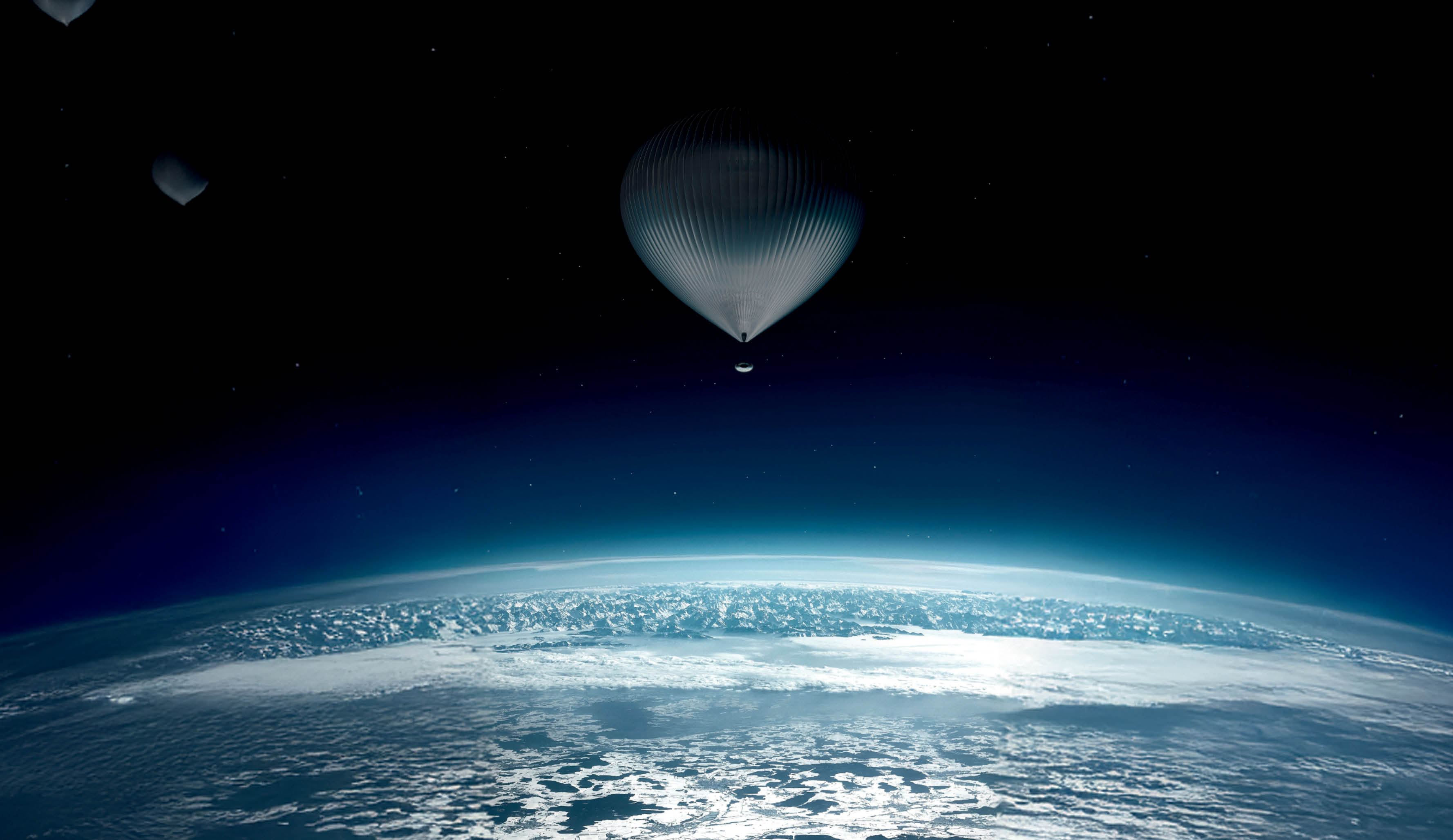
If you’d like a more sustainable approach to eating a meal mid-air, French luxury space tourism company Zephalto plans to use a space balloon to carry passengers in a pressurised capsule to the stratosphere as early as 2026. Apart from enjoying the view, passengers can also savour a Michelin-starred dining experience during the six-hour voyage. The ticket price per guest is pegged at 170,000 euros, approximately $190,000.
Virgin Galactic is now working on its Delta Class spaceships, which will be larger and more powerful. “This spaceship will be a game-changer in space access. The vehicle will carry six people (or scientific research payloads) to space and back—and will be flying multiple times a month. This access is unprecedented in the space industry,” says Bandla, who expects the first research flight in summer 2026, followed by private astronaut missions that fall.
That means your next flight could offer the best views of our wonderful world: trees of green, skies of blue, clouds of white...
To read more stories from Esquire India's May-June 2025 issue, pick up a copy of the magazine from your nearest newspaper stand or bookstore. Or click here to subscribe to the magazine.