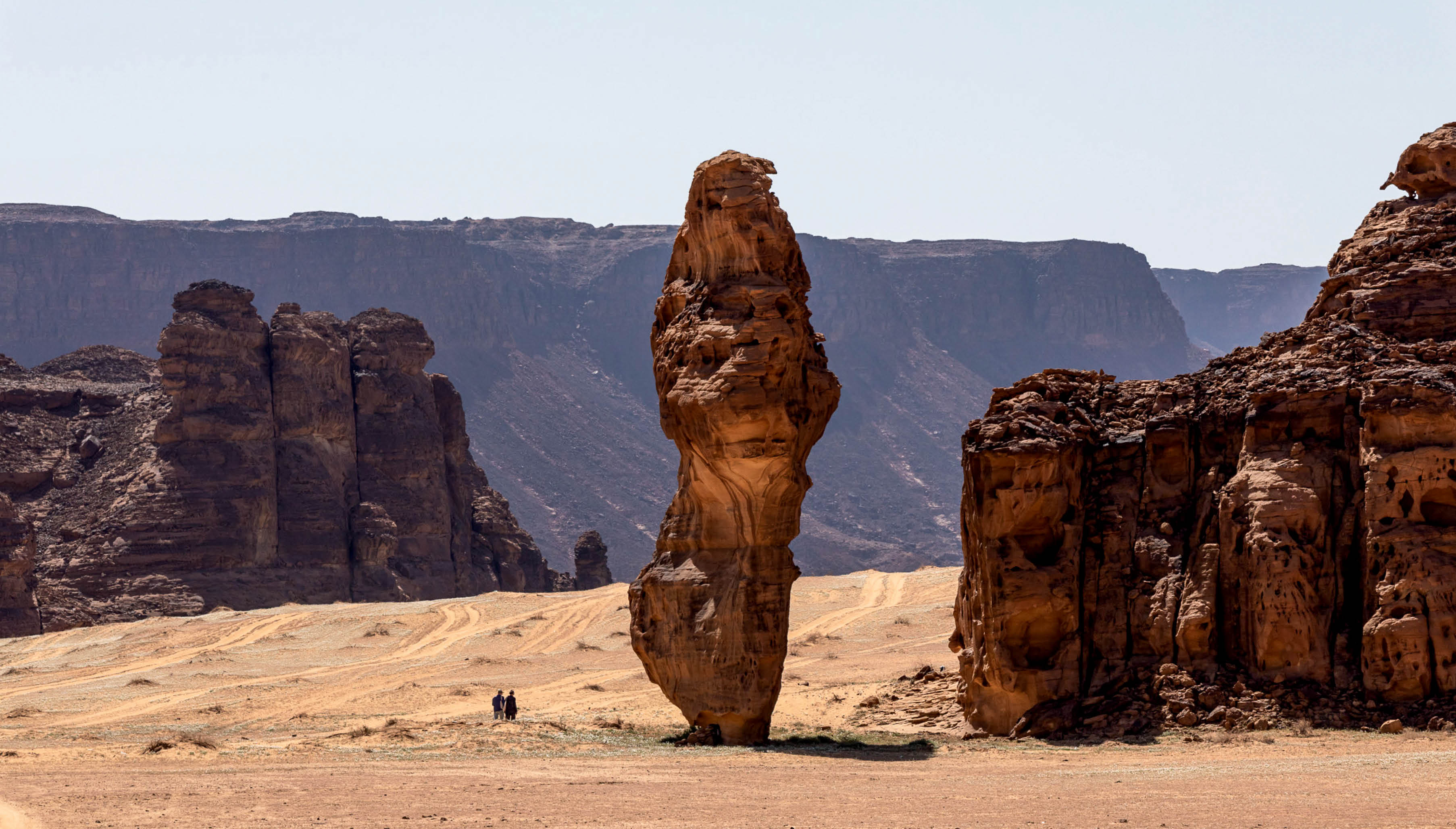
Beyond The Dunes: A Journey Through The Layers Of AlUla
Glimpses of life in AlUla scratched away the luxury veneer of this Saudi Arabian destination, revealing an ancient desert shaped by centuries-old culture and vibrant local stories
When I was offered an assignment in AlUla, Saudi Arabia, last year, scepticism took root immediately. I didn’t stop to consider the potential for discovery—a new country, its vibrant culture, its layered history. An ultra-luxury destination set in the middle of an expansive, otherworldly desert oasis that many still do not know much about. Speckled with views, and dotted with archaeological wonders as well as manmade wonders, a veritable Xanadu.
Instead, I fixated on safety, especially as a woman—a question I’m still asked by both loved ones and seasoned travellers—and on its one-dimensional portrayal as a luxury destination. I expected little more than a lavish backdrop resembling a Dune movie set. A conversation with my mum, however, convinced me to shed my inhibitions and take the plunge. What was the worst that could happen? I’d come back a little jaded.
So, in early November, I arrived in AlUla—an ancient crossroads of history on the Arabian Peninsula. What unfolded was a desert oasis encircled by the towering sandstone and granite peaks of the northwestern Hijaz— an unforgiving and otherworldly landscape that has sheltered human life for over two lakh years.
“When floodwater and enemies threatened a nearby city, its people sought refuge here, between two mountains,” begins Abeer, a rawi, or storytelling guide, her voice echoing gently through the sunbaked lanes of AlUla Old Town, called Ad-Deerah in Arabic. The story dates back to at least the 12th century, when 900 mudbrick homes, 400 shops and five town squares sprawled in a labyrinthine maze, protected by a fortress and 14 ancient gates. After the arrival of Islam in the seventh century, the site became a vital stop on the pilgrimage route from Damascus to Makkah, and was inhabited until the 1980s.
“It was designed so that if an intruder got in, they wouldn’t find their way out,” Abeer says, gesturing toward the desert’s architectural marvel, now teeming with tourists. Most homes had windows only on upper floors to filter in sunlight, and the town was fed by qanats—underground channels that carried spring water from the mountains to irrigate farms. Ingenious, in a region where water is rare, but mountains are not.
I follow Abeer up the steep stairs to the 45-metre-high AlUla Fort, also known as Musa Bin Nusayr Castle. The red sandstone glows deeper under the fading sun, overlooking a tangle of alleyways on one side—like an open-air excavation—and a sea of 2.3 million palm trees on the other. “Citrus and dates have always thrived here,” Abeer says. “People used to trade them with the Bedouins for camel milk and cheese.”
It struck me just how advanced this ancient civilisation was. I wondered what life looked like then—until I stayed at the nearby Dar Tantora The House Hotel. Thirty old homes have been lovingly restored into simple, comfortable rooms. There’s no electricity—just lanterns casting light down narrow alleys, preserving the spirit of the past.
But it’s Abeer’s own journey that lingers with me. At 46, she left a medical career in Riyadh, drawn by a love for travel and heritage. She moved to AlUla 18 months ago and hasn’t looked back. She’s optimistic about the country’s evolving tourism. “So much has changed already,” she smiles. “I love meeting new people every day.” On weekends, she visits her family in the capital—balancing two lives she deeply values.
Walls of sandstone rise like sentinels from the desert floor. I’m in Dadan, a stone-hewn city that flourished in the AlUla Valley around 800 BCE—long before Islam or Christianity. Once the capital of the Dadanite and later Lihyanite kingdoms, it thrived as a key stop along the frankincense trade routes to Egypt, Mesopotamia and the Mediterranean.
“Why did the Dadanite people, coming from the south, choose this place? Why is Dadan mentioned nine times in the Bible?” asks Mamdouh Abalawi, the site’s manager. “Because it was safe—with fresh water and food,” he answers.
It was sacred, too. While 21 tombs are clearly visible, over 1,200 have been identified—and more are still being excavated. At its heart lie the lion tombs, carved with fierce guardians symbolising strength, marking the graves of the elite. “The dead were buried with their belongings for the afterlife. But so far, we haven’t found a single body—most tombs were likely looted for valuables,” Abalawi explains.
I’d always assumed Islam was the only faith this land had known. Learning that ancient civilisations here once worshipped a pantheon of deities felt like uncovering a forgotten chapter—one that added surprising depth to the region’s story.
Back at the Visitor Centre, a modest but well-curated museum showcases artefacts like frankincense and the Dadanite script. But it’s at nearby Jabal Ikmah—often called “AlUla’s open-air library”—that I feel the full weight of its heritage: nearly 300 inscriptions, some over 2,500 years old. Etched into the rock by Dadanite and Lihyanite hands, they range from casual graffiti and musical harps to records of rituals, native animals like ibex and camels, and local customs. Fragments of a lost world still echoing through stone.
In the scrubby desert north of Alula, colossal carved tombs rise from the sand—rocky outcrops with Greco-Roman facades, weathered by time and rain. As the sun dips, they glow ochre and rose, their surfaces etched by centuries of wind and water.
“Marhaba,” says Enass Alsharif, my rawi, as she welcomes our group aboard an open-air jeep that rumbles across this Mars-like terrain. We’re in Hegra (also called Mada’in Saleh), Saudi Arabia’s first UNESCO World Heritage Site. By the 1st century BCE, this 1.6-hectare necropolis was home to the Nabataeans, a civilisation from the southern Levant (modern-day Jordan), with Petra as its capital.
“From nomads, the Nabataeans became trade moguls,” Alsharif explains. “They controlled vital caravan routes where camels carried silk, spices and incense—and they mastered water engineering.” In Hegra, they continued their Petra tradition: carving majestic tombs into rock faces. So far, 111 have been unearthed.
Our first stop, Jabal Ithlib, resembles a stone-carved town hall—a communal space once alive with music, dance and discussion. Alsharif holds up her phone and opens the Experience AlUla app. Through her lens, AI-generated illustrations flicker to life. It’s a reminder that technology can also illuminate the past without compromising its authenticity.
A narrow passage opens into a sacred enclave, where over 100 petroglyphs are scattered like ancient whispers. “They worshipped many gods and chose their deity,” Alsharif says, her niqab fluttering in the desert wind. Dushara, the eagle-figured mountain god, was chief among them. Their language, she adds, would later influence Arabic. “Women had equal standing,” she continues. “They made rules, owned tombs; it was class, not gender, that defined one’s place in society.”
For nearly two centuries, Nabataean masons chiselled tombs into Hegra’s sandstone, including the 72-foot-tall Qasr al-Farid. Though unfinished, it dazzles with symmetry: four Roman columns, dual staircases rising heavenwards, a cornice inspired by Egyptian temples, and the distinctive Nabataean crown. It was likely built for a prominent figure.
Among the most captivating clusters is Jabal Al-Banat, with 31 tombs linked to women. “They lived simply but wanted tombs built high to be closer to god,” says Alsharif. As in Dadan, most are empty—likely raided by the Romans. But at Jabal Ahmar, archaeologists found the tomb of Hinat, a wealthy woman who commissioned a resting place for herself and 80 descendants. Inside, they discovered human remains, leather and fabric—rare glimpses into Nabataean daily life. In 2023, scientists reconstructed her face. Today, she stands in quiet dignity at the Hegra Visitor Centre.
On the drive to Tabuk airport, I watch the scenery pass—modest homes, date palms and rocky peaks flickering past the window. Legendary Lebanese singer Fairouz’s voice floats in the background, her melodies mirroring my reflective mood. These past few days have upended so many assumptions.
Yet, it is a simple chat with Mohammed, my driver, that offers the clearest insight. “Most of us who move abroad can’t wait to come back,” he tells me. When I ask why, he lists the country’s healthcare, educational scholarships, tax benefits and unemployment support. “We have a good life here,” he said, without hesitation.
Of course, there’s progress still to come. But watching a tourism model rise—thoughtfully, from the ground up—feels like witnessing history in real time. At its best, travel isn’t just an escape. A way to challenge assumptions, foster understanding, and break down the illusion of ‘otherness’. Sometimes, the most unexpected places are the ones that stay with you the longest.
To read more stories from Esquire India's May-June 2025 issue, pick up a copy of the magazine from your nearest newspaper stand or bookstore. Or click here to subscribe to the magazine.