
- Entertainment
- Style
- Lifestyle
- Food & Drinks
- Tech & Auto
- Culture
AT 6AM ON A SATURDAY, MARINE DRIVE IS ALREADY STIRRING. Runners jostle past Chowpatty, earphones in, watches buzzing, pace and heart rate logged before their feet even hit the sand.
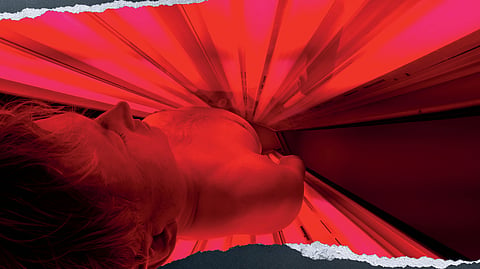
Yet, the run itself is only the opening act. The real theatre of contemporary male wellness isn’t playing out on the pavement. It’s being performed in temperature-controlled rooms across Mumbai, Delhi and Gurugram, in cryotherapy chambers that plunge to minus 110 degrees, in infrared saunas said to aid cellular repair, in ice baths where executives sit shivering beside weekend cricketers, all chasing the same elusive quarry: optimisation.
Welcome to the age of recovery culture, where rest has become a competitive sport.
A decade ago, the Indian fitness story was comparatively uncomplicated. Men lifted. Men ran. Men pushed through discomfort. The governing logic was straightforward—no pain, no gain. It’s a popular phrase that can be traced back to Sophocles’ idea of virtue being forged through endurance to the aerobics boom of the 1980s, when Jane Fonda helped carry it into modern fitness culture. Few places, however, have embraced its logic as instinctively as India.
In a society already comfortable equating effort with hardship, the idea translated easily. Rest has rarely been a part of the Indian lexicon, especially for men. Masculinity has long been measured in thresholds of tolerance, which means that recovery hasn’t truly registered as a practice all these years. At most, it has meant downing a protein shake taking the Sunday off. Today, that old rulebook is getting shredded.
The urban male has discovered that the body is not merely a machine to be flogged into submission, but an intricate system requiring maintenance and repose, or therapies borrowed from elite sport. Cryotherapy, red-light therapy, hyperbaric oxygen chambers, ice baths: these are no longer the exclusive tools of cricketers and Olympic medallists. They have migrated from training facilities to wellness centers, from physio clinics to luxury hotels, including the recently opened Fairmont Mumbai, which has India’s first luxury longevity suite called BluXone.

For those unfamiliar with the gadgets and gizmos of modern recovery: cryotherapy exposes the body to extreme cold; red-light therapy bathes cells in targeted wavelengths; infrared saunas send heat deep into tissues; hyperbaric oxygen chambers flood the blood with oxygen; and ice baths, of course, immerse you in cold. Each promises measurable effects; less inflammation, better circulation, faster muscle repair.
Even so then, the hovering question over this cold, redlit landscape is whether this represents genuine wellness evolution or simply a new arena for performance anxiety repackaged as self-care. Rest has gone from being a day off workout and letting the body recover—to plain inactivity.
When Mira Kapoor, founder of Dhun Wellness in Mumbai, launched the centre for holistic healing and wellness, she anticipated curiosity from men.
But they came in asking sharper questions. “They looked for measurable outcomes and thinking in terms of optimisation rather than indulgence,” she says.
In fact, the men walking through her doors often come in spouting performance jargon. “There’s a growing awareness of stress, hormones... even emotional bandwidth. Many are also seeking structure, such as protocols that give them a sense of control over how they feel and function,” she adds.
In times where volatile work schedules and tyrannical algorithms make so much seem ungovernable, the body seems to be among the few domains where control seems plausible.
Recovery culture fits neatly into that possibility. Wearables translate fatigue into numbers, right from heart-rate variability, to sleep scores, while cold plunges, red-light therapy and cryotherapy promise a way to intervene in those metrics that feel daunting.
But not everyone is convinced that the ice bath revolution represents unalloyed progress. Sohrab Khushrushahi, founder of SOHFIT and one of Mumbai’s favourite trainers, has tried every modality the wellness industry has to offer. And the verdict is blunt.
“[These are] great sources of recovery, if you have access to them regularly,” he says. “But my point is, first get your sleep right. We’ll sleep two or three hours, but we’ll get into a hyperbaric oxygen chamber and believe that we’re going to recover.”
For Khushrushahi, the issue is the status economy we have built around them. Sleep—unglamorous, unquantified, stubbornly ordinary sits at the bottom of a ladder topped by elaborate interventions. “All that’s cooler than sleeping, isn’t it? The number of people I’ve seen putting up posts on Instagram about ice baths or plunge pools... I’m like, okay, does it really matter? Do you tell people how much you slept? Do you put a picture of you sleeping? You don’t,” he says.
Some people are fans, though. Karan Sawhney, fitness coach, former professional footballer and founder, The Tribe India, feels that just because it’s trendy doesn’t mean it doesn’t work.
“Athletes do it, right? I don’t think any athlete would submit their body to a trend? So, there’s definitely merit there,” he expands.
That said, for athletes, these modalities were primarily developed as narrowly targeted interventions, deployed after specific workloads, injuries or tournament schedules, often under close physiological monitoring. Stripped of that context and transplanted into the broader wellness market, they begin to acquire a cultural badge that makes them aspirational, no doubt, but also open to interpretation and misuse.
The science, even for those who use these tools day in and day out, is still finding its feet. “Right now, it’s mostly anecdotal,” says Dr. Vaibhav Daga, Head of Sports Science and Rehabilitation at Kokilaben Dhirubhai Ambani Hospital and physiotherapist for the Lucknow Super Giants, when asked about the evidence behind cryo, red-light and infrared therapies. “There are studies coming out, sure, but I haven’t really seen a solid, robust paper yet.”
However, that does not mean the modalities are without promise. Clinical observation, he says, has been encouraging in some areas—particularly red-light therapy. “Unlike cold therapy which numbs the pain, red-light therapy works at the cellular level. The ATP cellular energy production of mitochondria helps muscles repair themselves faster without blunting the growth.”
Neither are the risks entirely negligible. Hypothermia, ice burns and sudden drops in blood pressure are rare but documented possibilities. For people with conditions such as Raynaud’s disease, peripheral neuropathy or significant cardiac issues, cold exposure in particular requires supervision. “It’s always better to begin under professional guidance,” Daga says. “Understand the benefits and the risks of that particular therapy, especially if you have medical history.”
None of this, he is quick to add, means that recovery should remain the preserve of professional athletes. “It is hundred percent required even for non-athletes,” he says. “Everybody today wants to be fit. The fitness culture in our country has grown leaps and bounds from when I started my career in the late ’90s, and it’s only now that people realise fitness isn’t just gym, but a thousand other things too— recovery being one of them,” Daga explains.
What has also changed, though, is the intensity with which ordinary people now approach physical activity. As Vikram Aditya Bhatia, CEO of DriveFitt—a Gurugram-based cricket, fitness and recovery facility co-founded by Shubman Gill and Preity Zinta—puts it, the old distinction between casual play and serious training is blurring fast.
“Gone are the days when we played recreational sports on a weekend,” he says. “Now people do it seven days a week. Some days it’s twice.”
So, then, recovery, as much as it feels like an indulgence, is also more of an injury prevention tactic. “If you want to sustain that kind of activity and avoid injuries, preparation and recovery have to be essential parts of the routine,” Bhatia explains.
“People aren’t just chasing performance for sport,” he says. “Parents want to keep up with their kids on annual sports days. Officegoers want to make it through the week without feeling wrecked. Being fit isn’t about medals anymore, it’s about staying on your feet, whatever your day throws at you.”
At the individual level, that logic often reveals itself through trial and routine rather than theory or trend. Vivek Keshari, a fashion and lifestyle influencer, encountered it almost experimentally. The first time the 25-year-old stepped into an ice bath after an intense leg workout, curiosity outweighed conviction. “I wasn’t sure if it would actually make a difference,” he admits. “But after doing it a few times, you start noticing that your body feels less sore.”
When he posts these routines online, the reaction tends to be immediate. “A lot of curiosity,” he says. “People are really interested in knowing if it actually works or if it’s just another trend they’re seeing online.”
Talking about social media, Bhatia mentions how these narratives make it seem like recovery exists in solitude, but truth is—it can’t.
Recovery, properly understood, sits between what he calls priming—preparing the body for training—and the training itself. “People are priming themselves to train, then training hard and then recovering from that training to again prime themselves and train.”
He also points to a looming health crisis that makes recovery relevant beyond the gym and photo dumps: musculoskeletal disorder. “The fastest-growing epidemic in the world,” he notes, stemming from decades of sedentary, screen-bound life. “We’ve now spent twenty years with a curved spine, looking at a phone and using our thumbs.”
Essentially, the urban body is accumulating strain long before any workout begins.
Taken seriously, that observation reframes the entire recovery conversation. What looks like a new wellness fixation begins to resemble a practical response to the physical conditions of contemporary life. “It does the work of restoring mobility, circulation and tissue health after hours of sedentary stress,” says Daga. Strength training may build muscle to fight the disorder, but recovery becomes the counterbalance, says Bhatia, a former tennis player.
Yet, the counterbalance does come with its own contradictions. Recovery culture, for all its emphasis on slowing down, remains embedded in the logic of optimisation. Rest is not an end in itself but a means to better performance.
In the end, the story isn’t just about ice baths or red lights. It’s about how the modern urban male measures strength: not just in muscle anymore, but in willpower, consistency and the discipline to pause without losing momentum. The Indian man is finally putting conscious effort into taking care of his body, and trend or not, it’s that intent that makes it sexy.
To read more stories from Esquire India's July 2026 issue, pick up a copy of the magazine from your nearest newspaper stand or bookstore. Or click here to subscribe to the magazine.