
- Entertainment
- Style
- Lifestyle
- Food & Drinks
- Tech & Auto
- Culture

There is a man buried inside the Bara Imambara in Lucknow — the very monument he commissioned — who is responsible for the finest thing you will ever put in your mouth. His name was Asaf-ud-Daula, fourth Nawab of Awadh. He was, by all accounts, a man who loved to eat and saw no reason to stop.
It’s often said that his royal kitchen ran on a collection of 150 different spices, with chefs under orders to produce a new variety of kebab every single day. Not because there was a shortage of old ones, but I mean, he was a king, so who cares? This was Lucknow in the late 18th century — a city that that loved excessiveness, where the Persian refinement of the Mughal courts had curdled, beautifully, into something entirely its own.
Then the Nawab lost his teeth!
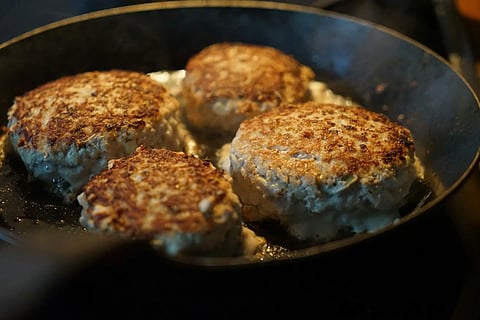
By his early forties, the overindulgences had caught up with him. He could no longer chew, but nobody was going to tell the Nawab he couldn't have his kebabs. So his cooks — motivated by devotion, terror, or some combination of the two — got to work. They finely minced the meat into a paste, tenderised it with raw papaya, packed it with spice, and shallow-fried it in ghee until it held just enough shape to be called a kebab.
They called it galouti.
The recipe was later perfected by a one-armed cook named Haji Murad Ali — tunday in Urdu, meaning one-handed — who introduced fat into the mix and made ghee-basted cooking the standard. He secured royal patronage, and in 1905, opened Tunday Kababi in Aminabad, Lucknow. In September 2023, Taste Atlas ranked it among the seven most legendary restaurants in the world. The original recipe, all 160-odd spices of it, still remains a family secret.
Where to find the best galouti kebabs
DELHI
Karim's, Jama Masjid
Gulati, Pandara Road
Qureshi Kabab Corner
Al Kauser
MUMBAI
Dum Pukht, ITC Maratha
Kangan, Westin Mumbai Garden City
Lucknow Yari Road
Pali Bhavan, Bandra