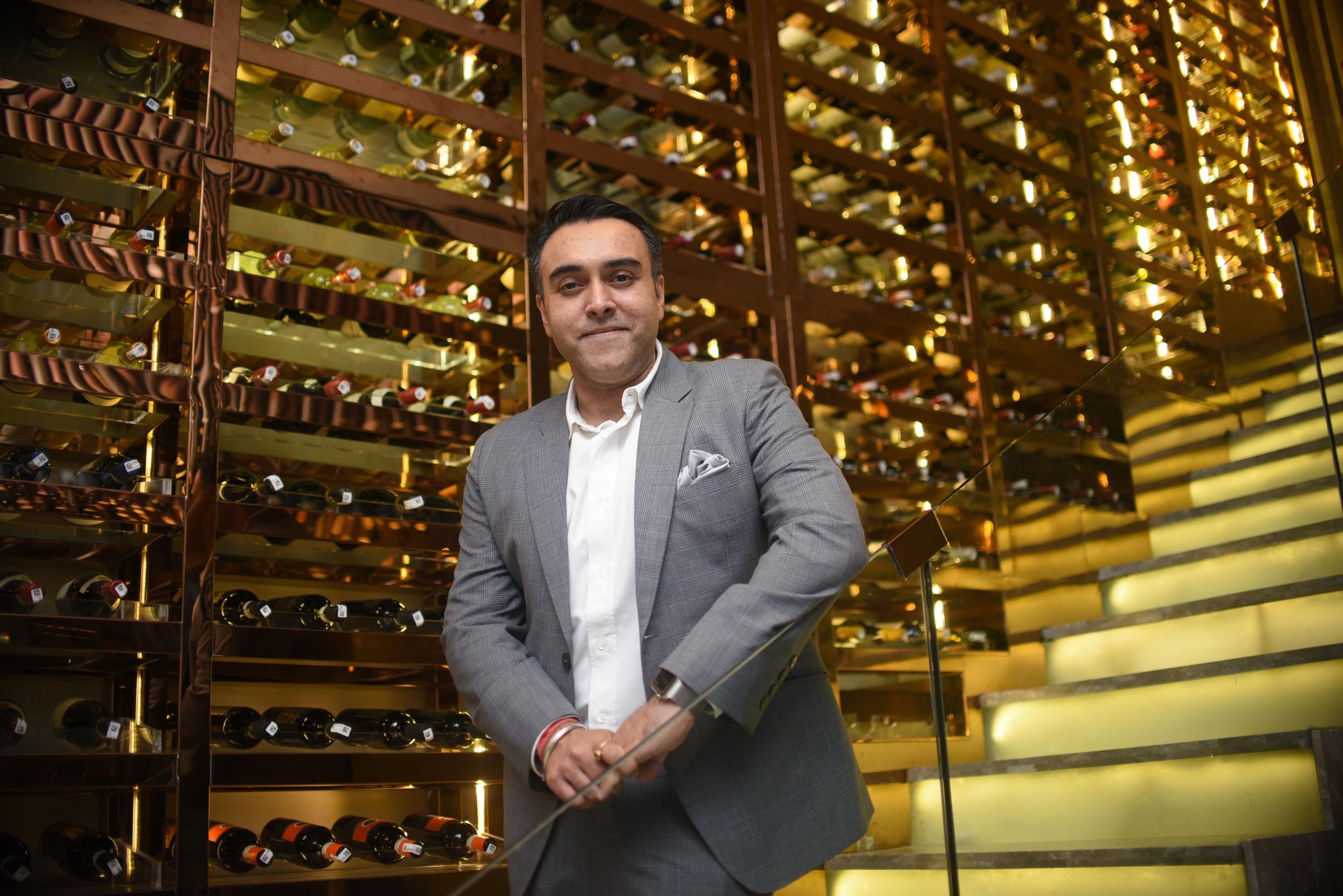
Zorawar Kalra Wants Indian Cuisine Everywhere
Restaurants, bars, burgers, speakeasies — Zorawar Kalra’s plate is full. And he’s just getting started
In the theatrical, high-stakes world of Indian hospitality — where a new bar opens every weekend and fusion food is both trend and trap — Zorawar Kalra doesn’t just play the game. He changes it. Over the last decade, the Delhi-born restaurateur has turned disruption into a dining philosophy, building a food empire that’s as culturally bold as it is commercially sharp. Farzi Café, Masala Library, Bo Tai, Louis Burger — each one a middle finger to convention.
But legacy hangs heavy. Kalra is the son of Jiggs Kalra, the man once dubbed the “Czar of Indian Cuisine” — a larger-than-life figure who introduced the world to the nuance of galauti kebabs and the poetry of regional thalis long before “culinary diplomacy” became a buzzword. And his son? He didn’t just inherit the kitchen — he inherited the mission. To put Indian cuisine at the centre of the global table.
“He [Jiggs] wasn’t just a fan,” Kalra says in an exclusive chat with Esquire India. “He was a crusader.”
Today, with Massive Restaurants operating 26 brands across eight countries, Kalra’s ambition has only gotten sharper. He’s not chasing stars — he’s building scale. In a chat on a sunny Monday afternoon, Zorawar and I discuss the rules of fine dining, democratising “haute”, and members-only cocktail dens in Qutub.
Excerpts from a conversation.
Let’s start from the beginning. Growing up with Jiggs Kalra as your father — what kind of lessons stuck with you? Was it something you were trained in, or did it just seep in naturally over the years?
You can’t force something onto a child — only nurture it. And that’s what my father did. Like most kids, I was fascinated by my dad’s world. His presence was larger-than-life. He worked with the best hotels in the world, building iconic restaurants — but never owned them. That always bothered me. He’d pour everything into a space, and then walk away.
He wasn’t just a fan of Indian food — he was its fiercest crusader. He believed it belonged at the top of the global food chain, and he dedicated his life to that belief. Through him, I came to see what Indian cuisine truly is: vast, intricate, unmatched. The way we use vegetables, spices, grains — nobody else even comes close. That diversity is our edge.
That’s what I inherited. Not a business, but a fire. He lit it — with food festivals, writing, travel — and I knew, even before my teens, that this was my path. Not because he told me to, but because I couldn’t do anything else. Even when I was doing my MBA in Boston, the plan was never corporate America. It was always to return and build something of scale. I came back around 2004–05 and launched Punjab Grill. Then I started Massive Restaurants. Today, every brand under it is an extension of the same mission. Profit isn’t the goal — that’s a by-product. What drives us is making Indian food unmissable. In New York, London, Dubai — we want Indian cuisine to be not just an option, but the option. One of the top three restaurants in any global city. That’s the legacy. That’s the fire.
You’ve been talking about putting it on the global palate—but more often than not, it’s still viewed through a very traditional lens internationally. Do you think that perception has shifted?
Yeah, back in the day, the perception was awful. My father used to get really upset about it. People thought Indian food was monotonous—just three gravies in rotation—and they’d reduce it to this one-note curry stereotype. You had British ladies showing off their turmeric-stained fingernails like badges—“Oh, we had curry last night!” That kind of superficial exoticism drove him nuts.
Now, we’ve started to take that narrative back. We’ve reclaimed the cuisine. My father was one of the first to start that shift. He travelled, wrote, hosted food festivals—he made it his mission to show the world what Indian food actually is. Today, there are chefs and restaurateurs across the globe continuing that legacy, and I think we’ve made major strides. But yeah, the earlier perception? Terrible.
Coming to Massive—there’s no denying it’s a full-blown food empire now. But when you first started ZK Gourmet Concepts back in 2006, did you have any idea of the scale you’d eventually reach?
Honestly? That was always the goal. Might sound pompous, but that’s what “Massive” stands for. The name isn’t an accident.
My MBA drilled one key thing into me—never think boutique, always think scale. And I already had that mindset. I wanted to build something that could have reach, influence, and impact. Because you can’t talk about putting Indian food on the global map if you’re just running two restaurants. You need energy, capital, vision—it takes serious momentum.
Did I know I’d reach here? No. But was that the intention? Absolutely. And even now, I feel like we’re just getting started. The goalpost keeps moving—we hit one, we move it further. That’s what keeps things exciting. You can’t ever get too comfortable in this industry.
And speaking of this industry—India is overflowing with new restaurants and bars every week. It’s a noisy space. How do you keep cutting through?
You said it earlier—innovation is the only way. That’s been our North Star since day one. I’ve never believed in walking a path that already exists. We’ve always carved our own.
When we launched Punjab Grill, nothing like it existed at the time. Same with Masala Library—it introduced molecular gastronomy to Indian cuisine. Even Pa Pa Ya—we brought sushi to Mumbai outside of five-star hotels for the first time. We made playful Asian cuisine cool and mainstream. People forget, but in 2015, that was radical. Then came Louis Burger—we created the country’s first true gourmet burger delivery concept. Again, another first.
So yeah, the innovation never stops. In this business, you’re only as good as your last meal. People talk about fast fashion needing constant reinvention—but restaurants are even more demanding. If we don’t evolve every six months, we’re irrelevant. Every brand we’ve built—Bo Tai, Papaya, Masala Library, Louis Burger, Farzi—has been about pushing the envelope.
But sticking to the theme of innovation—let’s talk about Mamma Killa. Where did that idea come from? And it’s a members-only bar?
So whenever we build a concept, it always comes from the question: Where would we want to go ourselves? What’s missing in the city? How do we plug that gap?
With Mamma Killa, we asked ourselves—where can you get a truly high-quality cocktail experience in Delhi? And not just any cocktail bar—but an exclusive, culturally rich space where the people in the room bring value. That’s where the idea started.
It’s a members-only bar, yes, but not the traditional kind. We don’t charge a fee. Instead, we curate the list. We want to bring in people who’ve added something meaningful to the city—entrepreneurs, creatives, tastemakers. And the cocktails? Every single one tells a story. They’re detailed, high-engagement drinks—the team lives and breathes what they’re serving.
That sounds wild. So this sits above Swan, right?
Yeah. Swan is open to everyone—it’s fully democratic. But Mamma Killa, which is upstairs, is a niche, curated space. Small, intimate—only about 30 to 40 seats—with one of the best views of the Qutub Minar. You’ve got a dedicated server per table, bartenders who’ve been trained intensively, and a deeply nuanced, cocktail-forward menu. And yes, there’s food—it’s what we’re known for—but this place is all about the drinks.
Do you think this is the boldest concept you’ve launched yet?
Every single thing I’ve done has been bold, honestly. Even the Louis Burgers—we’ve sold burgers at ₹900–999, which people thought was ridiculous when we started. Farzi Café had foie gras on the menu when it was legal. The space had a French bistro vibe, but served Indian food with high-energy vibes and music as an essential part of the concept.
With Mamma Killa, yes—it’s a commercially risky model. Any time you limit access, you’re narrowing your market. But we’ve built it on top of a successful restaurant, so there’s a cushion. That gives us room to take these creative, curated risks.
That balance between being a dreamer and being business-minded—how do you maintain it?
It’s hard. I have a thousand ideas a day—every morning feels like I’m a kid in a candy store. I genuinely struggle to switch my brain off at night. Sometimes I need to take an Alprax just to fall asleep. [laughs]
But here’s the thing: everyone has ideas. The key is execution. You have to filter them, be sensible, and show restraint. That’s the real secret. I might have ten great concepts in a day—but if I launched all ten, half would fail. You can’t fight a war on ten fronts. One or two—max.
But do you ever feel like you’re burning out?
Sometimes, yeah. But I’ve learned that a two-day break works wonders. No phone, no emails—just two days in a forest, or by the sea. That’s all I need. And then I’m back, fully recharged.
But sure, I’ve had those moments. I’ve thought, What am I doing? If I were in tech, I might be worth $10 billion by now. The return on effort is way higher in other industries. But this is the path I chose. I love it. It’s deeply fulfilling, and I feel like I’m contributing something meaningful to society.
You’ve said before—you don’t follow trends, you create them. What can we expect next?
We’ve got some really exciting things coming.
Farsi Café just opened in New York to a fantastic reception—and we’re going to go all in with marketing. Our cloud kitchen business is also booming. It’s become a major revenue driver, with better capital efficiency than restaurants. So, that’s our focus.
But look—restaurants and bars are in our DNA. They’re not going anywhere. They’re the last bastion of true human connection in an increasingly digital world. So we’re still going to build spaces that speak to Gen Z, Gen Alpha. And India is the place to do it. By 2030, we’ll have the world’s largest urban consumer base—around 900 million people. That’s three times the U.S. population!