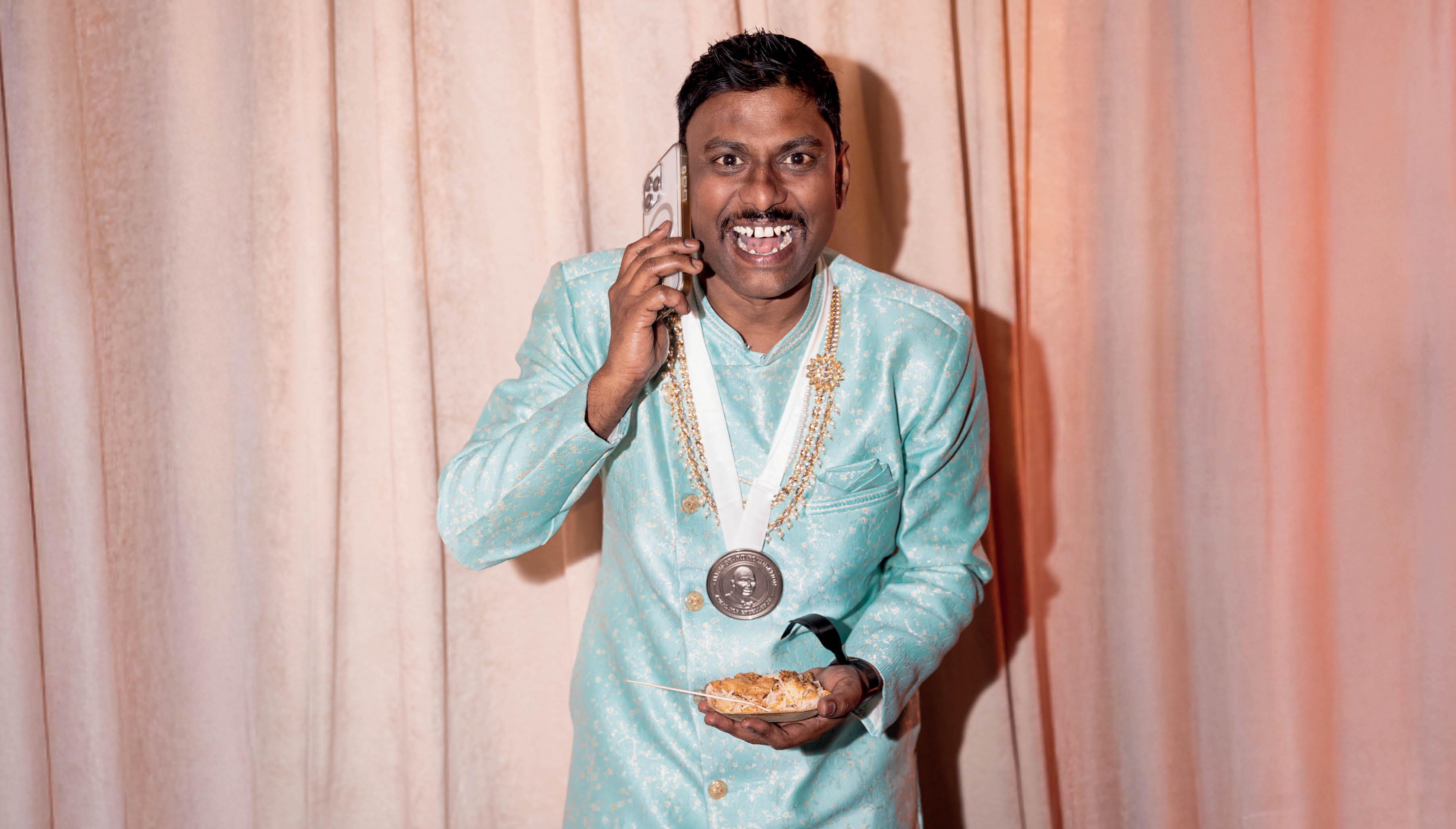
For Chef Vijay Kumar, Safe Was Never On The Menu
How James Beard Award-winning chef Vijay Kumar of Semma, New York, bet big—and won
A WISE MAN ONCE SAID: “WITH ALL of my restaurant experience I have come to learn one thing... There are great restaurants, good restaurants and poor restaurants, but no restaurant is better than the performance you can exact from it by knowing the chef.”
That man was culinary legend James Beard, and we’re taking his word for it as we turn our attention to the man behind one of today’s most talked-about restaurants: Semma, in New York’s East Village. Incidentally, the star of the show, Chef Vijay Kumar, just won the James Beard Award for Best Chef in New York State.
The win comes on the back of several accolades for the four-year-old restaurant, including a Michelin star (retained for a third consecutive year) and being named the Best Restaurant in New York by The New York Times. It’s been a whirlwind for the team, and maybe that explains why Kumar still carries the wide-eyed wonder of someone racing to catch up. His beaming smile does a good job of masking the weariness that comes from back-to-back interviews. His verbosity is oddly endearing, especially when he admits he was a shy child and still keeps his circle limited to close friends and family.
According to Beard, knowing the chef can only make your experience of a restaurant better. So, what do we already know about Kumar? He grew up in the small village of Natham, in the Dindigul district of Tamil Nadu, with big dreams. He’s also someone who’s willing to risk it all—pursuing a culinary degree (from the State Institute of Hotel Management in Tiruchirappalli) despite having the grades but not the funds to study engineering or medicine; quitting a five-star hotel job to join the Merchant Navy; hopping off the ship to move to America; and then driving cross-country from Los Angeles to New York with all his possessions to create a menu drawn from his family table—one that, in its own way, takes him back home.
During his chat with Esquire India, we learn there’s a lot Kumar draws on from those early years helping his mum on her trips to the market. “She’s a perfectionist,” he says. “Take the okra—she’d break it to make sure it’s good and young. Same with the meat—she literally chooses the goat. If the fish is dead, she’s like, ‘No.’” He believes he’s inherited that same streak of perfectionism. “Roni [Mazumdar] makes fun of me, says I have OCD because I need certain things a certain way.” Kumar credits his need for order, be it consistency in recipes, picking quality ingredients and precision in execution, to his mum’s example.
He had been searching for a kitchen where that kind of authenticity was possible when he landed in America. “In my previous jobs, I was cooking South Indian food—but it was contemporary South Indian food. For example, you'd use Californian vegetables like sunchoke [Jerusalem artichoke], artichoke, asparagus,” he says, pointing out how not using familiar ingredients like drumsticks, or adapting the spice palate, changes the taste entirely. “We also don’t de-bone the meat or fish—you eat it with the bone to get all the flavour,” he adds, admitting he often felt a disconnect trying to fit into someone else’s mould.
THAT’S WHY MEETING MAZUMDAR AND Chintan Pandya of Unapologetic Foods felt like fate. The duo were racking up accolades for serving real Indian food in Dhamaka and Adda. “I happened to congratulate them [for Dhamaka being honoured] because we have common friends, and we casually joked about how there’s no good authentic South Indian food in New York,” Kumar recalls. “A casual conversation became a serious one... it was destiny.”
Pulled towards the dishes he grew up eating, he felt a responsibility to share them with the world. “It’s funny—here, when you say you’re Indian, the next question is, ‘Are you a tech guy?’ And if you say you’re a chef, it’s, ‘Can you cook butter chicken?’” he says. “It’s a myth—not all Indians have to be tech guys, and not all Indian food has to be butter
chicken. I just want to change those perceptions. I don’t know if I can change anything single-handedly, but someone has to start. So why not me?”
The Tamil Nadu-inspired menu at Semma, crafted by Kumar, spans the familiar (sprouted bean salad, mirchi ka salan) to the underrated (Nathai Pirattal, snails in ginger-tamarind, and Kudal Varuval, goat intestines spiced with garam masala). These dishes may be elevated from Kumar’s childhood kitchen, but there’s no compromise on flavour. “A lot of these dishes are forgotten in parts of urban India, or dismissed as poor people’s food, but they’re being eaten in villages,” he says of these age-old recipes at Semma that now tick all the right boxes: sustainable, organic, natural. More than that, they touch people’s hearts. “Guests say the food is not only delicious, but that it took them back to memories of their mother.”
Kumar admits it can be challenging to coax diners into trying the snails: “I’ve seen the hesitation on their faces—how to eat snails? But once they do, they order it again and again. So it’s just a matter of introducing them to it. I think we need to come out of the comfort zone of just saying, ‘Let’s go eat dosas.’ There’s really good food out there—I just want more people to try it.”
Speaking of the undisputed hero on the menu—the Gunpowder Dosa—Kumar credits its popularity not just to its perfectly judged texture (soft underneath, crisp on top), but to something more elusive. “If you ask me what the secret is, I’d say I put extra love,” he says with a grin. Which is not to say, he can’t hold a grudge. “People ask, ‘Why is it $20 for a dosa?’ They’d
happily pay $40 for a tiny plate of pasta. And I don’t mean any disrespect to other cuisines, but I don’t like that double standard. I tell them—look at how many components this has!”
Whether in his cooking or his spirit, there’s a certain heat to Kumar. And yet, when he’s not in the kitchen (which is rare—he works six days a week), you’ll find him at a neighbourhood restaurant (Don Angie for the Italian), or on a long drive, surrounded by nature. “Watching the water, listening to Ilaiyaraaja…it brings me back, especially on rough days,” says the chef, who hasn’t returned to India in over five years.
Ambition may have taken the boy out of Natham. But Natham never quite left the boy.
To read more stories from Esquire India's August 2025 issue, pick up a copy of the magazine from your nearest newspaper stand or bookstore. Or click here to subscribe to the magazine.