Turn Down The Kitchen Heat
How a new generation of chefs is dialling back testosterone and toxicity, creating kitchens defined by respect, empathy and a shared love of cooking
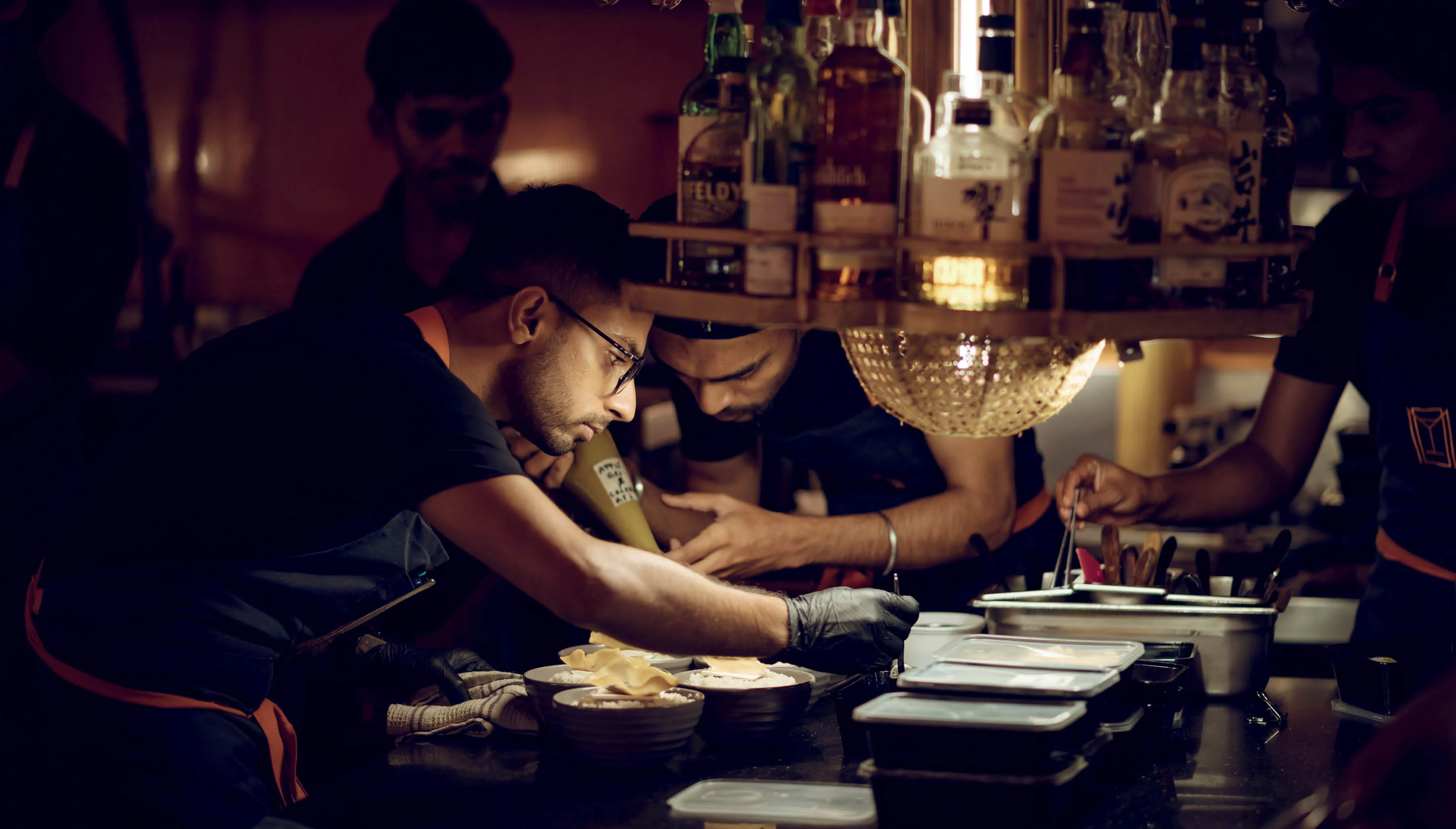
Every week, Chef Madhav Dayal sits down with each member of his team—one on one. He asks how they're doing, what they think is broken, what they'd fix. Then—and this is the part that would make a traditional head chef choke on his demi-glace—he asks them to review everyone else on the team (including himself). “Having empathy for your teammates is very important… whether it’s gossip, ego, drama, I write it all down,” says the 29-year-old chef who runs Miguel’s, a 25-seater bistro in Goa. “If more than two people have spoken about something, it’s a genuine concern that needs to be brought up and fixed.”
It is, by any measure, an unusual management practice for a professional kitchen. It is also, Dayal would argue, simply what running a good one requires.
For anyone who has spent time in a professional kitchen, or watched enough Hell’s Kitchen to think they have, this is not how it's supposed to work. The kitchen, as it has lived in cultural imagination for decades, is a place of hierarchy, heat, and a very particular kind of chaos (The Bear, yes). You don't ask the line cook for feedback, you just tell him to move faster.
That version of the kitchen has a long and storied mythology, amplified by Gordon Ramsay, who turned screaming into primetime entertainment, and given literary credibility by Anthony Bourdain, who made the brigade system sound like a rite of passage. It found its most celebrated real-world form at Noma, where revered chef René Redzepi stepped down amid allegations from former staff of years of physical and psychological abuse.
As a global reckoning unfolded, a shift has already been underway in India: a new generation of chefs, like Dayal, reshaping what it means to hold the pass. Trained in the old system—hierarchical, male-dominated and fuelled by performative toughness—they are now rejecting it.
Thirty-year-old Chef Vishesh Jawarani runs JSan, an Izakaya-inspired fifty-seater restaurant in Goa. Trained at the Culinary Institute of America and having worked at Michelin-starred restaurants in New York, he watched a particular style of toxicity travel down a kitchen hierarchy with the fidelity of a handed-down recipe. “You’re doing 150 covers, you’re slammed during service and every mistake is essentially berated,” Jawarani recalls of a Chef de Cuisine (CDC) he once worked under. “You could tell it had translated from him—the same toxic behaviour he ran his kitchen with.”
For Dayal, a culinary arts graduate from Switzerland, a turning point came during his internship at the Michelin-starred Gaggan in Bangkok, where a sous-chef had a habit of waiting, almost predatorily, for mistakes to happen. “It started to feel like I was always being watched, which made things creepy and unsettling,” he says. “I was constantly working in fear.” During one service, Dayal packed a set of siphon-made idlis incorrectly. The sous-chef called him out in front of the entire kitchen. “He made me cry,” Dayal says. “And while I was tearing up, I kept plating.”
He reflects on it now with clarity: “Any form of aggression or ego will only prevent that from happening”—that being teaching, and drawing out the best in a kitchen team. Jawarani found proof of that at Mari, a Michelin-starred Korean restaurant in New York, where the culture was the inverse of what he’d known. “When you have the guy on top of you constantly encouraging you, pushing you to create, but not berating you for mistakes—asking you to figure out where you went wrong, looking at it in a very analytical way—it changes your outlook towards how a kitchen should be run.” The standards could be just as high, the food just as serious. The cruelty, it turned out, had never been the key ingredient.
So, what does the new kitchen actually look like?
At Jsan, Jawarani’s non-negotiables are stated simply: greet everyone when you arrive, say goodbye when you leave, keep the kitchen clean, no abuse, no walking out mid-service. “It's not ‘I’m your boss and you work for me,’” he says. “We all work together.” Anyone on the team can develop a recipe; if it’s good enough, it goes on the menu. The result is a kitchen where people treat the work as their own, because functionally it is.
Dayal runs Miguel's on a similar philosophy of shared ownership — no rigid hierarchy, but a clear process that everyone follows, open to challenge outside of service hours. “There are millions of ways to make the same sauce,” he says, “but we have a process here and this process has to be followed because it’s what we've found works best. If you don’t agree with it, we can pick it up and fix it —but not in the middle of service.”
Building this kind of culture, though, requires vigilance against the forces that erode it and chief among them, Dayal says, is ego. As restaurants gain recognition, he’s noticed, the team’s sense of itself can inflate with it. His answer is structural: departmental rotations, moving people from kitchen to bar to front of house, so that everyone periodically becomes the new person again. “The day you think you know everything is the day you start going down,” he says. “Because it is an endless learning curve.”
Communication, not fear, is the new currency of the kitchen. But as Chef Niyati Rao points out, even that has limits. “The first time, someone explains what needs to be done and why,” says the 29-year-old cofounder of Ekaa, KMC and Bombay Daak. “You make a mistake once, calmness. Twice, calmness. The third time? There’s no calmness. You don’t deserve calmness.”
Rao trained through the management programme at the Taj — 4.30am starts, two-and-a-half-hour commutes from Madh Island, 18-hour shifts, a batch of 14 trainees whittled down to six as the rest dropped out. She remembers a head chef who used a toothbrush to redo their work during deep cleans. Her own harshness today is very different from what she experienced then. “I always push the team with reason,” she says. “I’m like, what’s your age? You’re 24. Do you see yourself like this? Do you enjoy seeing yourself like this? You can drink, go out, get married—and you don’t know how to clean a fridge. Are you okay with that? If you’re not, then do it again.”
It is also a different generation in the kitchen, less willing to inherit the old rules unquestioned. “No offence, but this generation is a bunch of namby-pambies,” says Rahul Akerkar, one of India’s most respected chefs and the man behind Indigo, voicing the older generation’s scepticism plainly. “They’re all about work-life balance and yoga.” Rao, however, isn’t jumping on the Gen Z–bashing bandwagon; she simply calls them different. “They are more vocal in their need for work-life balance,” she says, adding, “Some of them tell me, ‘I don’t get time to play tennis.’ And I’m like—how do you even have the energy to play tennis? I need tips from that person.”
Part of what makes this generation of chefs different, too, is what they’re not chasing. The old kitchen ran on a very specific idea of ambition — stars, rankings, the relentless pressure of being the best. “A lot of people are getting to a point where they feel it’s okay if I get a star, it’s okay if I don't,” Jawarani says. “If I lose it, it’s not going to kill me. Because by the end of it, it’s all about the people you're serving. If they know you're going to serve good food and they’re coming back again and again—that’s good enough.”
At the end of it, the one constant across generations is the guest. Dayal describes a video that circulates among restaurant workers on Instagram: a waiter tells a sous-chef a guest wants an eggless omelette; the sous-chef erupts—what the f**k does that mean?—and then a head chef quietly steps in and asks the waiter to find out whether the guest wants whole eggs or just whites. It’s a problem solved in ten seconds. “What that video shows,” Dayal says, “is that your frustration is not going to resolve whatever tension there is. Nothing good can come out of a stressful, aggressive environment. Everything comes out of good intention.”
So yes, the kitchen is changing. Perhaps not everywhere and not fast enough. But in the places where it is, the food, it turns out, is just as good.
To read more such stories from Esquire India's April 2026 issue, pick up a copy of the magazine from your nearest newspaper stand or bookstore. Or click here to subscribe to the magazine.