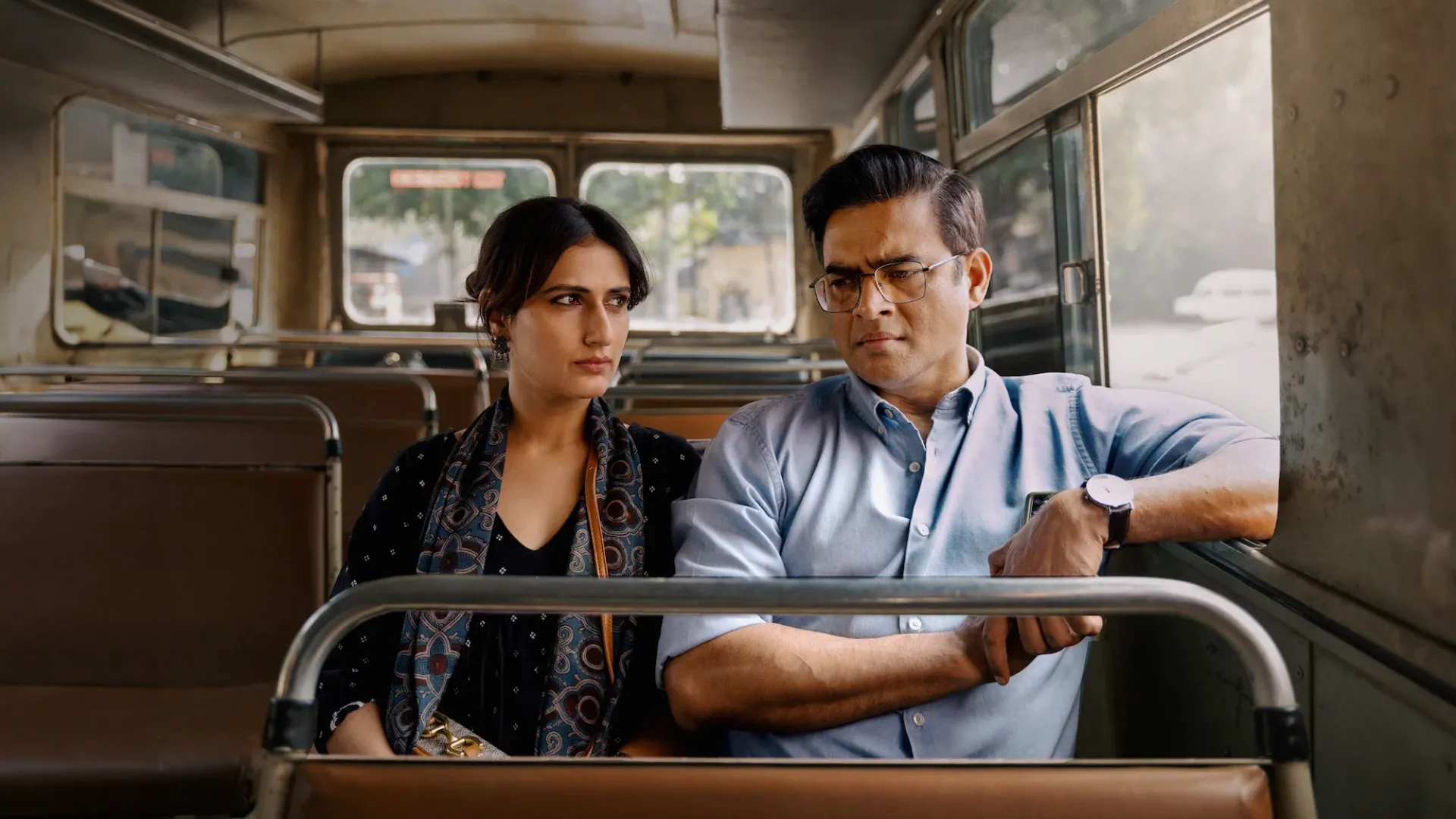
Aap Jaisa Koi Movie Review: The RomCom Wants To Be Iconic But Is It?
The film feels like sparkle on the surface but fades as a replay
There’s a particular kind of anticipation when you set out to make kosha mangsho—the kind of slow-cooked Bengali mutton curry that needs patience, rhythm, and a careful layering of spices. You start with aromatics dancing in mustard oil, add meat that sizzles before being lovingly coated in masalas, then let it simmer, covered, on a low flame.
Time is its secret ingredient. But give it too much time or keep throwing in more spices hoping to “fix” the flavour and what you’re left with is not a delicacy, but a dense, confused mess. The meat goes rubbery. The masala loses definition. The dish, once full of promise, ends up overcooked.
That is the fate of Aap Jaisa Koi, the Netflix original directed by Vivek Soni and starring Fatima Sana Shaikh and R. Madhavan. It begins with intention of exploring the languages of love, the politics of marriage and match-making, and the tightrope between tradition and modernity, old against the new, French against Sanskrit.
But somewhere between the long build-up, scattered subplots, and its desperate desire to say everything, the film loses its balance. Like a kosha mangsho that stayed on the stove too long, it overshoots its emotional climax and winds up underwhelming what could have been a quietly potent story.
At the center of the Dharma Production film co-written by Radhika Anand and Jehan Handa is a thoughtful idea: love is not merely a feeling, but a language—and often, we’re the ones who don’t know how to speak it and worse, come in our own way.
The rom-com tells the story of Shrirenu Tripathi, a 42-year-old Sanskrit teacher from Jamshedpur, and Madhu Bose, a 32-year-old French teacher from Kolkata. They meet through a unique circumstance and develop a deep emotional connection despite being opposites. We're introduced to Shrirenu at a 1998 Christmas party, that forces nostalgic hues of Kuch Kuch Hota Hai and the love story that defined a generation's idea of romance.
But the nostalgic momentum is quickly squandered as young Shrirenu's confession to his crush at the party leads to a rejection and a curse. Now a single and unmarried 42-year-old Sanskrit teacher from Jamshedpur who's struggling to find love and intimacy, he is smitten by Madhu Bose, a 32-year-old French teacher from Kolkata. Through series of romantic songs and a few some questionable stunts on Shrirenu's part, both decide to get married.
The film tries to make itself relevant in pop culture by comparing Shrirenu to Ashok Kumar (older, more handsome and a way to present the 10 year age gap in the film and Madhu's interest in older guy like Shri) and Madhu's beauty to Madhubala since Shrirenu's love for the legendary actress of Hindi cinema is established in a single shot where we are told he has photos of her framed on his wall.
The makers of the film attempt to explore what it means to unlearn the emotional habits we inherit from our families, and how connection can be derailed by fear, control, or ego. But while the rosy start to their love story seems to be promising of a good rom-com to the audiences, the plot becomes bloated with unnecessary diversions that gets in its own way prolonging its expect climax.
Though the visual grammar (the close-ups, the characters looking just off-camera ),the montage fuelled music perfectly infuses the nostalgia of old-school romance and alludes to Soni's style we have seen in his debut work, Aap Jaisa Koi reveals a few hiccups in the very foundations of its construction. The biggest one is the obvious similarity with Dharma productions Alia Bhatt and Ranveer Singh starrer Rocky Aur Ranu Ki Prem Kahan. Romantic lead from a conservative family, unaware of the bounds of patriarchy falls in love with a progressive, liberal Bengali girl.
But where that film leaned into flamboyance and high drama, Aap Jaisa Koi opts for restraint. But the subtlety doesn’t translate into depth, rather it feels diluted, like a masala paste stretched too thin.
The plot inconsistencies starting with an emphasis on establishing the love story mingles with unnecessary subplots that have no payoffs anywhere in the 1 hour 30 min film. Shrirenu's student, for instance, is tasked to unearth information on Madhu. He is sent to her home in Kolkata as her student making a documentary on his favourite French teacher. While Shri and his friend Deepak get the meat they're looking for, we are left wondering what happens to the student and why it is never revealed to her by Shrirenu or her family members when all hell breaks loose.
Moreover, the titular “Aap Jaisa Koi” app, a fictional sex-chat app , is a promising device that could have subverted the gender dynamic or exposed layers in Shri’s performative masculinity. But it fizzles out after functioning briefly as a catalyst for conflict. In its final act, the film retreats into safe, formulaic territory. Even the climax, involving a paint-by-numbers family reunion and pseudo-feminist redemption arc, feels stapled together in post.
Similarly, while R. Madhavan brings a sense of gravitas and age-appropriate weariness to the role, his performance is inconsistently directed. At times, he teeters into Rehnaa Hai Terre Dil Mein territory — brooding, intense, and borderline manipulative— undermining the premise of a repressed academic finally breaking free.
And though Fatima Sana Shaikh, who showed enormous promise in Metro... In Dino, plays her part well, her Madhu finds herself as a flat character who is ultimately redacted to the traditional trope of the forgiving woman when the promise of change is alleged. We are given a sense that her character is meant to be a force of modern, self-aware womanhood yet by the end the film she finds herself choosing between the same two dudes that Celine Song's protagonist did in Materialists.
What’s most frustrating is how Aap Jaisa Koi flirts with socially relevant themes—chauvinism, sexual repression, generational trauma, but pulls back before committing to any real stance. Instead of organically dramatising these tensions, the screenplay literalises everything through overwrought metaphors (a sitar-piano jugalbandi for compatibility?) and dialogue that reads like inspirational tweets and promises that will eventually fall short.
Aap Jaisa Koi wants to be thoughtful, progressive, and tender. It wants to ask questions about love, gender, and tradition. And it could have been all that—if it had just trusted its central flavour and allowed it to simmer slowly, without trying to impress with every spice on the shelf.
You can catch Aap Jaisa Koi on Netflix India.