Tillotama Shome On Morally Ambiguous Characters, Production And Life-Affirming Stories
A fine blend of tenacity and nonchalance is why Tillotama Shome’s an Esquire woman
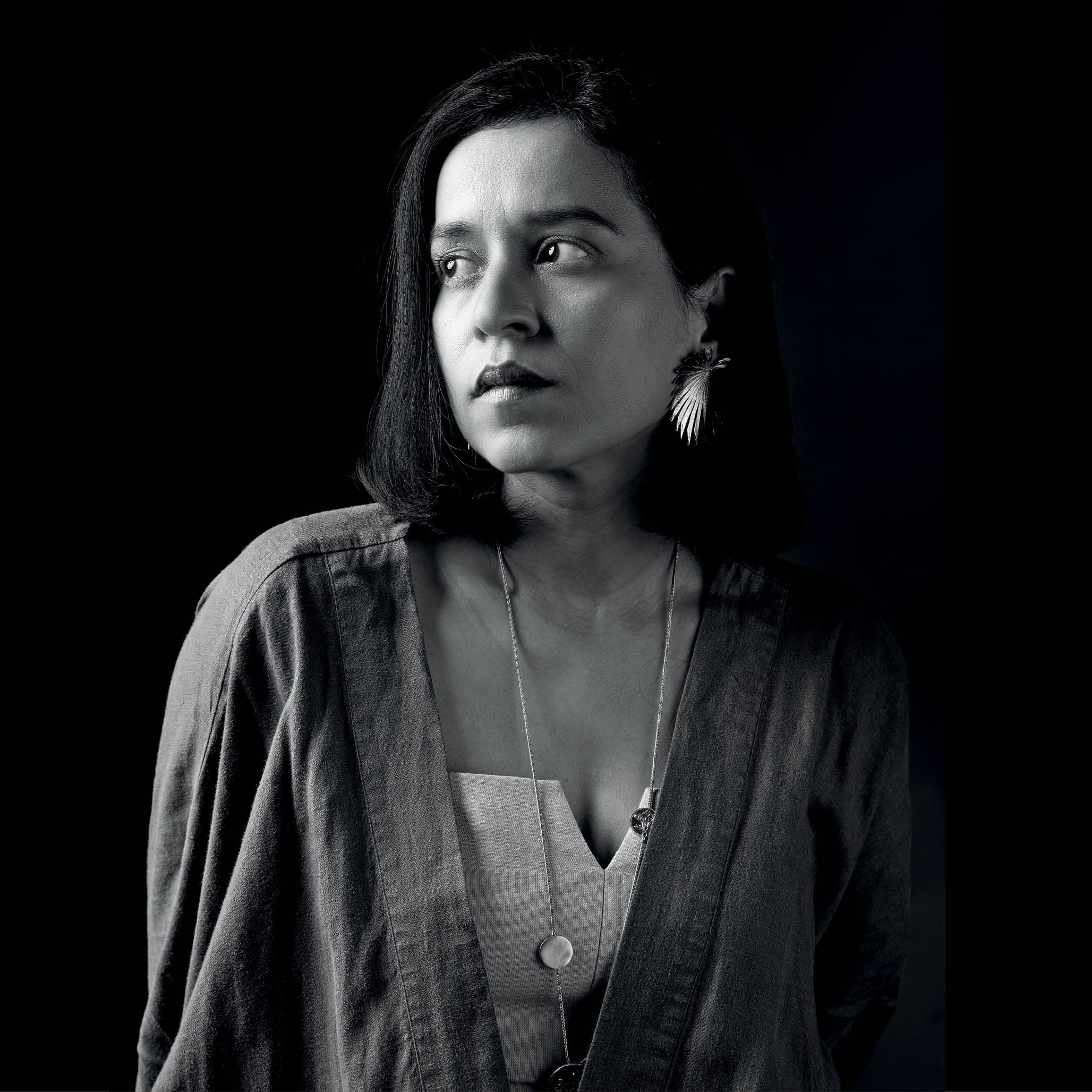
Of all her appeal as a redoubtable performer of our age, perhaps it is her refusal to explain—to be defined one way—that makes Tillotama Shome a woman we love. From tiptoeing into our imagination as the demure Alice of Monsoon Wedding to today, when Baksho Bondi, a film she not only stars in but has also co-produced, premiered to resounding acclaim at the 2025 Berlinale—she has showcased a rare blend of magnetism and panache.
This polyphonous tableau of performances—the domestic help in love, the monstrous serial killer burning with unbridled ambition, the determined police officer with a soft inner life, the resilient sex worker—bristles with a quiet ferocity and minimal pomp. And yet, she just sees it all as the restless search for stories that are life-affirming. This balance of tenacity and nonchalance is why she’s an
Esquire woman—though, fair warning: she isn’t one for straitjackets really.
“One is just grateful to come across a good script—it is so rare, that when one even gets a whiff of it, you run towards it like your life depends on it,” she says. Because, in a way, it does. “We have to sometimes do work to pay the bills, but if the work is bad, it extracts from you your sense of hope.”
Which is why women who don’t fit into neat categories—but are instead “morally ambiguous” and bristling with “inscrutability”—fascinate her. Baksho Bondi, directed by Saumyananda Shahi and Tanushree Das, following the life of a lower-middle-class homemaker managing the burdens of caregiving and working multiple jobs, was one such script. And so, “when something like this comes into your life, you recognise that it is a lifeboat—the rescue—back to hope”, she circles back poetically.
And at Berlinale this year, the world seemed to finally hold all these women up in return. “In the film, there is a [scene] where Maya says, ‘I have to eat, I am human’. To hear a row of German women make deep sounds of approval was very moving,” she recalls. “It was a shared, universal acknowledgement of the invisible labour of women worldwide.”
Surely, onus is the unspoken rule of enterprise. Turning producer with Baksho Bondi, Shome brought to the business the same tenacity that we’ve come to associate with her characters. “With women actors asking for more for themselves both on and off screen, it was a natural way forward. Producers have for the longest time been just men. Our bodies have been used to tell stories, and if you have enough power or popularity, you play characters that have greater agency and prominence in the film,” she observes. “But beyond the fiction of the screen, women have rarely been trusted with power and responsibility.”
Having grown up across the country, the daughter of an Air Force officer, she brings a surprising lived-in intimacy with characters often existing on the fringes of society. And yet, the term “women on the margins” doesn’t sit exactly right with her. Her Baksho Bondi director, Tanushree Das, put it best: “How thick is this margin?” And Shome echoes the sentiment.
“If the margin is so thick, so densely populated by the invisible labour of billions of women, they are no longer the margins and no longer do they deserve to be marginalised,” stresses Shome. “And one day, when the anger sublimates, may there be a host of women who can just laugh, because they are done being angry and tired.”
In the same way that her complex and morally ambiguous parts have bonded her to our admiration of her, the women essayed by Isabelle Huppert have captured her heart “with a delicious sense of uneasiness”, she says, referencing the iconic French actress. “She does not explain her choices as an actor, and that excites me. Why explain everything and kill the opportunity for the audience to bring themselves to the story?”
That philosophy extends to her own life. Her X bio describes her as an “insatiable reader”, and if that’s true, her palate and appetite for the word are just as textured and layered. She recently finished The Firebird by Saikat Majumdar and has now picked up Perineum by Ambarish Satwik. One saw her embroider in Paatal Lok, where she played a hardened police officer who’s also a tender single mother—which is how an actor of Shome’s métier inhabits their character. “Embroidery, long walks, gardening, talking to my plants, meeting the people in my neighbourhood... these things keep me alive in moments when I am paralysed by my overthinking. Living needs time and creativity.
To read more stories from Esquire India's March 2025 issue, pick up a copy of the magazine from your nearest newspaper stand or bookstore. Or click here to subscribe to the magazine.