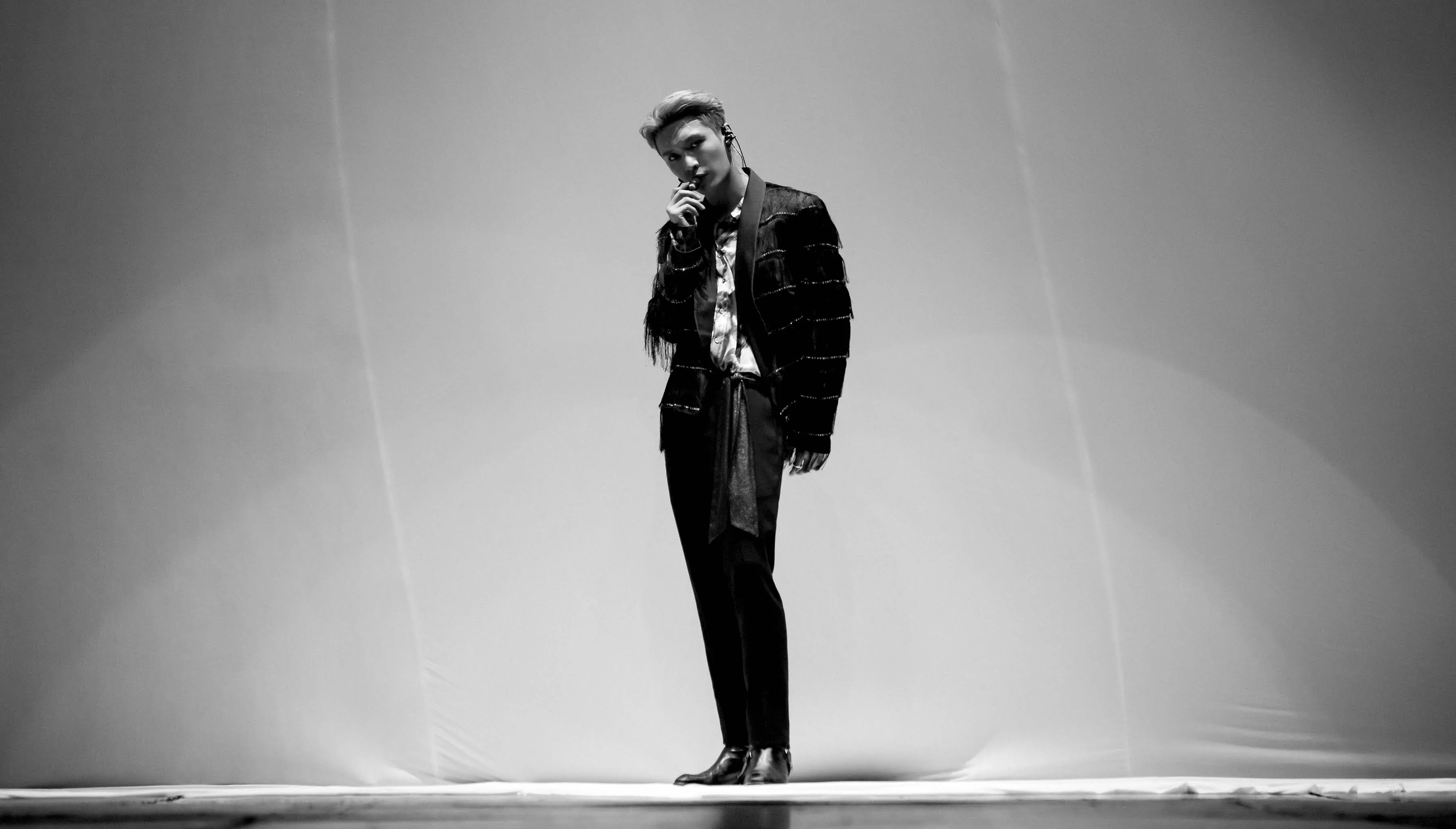
Lay Zhang And The Monkey King Within
The pop icon talks mythology, music, and why self-belief is non-negotiable
The first thing Lay Zhang tells me is that managing his life is “impossible.” He says it lightly, but he means it. We’re speaking in the middle of a schedule that would flatten most mortals: studio sessions, film development, label meetings for Chromosome Entertainment Group, global brand obligations, choreography rehearsals. The 34-year-old sits in his trailer in China as we connect online.
Lay has been famous for nearly half his life — from debuting with Exo in 2012 to becoming one of the first Chinese idols to reverse-export K-pop credibility back into the mainland industry. “It’s a team win,” he says, matter-of-fact.
Privately, though, Lay’s mythology is operatic. His recent conceptual era, “Rock the Heavenly Palace”, pulls straight from Journey to the West. Sun Wukong, the Monkey King, and it’s all reflective of rebellion, power, and restraint.
Lay has always braided traditional Chinese instrumentation into what he calls M-Pop — Mandarin pop spliced with global production — but this was different. When he talks about performing at the Beijing National Stadium — the Bird’s Nest, built for the 2008 Olympics and later used during the 2022 Winter Games — his voice shifts. Nearly 70,000 people attended his show in his home country, in the same arena that once staged opening ceremonies. “That one really means a lot to me,” he says. For a kid from Changsha who was once told he wouldn’t amount to much, it reads less like a concert and more like a true success story.
This year, he says, he wants to show another side — softer, more personal, visually reimagined. The timing tracks. After charting on the Billboard 200 with Namanana, launching international tours like Grand Line, expanding into Hollywood, and steadily building Chromosome into a next-generation talent incubator, Lay is no longer proving he can win. He’s asking what winning costs. Discipline, he says, is non-negotiable. So is self-belief. Doubt has been his long-term co-star.
What’s next in 2026? New music, certainly. Film projects continue to percolate; his recent screen work has ranged from prestige dramas to crime thrillers, with a noticeable tilt toward international expansion.
In an exclusive interview with Esquire India, Lay dives into his journey, what’s next, and why discipline is a non-negotiable for him.
You’re a pop star, an actor, and an entrepreneur. How do you manage it all?
I think it’s actually impossible for me to manage all of that alone. I have a really good partner, and we have a strong partnership. I think success in different territories is always a team win. Yeah, it’s a team. We are a team. Everyone has different responsibilities in different fields. All the guys did an amazing job.
You’ve been in this industry for over a decade now. When you think about your career milestones, are there any favourites?
If you calculate from my childhood, it’s almost 30 years. I would say the Bird’s Nest — the Beijing National Stadium. Almost 70,000 people came to see my show in Beijing. That one really means a lot to me.
The stadium itself is very symbolic. It held the 2008 Olympic Games, and also ceremonies for the 2022 Winter Olympic Games. To be able to perform my own show in that stadium — in China, in Beijing — that was very special for me.
Would you like to perform in Beijing again in the future?
Yeah, absolutely. I will.
Music has obviously been a huge part of your life — from your 2012 debut to your recent solo releases. How has music evolved for you over the years?
Music is like my girlfriend. (laughs) My water, my girlfriend. I cannot live without music. I think a lot of artists have very vulnerable hearts. Sometimes we feel lonely. Sometimes there’s nobody to talk to. Because of how I grew up, I didn’t always feel safe. I always felt like I had to keep learning, keep absorbing new things, keep building my ability — so I could feel stable.
So music is like my girlfriend. When I have a story, or something I want to say, I tell it to music. I say, “Right now, I feel really hurt.”
When I was growing up, there was a lot of judgment. Some family members would say, “This guy will not achieve anything. He cannot be successful.” Even when I debuted — in the Chinese market and in other markets — there were many haters. People judged me. They said, “This guy sucks.” So I just wanted to improve myself and earn real recognition. I’m still on that road. But I will try my best.
Your music is sensational. You became a huge pop star — you proved people wrong. But as you said, the journey isn’t easy. There are good times and bad times. When it gets difficult — when you want to write but it’s not easy — how do you keep yourself going?
Because of the judgment. There are so many haters. I want to respond to those comments and say that I will stand and I will soar. I will throw all the bad things to the sky and rock the heaven. That’s why I created the concept “Rock the Heaven.”
Do you know the game Black Myth: Wukong? Wukong is a character from our traditional mythology — from Journey to the West. He is the Monkey King. He is invincible, powerful, fearless. If he wants, he can destroy everything.
So at that time, I wanted to awaken the Wukong inside my body. To rock my whole life. To show people how powerful I am. But in the past few years, I feel a little different. I think Wukong also has a vulnerable heart. A fragile side. So maybe this year, I want to use music to express another side of Wukong.
What can we expect from you in the coming year? What’s next — music, film, something new?
I want to express another side of Wukong — with a new brand, new visuals, new music. I want people to feel closer to me, more connected to who I am personally. I want to go to different places, to learn, to do something really unique — something that truly represents who I am.
You became famous at a very young age. How has that journey been? Any lessons you’ve learned along the way?
Since I was young, a lot of people doubted me. Even some close family members. So in my situation, there were always suspicions. Not much belief. Because of that, I had to become strong enough myself. That’s why people always ask me, “Why are you so disciplined?”
It’s because if people say you cannot achieve your dream, then you have to build self-discipline. You have to put in effort. Nobody is just born with strong talent and doesn’t need to learn anything. If you don’t work, you cannot achieve. So I made myself disciplined to build my dream and achieve my dream.
When you’re off stage, who is Lay Zhang?
Lay Zhang is a robot. A learning robot. I don’t want to rest too much. I got fame at a very young age. So I think I have to give back to society, to charity. I need to keep improving my capacity and I want to be a good role model for this industry.
A fun question — do you prefer acting or singing?
That’s a really good question. They are totally different territories. As an actor, you cannot be yourself. You have to become the role. But as a singer and producer, you express yourself a lot. You have to know who you are. You need an anchor. So it’s hard to choose. Acting lets me experiment. And I use what I learn from acting — the emotion, the technique, I put it into my music.
Any message for your fans in India?
Oh my gosh. I don’t know how so many Indian fans are still here — waiting for me, supporting me. Hopefully I can come to India and see my fans. I want to bring my new album to the Indian market.
When I go to India, I want to learn yoga, learn more about the culture, stay with you guys, and give you a really good performance. I appreciate it. (Laughs) Namaste, India. What does “Namaste” mean?
It means hello — it’s a respectful greeting, like “I bow to you.”