Zoya Akhtar, Reema Kagti, and Ayesha Sood on the Unscripted Honesty Behind 'In Transit'
In a conversation with Esquire India, the trio talk about representation, building intimacy and rejecting binaries
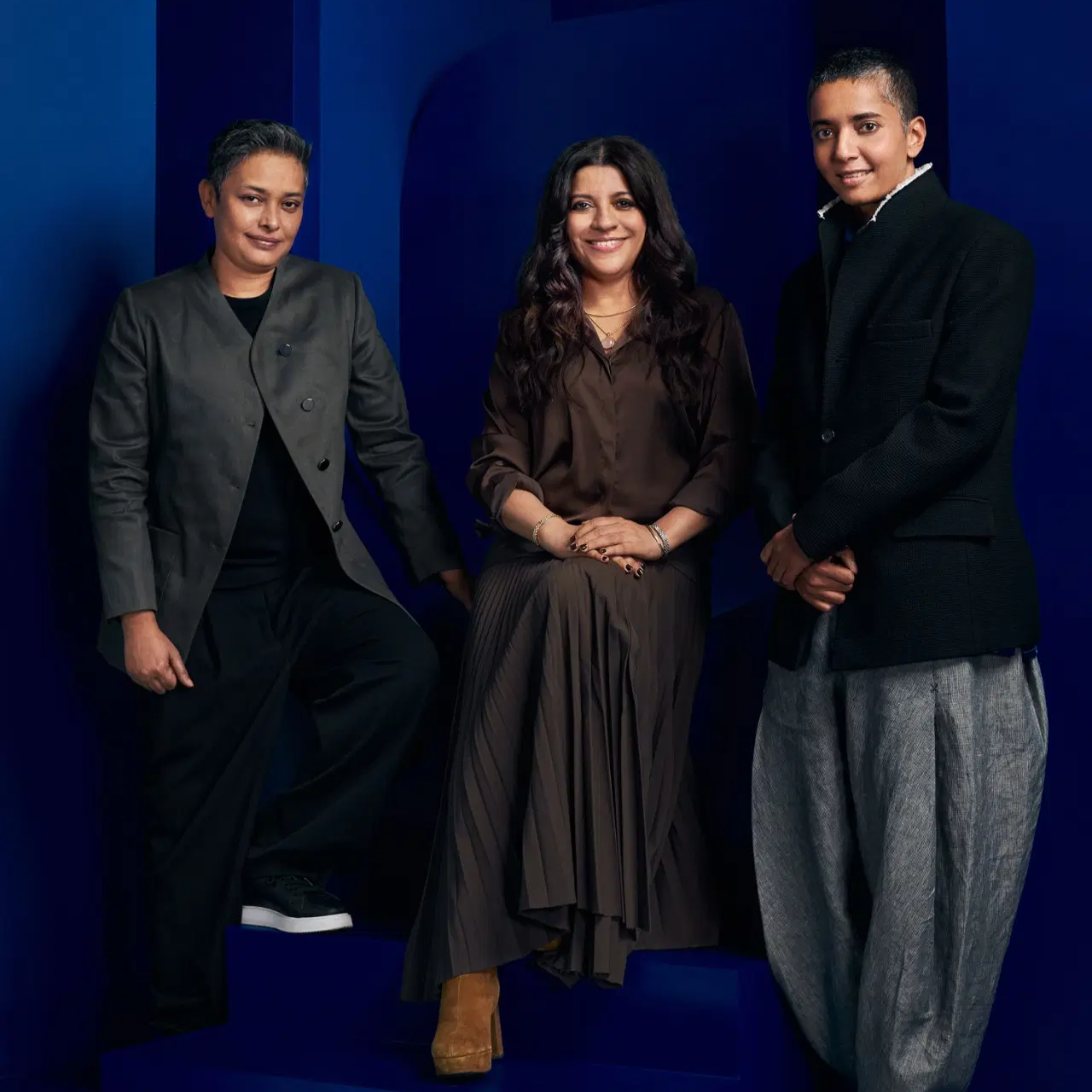
There’s a moment in In Transit—Prime Video’s latest docuseries—where Rumi, a classical vocalist, recalls performing on stage in a sari and feeling like “cockroaches were crawling all over my body.” In another moment, Teena reflects, “Is it really that easy? Can you switch genders whenever you want?” She says it casually, without self-pity. It’s moments like these that makes this show the most important docu-series of the year.
Created by Zoya Akhtar and Reema Kagti’s Tiger Baby, and directed by longtime documentarian and director Ayesha Sood, In Transit is a portrait of nine trans, non-binary, and gender-nonconforming individuals across India—a country still catching up to its own progressive shifts.
But it doesn’t scream that at you. It doesn’t come pre-packaged with educational intent. Instead, it slips into your consciousness like a conversation that starts on a couch and ends four hours later with tears in your throat and something inside you shifted.
A Different Kind of Truth-Telling
For Akhtar and Kagti—titans of Indian storytelling best known for Zindagi Na Milegi Dobara, Gully Boy, and Made in Heaven—this isn’t their usual terrain. In Transit marked a pivot.
“We actually love watching documentaries,” Akhtar tells Esquire. “We’d been thinking of ideas in the unscripted space for a while. Some stories just need to be told this way.” Their entry into the genre began with Angry Young Men, a docuseries on Salim-Javed.
But the seeds of In Transit were planted during Made in Heaven’s second season, while researching the character of Meher Chaudhry, played by trans actress and doctor Trinetra Haldar Gummaraju.
“Those interviews stayed with us,” says Akhtar. “There was just so much depth. We realised very quickly that this couldn’t be a side story. It needed its own space.”
And so, In Transit was born. The series follows four loosely themed episodes—realisation, survival, love, and community—but its power lies in its refusal to force structure on its subjects. Each story unfolds in its own rhythm, its own register. One moment you’re laughing with Patruni, a drag artist with unapologetic flair. The next, you’re watching Saher navigate the aftershocks of a painful transition, or listening to Madhuri describe losing everything for the sari she now wears with pride. None of them are tokens. None of them are tropes. And none of their journeys are straightforward.
“You start to notice it’s not the differences that stay with you,” says Kagti. “It’s the sameness. Everybody wants love. Safety. Family. Dignity.”
The Ayesha Sood Lens
This is Ayesha Sood’s terrain. Having directed some of India’s most acclaimed non-fiction—Indian Predator, Trial by Error: The Aarushi Files—Sood isn’t new to telling difficult stories. But In Transit demanded something different. Less directorial command, more empathetic presence.
“I didn’t go in with a lens of ‘how do we handle this for an Indian audience,’” Sood says. “We weren’t taking a stand. We weren’t being provocative. We were just talking to human beings about their lives.”
“When you have such a diverse bunch of characters, who are you going to take issue with?” she shrugs. “We’re just letting people be.”
It’s this restraint that makes In Transit radical. The people on screen aren’t symbols. They’re not framed as “brave” or “damaged” or “inspirational.” They’re just people. Sometimes chatty. Sometimes guarded. Sometimes joyful, exhausted, furious, soft. The camera doesn’t force intimacy—it earns it.
Sood spent over a year and a half getting to know her subjects before a single frame was shot. The process was rigorous, respectful. “We worked with our characters for months,” she says. “We knew their arcs, their pain points, their joy. And even then, they surprised us.”
Aryan, a psychologist from Mumbai, was initially meant to anchor the theme of identity and love. But his conversations opened up unexpected windows into family trauma, childhood memories, and moments of self-discovery—like watching Hum Paanch and seeing himself in tomboy “Kajal Bhai.”
“There were things we didn’t anticipate,” says Sood. “But when someone trusts you enough to go there, you go with them. And you honour that in the edit.”
Meanwhile, for Zoya Akhtar, who’s spent decades crafting dialogue and character arcs, this project required a different muscle: humility.
“I think you just have to be clear that you’re not here to manipulate,” she says. “You’re not here to shape a narrative. You’re here to listen.”
“We kept asking ourselves—how far is too far? Are we pushing? Are we projecting?” says Sood. “That voice in your head, it has to stay on. Every edit is a conversation between truth and responsibility.”
Between Pain and Power
There’s no shortage of pain in In Transit. Some characters were disowned. Some attacked. Others forced into silence by families, by law, by fear.
For a show that’s built on so much grief — rejection, isolation, hate crimes, families torn apart — In Transit never leans into misery. Instead, it moves with quiet dignity. “Some stories are heartbreaking,” Reema says. “But they’re also celebratory. Uplifting. You go through the full spectrum of human emotion with each of them.”
“You’re not trying to make them tragic,” she adds. “You’re trying to show them whole.”
Reema shared one such particularly affecting off-camera moment came at a screening event. Madhuri—whose story of love and resilience is one of the series’ most tender threads—shared a quiet hope: that her estranged sisters would watch the documentary and reach out. “That broke my heart,” says Kagti. “And it’s not even in the final cut. But that’s what this show is. It’s not about representation as a checkbox. It’s about connection.”
When asked if India’s media landscape is truly ready for In Transit, the team gives a collective shrug—and then, cautious hope.
“Everyone who’s touched this—from funders to crew to the people on camera—is Indian,” Akhtar points out. “So I think in some ways, yes, we are ready. At least enough to start the conversation.”
Kagti believes its power lies in being a conversation starter, not a manifesto. “What really struck me when I watched Ayesha’s first cuts wasn’t the difference in people’s lives—it was the similarity,” she says. “If you can see that, you’re halfway there.”
“It’s All In Transit”
The title — In Transit — was originally a placeholder. But the more they filmed, the more it stuck. “It just worked,” Akhtar says. “So many of the people were transitioning, yes. But also — Section 377 had just been decriminalised, but civil liberties still lagged behind. Marriage rights weren’t there. Lives were in motion. Nothing was fixed.”
“It just kept feeling right,” says Kagti. “One of the subjects even said: now it’s not just us who are in transit—maybe the audience’s mind is too.” And that’s the ultimate goal here. Not just to shine a light on marginalised lives—but to nudge viewers into rethinking their own.
When I ask Sood what her biggest learning was from making this series, she doesn’t hesitate. “Throw your judgment out the window,” she says. “We live in a world obsessed with binaries. But if you really want to be human, you have to embrace the grey.”
In Transit is a vital, moving, impossibly tender reminder that lived experience is not a monolith, and that empathy—radical, rigorous, unfiltered empathy—is the beginning of everything. And that in a country as complicated as India, maybe the most powerful thing we can do is shut up and listen.
If this is the future of unscripted Indian content, we’re in good hands. And if the industry has any sense at all, it’ll follow Tiger Baby’s lead—not with more docuseries that tick boxes, but with stories that open hearts. Stories like In Transit.