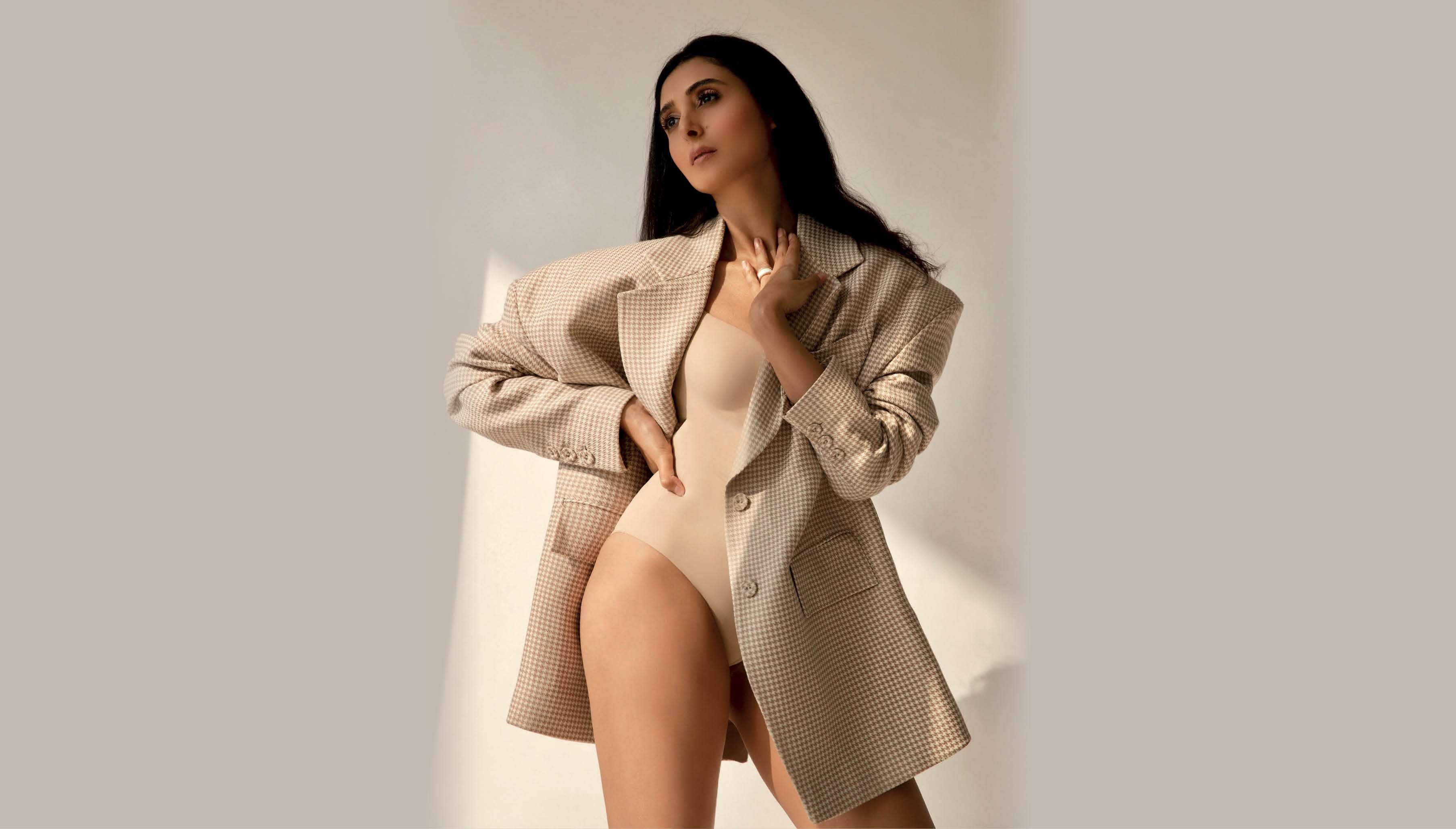
Fashion Entrepreneur Pernia Qureshi On Success, Stillness And Staying Rooted Through Reinvention
What sets Pernia Qureshi apart—and why she’s every bit an Esquire Woman
SHE’S NOT ONE TO LINGER IN THE SHADOWS OF past triumphs. Nor does Pernia Qureshi do the regular. Look at the way she transitioned from helming her now-sold fashion juggernaut, the trailblazing Pernia’s Pop-Up Shop, a few years ago—to her podcast, Fashionably Pernia, last year.
“I’d been holding on to the idea of a podcast in the luxury lifestyle and fashion space for a long time. There was nothing of its kind in India; most podcasts here are generic and deal with categories and topics that are completely unrelated to each other,” she says.
“About a year after I had my daughter, I wanted to start something new. Fashionably Pernia is the first [podcast in India] to deep-dive and explore these particular categories with pioneers in the industry, and cater to an audience that has interest in lifestyle and luxury,” says the polymath, who has on her guest list “experts and pioneers who have built a career or made an impact in luxury, lifestyle or fashion”, or “the next big thing” from across the industry.
After holding India’s style-conscious in a vice-like grip for over a decade with Pernia’s Pop-Up Shop, she has embarked upon an equally formidable pursuit—a powerful podcast. That Qureshi is unquestionably and multifacetedly relentless is why she is a woman we love.
Her podcast might place great value in expertise and industry cred, but Qureshi herself defies categorisation. Entrepreneur, author, podcast host, classical dancer, devoted mother. But she is among the few who do consider fashion a cultural time capsule.
“Fashion is a critical pillar of culture,” she notes. “What people have worn historically and what they wear today says everything about who they are and where they are from. I think the best way to get to know Indian culture is to attend an Indian wedding. The fashion will tell you all you need to know about which part of India the wedding party is from, what their history is, where they are as a society today and where they are heading.”
If fashion connects Qureshi to the present, food is her bridge to the past. Her latest project—a deeply personal cookbook rooted in the recipes of her late grandmother—is an ode to memory, matriarchy and the magic of the Indian kitchen.
“The biggest and best inheritance from my grandmother are her recipes,” she says of the cookbook, titled Ammi’s Kitchen: Heirloom Recipes from Rampur. “Food was her love language and I wanted to preserve her love in a physical form forever. I also wanted to share with the world the genius and talent of Ammi. This book is my tribute to her and to all grandmothers who are the torchbearers of preserving our rich culinary history,” she smiles.
“My grandmother was a magician in the kitchen,” she recalls. “She knew every recipe by heart and would constantly improvise. She made every dish her own by adding personal touches.”
Writing the book was both cathartic and revelatory. “It was a very emotional journey,” she confides, adding, “It brought me closer to her, even though she’s no longer with us. The recipes are presented exactly as she made them—no modernisation, just pure, unfiltered heritage.”
And in honouring her grandmother’s legacy, she honours countless women whose stories have simmered quietly in their kitchens. “Traditionally, the kitchen was always a woman's domain in India and I always believed that the kitchen is where the soul and joy of a home resides,” Qureshi says. “India has been raised and nourished from the food of our mothers and grandmothers. It is high time they got their due credit. Women and their kitchens have been the backbone of our society.”
More than anything, she hopes the cookbook will act as a cultural connector. “I want readers to discover Rampur and its rich culinary traditions. I hope this book brings people together over delicious, hearty meals, the way Ammi’s food always did.”
For someone so prolific as Qureshi, the notion of rest isn’t alien. “On days off, I actually like to do nothing,” she says, smiling. “Eating great food in good company and getting some time in with my daughter—that’s the ideal day.”
Motherhood, too, has been a transformative chapter. “Since becoming a mother, I’ve realised I actually like being a morning person. They’re my favourite part of every day now, which was never the case earlier,” she admits. The change has brought unexpected joy, and with it, a redefinition of success: “A calm nervous system, emotional support and peace of mind... that, to me, is the meaning of a successful life.”
Of course, parenting is an evolving art in itself—one Qureshi approaches with mindfulness.
“It’s difficult to judge oneself as a parent,” she reflects. “I try to create a balance for Sophia where she has a routine, but also the freedom to explore her preferences, hobbies and ideas. I’ve become so much more aware of my words, my actions and of the people around her. It’s made me realise the implications they can have on her.”
But long before she became a mother and a tastemaker in fashion and lifestyle, Qureshi was—and remains—a classical dancer, trained in both Kathak and Kuchipudi.
I began Kathak at the age of three or four,” she recalls. “My mother went for classes, and I used to tag along. Since then, I haven’t left dance—it’s one of the best parts of my life.” Kuchipudi came later, when she was 17, via a serendipitous workshop that led her to study under the legendary Raja Radha Reddy and Kaushalya Reddy in Delhi.
The two forms couldn’t be more different. “They require a totally different body language, postures, footwork, hand gestures and music. The contrast in the two styles is reflective of how diverse India is as a country,” she explains, adding that her “primary focus as a dancer is on Kuchipudi”, and that is what she mostly performs. However from time to time I do get the opportunity to do Kathak as well.”
Dance, she says, is her daily anchor. “It is what grounds me. It is the meditative part of my day. It is the only time in the day I am completely off the radar and not accessible on my phone.” Her pre-performance rituals are minimal yet meaningful: calm morning,gentle stretching and a quiet prayer. “That’s all I need to centre myself.”
As for the relevance of classical arts in contemporary India, Qureshi is quietly optimistic. “There is a certain amount of sophistication one needs, mentally, to really enjoy and hone the classical arts in India. I only hope that this segment of people grows. I do believe social media is helping the cause. This is one of the richest and oldest traditions of India and keeping the legacy alive is crucial.”
Qureshi lives many lives in one—each a different expression of the same inner fire. Whether she’s dancing barefoot in silence, curating conversations with India’s most stylish minds, or passing down generations-old recipes wrapped lovingly in a hardcover heirloom, she is constantly honouring both legacy and possibility. Hers is a life incubated by precision and passion; a testament to what it really means to create one’s own destiny.
To read more stories from Esquire India's August 2025 issue, pick up a copy of the magazine from your nearest newspaper stand or bookstore. Or click here to subscribe to the magazine.