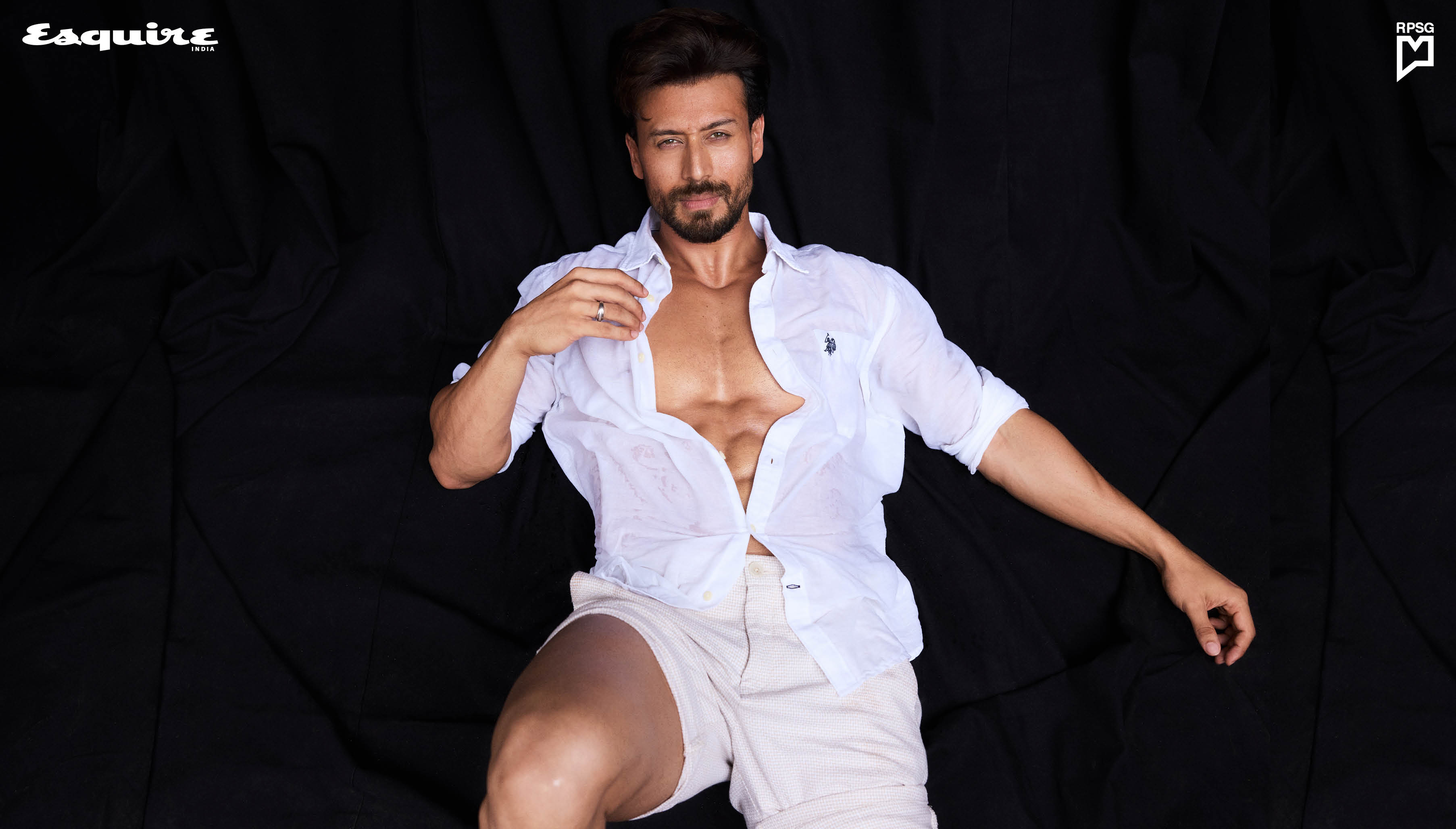
Esquire India's Digital Cover Star Tiger Shroff Is Earning His Stripes
Beneath the raw, bulked-up menace of Baaghi 4 beats a tender heart, one learning to treat action as more than muscle and movement, but as performance art. The industry’s favourite cub is all grown up
Through a glowing mist, he rides out on his bike, shirt loose and floral, unbuttoned to the waist. His lady love sits pillion as rose petals rain down on them. They light a candle at church, hand in hand, making a wish, secret smiles exchanged. Housekeeping together. Rescuing a puppy in the rain. The couple breaks into dance, but not the sharp gyrations he’s famous for. An easy, languid two-step. Moments as simple and sweet as the heart-shaped emoji they trace with their hands.
Until the last frame: a blood-splattered end. Yes, he’s back.
For a minute there, it almost looked like Tiger Shroff had entered his softboy era. After all, in a time obsessed with the tormented dreamer and the red-flag anti-hero, even a dyed-in-the-wool action star might be tempted to flirt with something different. But as he shoots for a digital cover with Esquire India, it’s clear Shroff has no plans of laying down the action-hero mantle just yet. One of his Instagram posts last November teasing his upcoming release, Baaghi 4, foreshadowed it all: “A darker spirit, a bloodier mission. This time he is not the same.”
Then again, would it be fair to say… he’s a little same? After all, how much variation can you really bring to the hit-kick-roll-repeat school of performance that action heroes belong to? And yet, Shroff insists his latest outing has pushed him out of his comfort zone. “It’s a lot more gruesome, violent, brutal and hard-hitting. Mentally, it’s just the most intense, most emotional I’ve done yet. So, it was really draining emotionally—not just the action, but everything through the film,” he says.
The actor, who was last seen in Singham Again (2024), is excited for fans to see the new chapter of the Baaghi franchise, which first shot him to fame, almost a decade after the film’s 2016 debut. “I’ve sort of grown up with the Baaghi franchise, literally,” he reflects. “It has given me an identity in the industry and I’m forever grateful to my mentor, Sajid sir, to our company, Nadiadwala Grandson, and to the audience that has shown so much love to the franchise and my character.”
On The Kapil Sharma Show, producer Sajid Nadiadwala once recalled a hilarious moment from before the launch of Shroff’s debut film Heropanti (2014), involving his father, veteran star Jackie Shroff. “Dada once told me, ‘Bhidu, mera kaam hai sirf bachcha paida karna. Star tu bana le’ (My job is just to have the child. You make him a star),” he said.
Speaking to Esquire India, Nadiadwala adds, “For me, Tiger isn’t just an actor I launched, he’s like family. Watching his journey feels like watching my own child grow into a man the world admires.”
Shroff wasn’t always the buff, killing machine you see on screen. People who’ve known the actor—born Jai Hemant Shroff—recall him as a “tiny, baby-faced boy; a Class 6 kid who looked like he belonged in Class 4,” says one. His interest in martial arts began early, and he’s a black belt in Taekwondo while also practising Kalaripayattu and Krav Maga. Reportedly, martial arts was the career he intended to pursue before pivoting to films.
That discipline and commitment to the craft helped cement his position as India’s leading action star. “Right from the time he arrived, Tiger stood out as somebody who knew his stuff,” says film critic Baradwaj Rangan. “He’s one of Bollywood’s first cadre of stars who looked like they were really born for action, as opposed to the earlier ones who did action along with other things like humour, romance, etc.”
Until then, India’s action hero archetype was the big he-man doing macho stunts. “The people that came before him [Shroff] were all hulks. When Sunny Deol said dhai kilo ka haath (a hand that weighs 2.5kg), he really meant dhai kilo ka haath—or probably even more—because he’s like this big hammer kind of guy,” Rangan points out. Shroff, along with contemporaries like Vidyut Jammwal, ushered in a new era of action, replacing the heavy, lumbering men.
Over the course of his career, Shroff has only gone from strength to strength in the physical feats department. From the rooftop parkour chase in his debut Heropanti, to the Baaghi climax inspired by Thai martial arts films, the helicopter stunt in Baaghi 2 (2018), and the MMA fights in Ganapath (2023), he’s chopped, slashed, sliced and high-kicked his way to the top of Bollywood’s stuntwork pyramid. “It’s very clear that Tiger enjoys his action, that he works hard for it, and that he wants to be known as an action hero,” Rangan continues, adding that the actor’s soaring leaps, even when wire-assisted, are clean, with the grace of a ballerina in combat. Referring to the opening sequence in War (2019), where Shroff takes down a gang of men in a continuous single shot, he points out: “I don’t think there’s anybody else in Bollywood who could have pulled off an action sequence like that. It’s just a thing of beauty and only a very dedicated, highly trained fighter can do it.”
Even Hrithik Roshan, whom Shroff considers a mentor, was unequivocal that the film needed the young action star in it. “I told them I’m doing War only if Tiger Shroff is there. I know for a fact that only he will be able to stand in front of me and make me feel like s**t. I will have to be at my best to even be at par with Tiger—and I don’t think I’m at par with him even then,” Roshan told Pinkvilla.
Shroff’s brand of ‘old school clean action,’ reminiscent of the ’70s Hong Kong kung fu era, has been key to his commercial appeal. Beyond the box-office runs of Baaghi and Baaghi 2, and the record-breaking success of War, he has also built a dedicated fan base. “Waiting for Baaghi 100,” as one superfan puts it, pretty much sums it up.
It helps that Shroff doesn’t just play the action hero. He lives like one. His daily routine is closer to that of a professional athlete than an actor training for a role.
“Physical movement is literally therapy for me. It’s my meditation, the way I channel myself. No matter what state of mind I’m in, the moment I do some sort of physical activity, I become aligned with myself,” he tells Esquire India.
A typical day starts with 45 minutes of cardio on the stepmill or treadmill, followed by skill work—either kickboxing or dancing. Afternoons are for rest before he gets into strength training, with resistance-heavy weight sessions that target specific body parts. Nights are reserved for sport, and the actor is known to enjoy football, cricket and basketball.
Contrary to conventional fitness wisdom, Shroff doesn’t believe in taking days off. “I know that’s the opposite of what a lot of health experts say, but I get my seven, eight hours of sleep at night and I’m good to go.” What he doesn’t compromise on is recovery. “Saunas, ice baths, sleep—just because I don’t take days off from training doesn’t mean I take days off from recovery,” he clarifies. On set, Nadiadwala reveals his discipline is extraordinary. “He treats every film set like a temple and every shot like his prayer,” says the producer.
Given that it’s been nearly a decade since Baaghi, Shroff acknowledges his rhythm has evolved, not just in the kind of person he’s become through his film experiences, but also in how he adapts to what the character and script demand. “For Baaghi 4, I had to get a lot bigger, a lot more menacing looking, so I really muscled up in certain areas around my back and shoulders. They wanted a raw, brutal, bulkier look,” he explains.
While early in his career, Shroff was all about showcasing acrobatics and sheer physical prowess, now he says he’s learned to think beyond muscle and movement. An approach reminiscent of global stars like Jackie Chan and Tom Cruise, who treat action not just as stunts but as a form of performance art. “In my early years, I was just so eager to show my physical prowess and my ability to do certain things,” he admits with candour. “But I’ve come to realise that, in certain sequences, less is more. Earlier I always wanted to push the bar on every sequence. Now I know that sometimes restraint is more impactful, and I’m a lot more aware of the camera and how I need to marry my movements to what it sees.”
Chan has famously said: “I want to change my character. I want the audience [to] know I'm not the action star—I’m the actor who can fight.” Does Shroff risk falling into the kind of trap Chan referred to? Has his greatest strength—the ability to embody action so seamlessly—also proven to be his greatest limitation, confining him to one type of role?
Not quite, says Rangan. “Too often, people think of acting as just emoting or delivering dialogue. But action is also performance, and it requires a very specific skill. Think of it like ballet: you’re not just watching facial expressions, you’re watching how the body moves, how every limb carries intention. That’s art, that’s craft, and not everyone can pull it off, but an actor like Tiger is a master of it.”
Perhaps the greatest irony is that, beneath the chiselled exterior, Shroff is in fact a tender heart. Every positive connotation of a softie.
Painfully polite, raised by his mother in a more anglicised, non-Bollywood household, he’s said to have a quietly mischievous sense of humour (one source recalls how he shared and reposted every meme about himself after Heropanti released). Confident enough to leave his shirt unbuttoned down to the navel, yet still disarmingly gentle in his speech. It’s also been reported that he’s scared to sleep alone in a hotel suite, preferring the comfort of a simple room. “A tiger who sometimes mews,” is how he’s been affectionately described.
Nadiadwala concurs: “What makes Tiger special is not his stunts or his dance, but his pure heart and respect for everyone around him. Tiger’s loyalty is rare, he never forgets the people who stood by him at the beginning. He’s proof that you can be strong and gentle, fierce and compassionate, all at once.”
Shroff’s candour about what might be his limitations—despite the fact that he was born to a successful actor—is in line with his surprising sense of self-awareness. “My father was born to be a star. He had the X-factor as an actor. I don’t. I’m not that blessed. I’ll just keep working hard and hope for the best,” he admitted in an interview with Subhash K. Jha after his debut film’s release.
As the industry wrestles with uncertainty, with no one quite sure what works, and every success sparking a rush to mimic, the question arises: how does a classic action star chart his future? And in an era where problematic male leads dominate, does Shroff’s brand of heroism still hold?
For Rangan, who found himself enjoying Shroff’s turn in A Flying Jatt (2016), the answer lies in focus. “When you look at the great action stars, they are not really versatile actors in that sense. You don’t go to a Schwarzenegger movie because he’s great at romance or cries convincingly. You go because he does that action thing so well,” he says, adding, “Is Tiger convincing in the Baaghi series? Well, definitely yes.”
Also noteworthy is the fact that Shroff has pretty much reinvented a genre of emotion-led romance that was originally associated with the indelible star presence of Salman Khan (Khan did the original Baaghi in 1990)?
Rangan continues, “Not everybody can be everything or needs to be. Sometimes it’s just easy to say: okay, I want action, I’m going to a Tiger Shroff movie. Unlike drama or romance, action is a big-screen thing.”
Words that may prove prophetic — and perhaps deliver Shroff his next roaring success.
With contributions from Saurav Bhanot, Prannay Pathak and Sonal Nerurkar
Credits
Editor: Rahul Gangwani
Styling and Creative Direction: Vijendra Bhardwaj
Photography: Taras Taraporvala
Editorial Mentor: Saira Menezes
Managing Editor: Sonal Nerurkar
Deputy Editor: Mayukh Majumdar
Words: Team Esquire India
Hair: Amit Yashwant
Grooming: Rahul Kothavale
Fashion Team: Komal Shetty
Bookings Editor: Varun Shah
Production: P Productions
Media Consultant: Universal Communications
Esquire India Editorial: Saurav Bhanot , Nitin Sreedhar , Prannay Pathak , Abhya Adlakha , Rudra Mulmule , Riti Ghai , Kashish Mishra
To read more stories from Esquire India's September 2025 issue, pick up a copy of the magazine from your nearest newspaper stand or bookstore. Or click here to subscribe to the magazine.