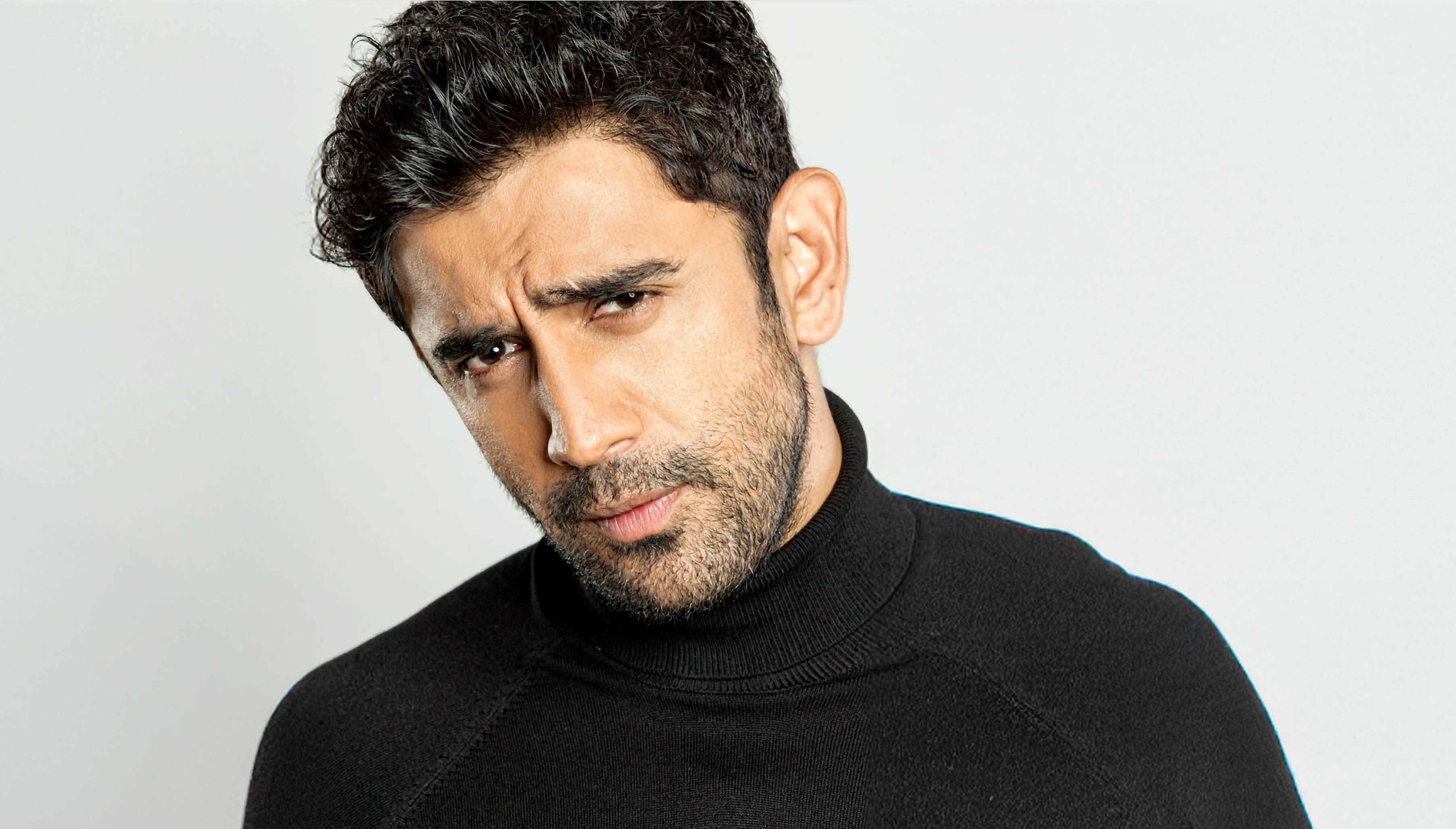
Amit Sadh: Riding Through Life Real And Reel
The Bollywood actor shares why he loves playing complex characters, his latest film Pune Highway and his idea of a hero
The red cap is impossible to miss. Amit Sadh sits comfortably at home in Mumbai, all easy charm and calm energy. He is the kind of guy who might just disappear for a weekend ride upstate and you wouldn’t even know. For those wondering about his love for motorcycles isn’t a phase; it’s almost a second language.
But right now, in an exclusive conversation with Esquire India, he’s firmly in the moment, reflecting on a seven-year break from films and the strange, messy, deeply human characters that have always found their way to him.
His latest, in Pune Highway—a murder mystery co-directed by Rahul da Cunha and Bugs Bhargava Krishna—has him playing Khandu, a man caught in a quiet but seismic emotional storm.
Khandu doesn’t raise his voice much. But you can feel the turbulence beneath the stillness. Also starring Jim Sarbh, Manjiri Fadnis, Anuvab Pal, the film revolves around a dead body and the secrets that unravel, creating a suspenseful narrative.
“I have this fascination with human nature,” Amit says when we bring up the role. “Our duality. It excites me and complexes me.” From anyone else, that might sound like a carefully curated soundbite. From Amit, it feels like something he’s been unpacking long before the cameras rolled.
To be honest, Amit Sadh has been doing this kind of work—quietly, consistently, almost stubbornly—for years. He’s carved a place in the industry not by chasing leads, but by choosing characters with cracks. Men who are flawed, wounded, restrained. Men who often say more by saying less.
One glance at his filmography and you see the pattern. Omi in Kai Po Che! is the hopeful idealist whose politics cost him his friendships. The emotionally grounded coach in Sultan, holding his own in the orbit of a megastar. Or Raghubir Pratap Singh in Gold, adding gravitas where most would fade into the background.
“The juice is in people, not things,” he says. And that’s the throughline in all of them. Against the aura of the leading man, the characters don’t necessarily fade into the background. Rather they’re emotional anchors making the leads look good. But more than that, in recent years, we have been witnessing an evolution in how the side characters are portrayed on screen. They are given tension, sorrows, bites that make them more rounded. They are hurt but quietly protective and are certainly driven by self-awareness.
Gone are the days when the story revolved around a single saviour. Today, it’s the ensemble that’s doing the heavy lifting. We had Kashyap’s Gangs of Wasseypur embrace it for the big screen. In recent times, Hansal Mehta’s Scam 1992 and Raj and DK’s Stree have followed the tradition of bringing life in these roles. And audiences are watching the guy at the edge of the frame, not just the one in the spotlight.
Amit’s film choices also reflect that shift—deliberate, instinctive, sometimes a little rebellious.
“My choices are very instinctive. Like Kabir Sawant—he was a great guy, but he was so troubled,” he says. “I think I have a soft corner for it. I think all human beings are so troubled with our past, with our childhood, with our lives. Sometimes, I meet a group of people who want to narrate different stories to me, and even before they narrate a film to me, I know I'm doing this film...Of course you look at the script, but it's mainly instinct.”
That instinct, time and again, pulls him toward men in emotional chaos. Not for shock value, but for insight.He admits that playing these emotionally bruised characters helps him go inward. It’s not just work; it’s something more elemental.
“I think it has helped me a lot by channelising my thoughts and emotions. It's a great getaway – while you can't run away from life, immersing yourself in different characters on screen provides a unique escape. Each character I've portrayed has given me something valuable, whether it's a moral lesson or a new perspective. I've been fortunate that every role has contributed to my personal growth in some way.”
“I surrender myself to the script. I surrender myself to my director,” he reveals when asked how he makes the men he plays linger longer on our minds. “When you are brought into a film, you're already a year and a half or two years late. The director and the writer and the producer have lived with that for a year.” He states that he follows two things with intent: surrendering and listening, both of which he reveals helps him prepare for his roles.
At some point, the conversation hits that familiar and unavoidable term: hero. He isn’t hesitant to voice his opinion, “For me, I've kept it very simple. Even now I'm an actor. I take a part—sometimes it is the most important part, sometimes it is a leading part, sometimes it is a part which is contributing to the story. For me, it's just parts… I don't have any problem (with the label hero), it's just that I like being away from all these definitions because definitions limit you,” he explains.
That aversion isn’t about false modesty. It’s more philosophical than professional and seeps into the conversation every now and then. In fact, it’s a quiet protest against a system that worships image over intent.
“I have met such powerful people who nobody knows, and they're doing so much for the community,” he adds, referring to his documentary work The Custodians of India. “So, the screen hero is the character. He's not the hero—he's the hero of that story, and the guy playing it is a human being. He's an actor. Also, what is this hero-heroine thing? Can we stop saying heroine? She’s not my heroine. She’s my co-actor. She’s a human being.”
It’s not just semantics—it’s a reordering of the industry’s long-standing hierarchies. “I think the younger lot in India is more courageous. They're not blinded. The system is at least appreciating different forms of acting, the uniqueness,” Amit observes.
Off-set, Amit finds clarity in the wild. His motorcycle rides through the Himalayas, treks across Sequoia National Park, solo escapes into nature—they aren’t just leisure. They’re part of the process. They bleed into his performances in ways he doesn’t always talk about. That time away from the city, away from the noise, is where the next version of himself often begins.
According to the actor, travelling is the best teacher in life. "What it does is basically out of your comfort zone. It takes you out of your bubble. It kind of takes you out of your restricted mindset. It makes you unlearn it makes you in. It keeps puts you in different situations. It shows you the magic of life once you get in, tuned, and tapped into the magic of life. "
“I’m excited to use this vessel and use all these things that have happened to me in my life and find the next story. Find the next film. Find the next part,” he shares.
And with that, the red cap is back on. Not as costume. Not as statement. Just as Amit. Somewhere between the road and the next role.