Review: 'Materialists' Doesn't Romanticise Love, It Disassembles It
Song’s sophomore movie is a psychological autopsy of modern love
There’s a moment in Materialists when Lucy (Dakota Johnson), our high-end matchmaker heroine with a killer sales pitch and even better cheekbones, lies in bed with our unicorn billionaire (Pedro Pascal) in a Tribeca penthouse and asks, deadpan: “How much did this place cost?” He answers without flinching: “Twelve million.” She doesn’t blink either.
That—right there—is the emotional temperature of Materialists: icy, precise, quietly devastating. It’s a romance that masquerades as a game of numbers and pedigrees, only to dismantle every spreadsheet and dating app algorithm with the oldest wildcard in the book: longing.
Set in a sleek, unmistakably A24-fied Manhattan, the movie follows Lucy, a high-end matchmaker who treats dating like corporate strategy. “You’re not just looking for a boyfriend,” she tells one client early on. “You’re looking for a nursing-home partner. A grave buddy.” It’s funny, yes, but it’s also alarmingly true – and that’s where Song thrives. She sets us up in a world that looks like rom-com, but it's not just about that. It's about how marriage is an economic proposition in the world world under capitalism and dating has turned us all into commodities, but it's also very much about love.
When Lucy’s past collides with her present at a wedding (where she’s the matchmaker, of course), the film sets up its love triangle: John (Chris Evans), the broke bartender ex who still knows her drink order — Coke and a beer — and Harry, the absurdly eligible older brother of the groom. Johnson, playing opposite these two polar opposites, somehow makes Lucy’s icy ambiguity magnetic. She’s unreadable, but not cold. Sharp, but never cruel. Her every glance seems to weigh a hundred factors at once. Love, for Lucy, is not just a feeling; it’s a cost-benefit analysis.
What Song does in her sophomore film is something sneakier and more cerebral than anything she attempted in Past Lives. That film wore its melancholy on its sleeve — wistful, yearning, achingly poetic. Materialists, in contrast, plays its heart close to the chest. It wears Prada and sarcasm, has immaculate lighting, and prefers to make its heartbreak felt in the margins. If Past Lives asked “What if?”, Materialists mutters “What now?” into a glass of overpriced pinot.
Because here, Song isn’t interested in whispering sweet nothings — she’s itemising the price of love, tax and tip included. This, more than anything, is the film’s thesis: love isn’t blind. It sees the Rolex. It checks the LinkedIn. And in 2024, it absolutely knows the square footage. Song doesn’t pretend otherwise. In fact, she leans in, satirising our collective hunger for the complete partner — the one who’s tall, funny, rich, emotionally available, and also into oat milk and open communication.
The film opens with a sly anthropological joke — a caveman courtship scene — suggesting that bartering for love is hardly new. But this isn’t a satire; it’s more like a biopsy. Song isn’t mocking the system. She’s dissecting it, quietly, clinically, but with the care of someone who knows what’s at stake.
One early scene has a client angrily complain: “She’s 40 and fat. I would never swipe right on a woman like that.” It’s jaw-droppingly crude, but it lands like a cultural gut-punch. That’s Song’s brilliance — she lets ugliness exist without apology, because that’s the world we’re dating in. She’s not writing a fantasy. She’s writing what we’re too embarrassed to admit at brunch.
There’s a moment in the film where Lucy explains, quite plainly, that love and money aren’t separate currencies—they’re entangled, inseparable. It’s an idea that should feel cold. But in Song’s hands, it’s strangely freeing. Materialists doesn’t moralise. It doesn’t punish Lucy for choosing a life of comfort, nor does it sentimentalise the starving artist she left behind. Instead, it sits with the discomfort of that choice. What if wanting more—more security, more stability, more power—wasn’t a betrayal of love, but a version of it?
Money is a huge factor in this film. It's basically the fulcrum that this story balances on. But a good drama is when both sides of an argument make strong points. Such is the case with Materialists. Harry has money. John doesn't. This sets the stage for many powerful, memorable conversations between John, Lucy, and Harry. It's both hilarious and undeniably provoking.
Meanwhile, Song couldn’t have picked a better cast.
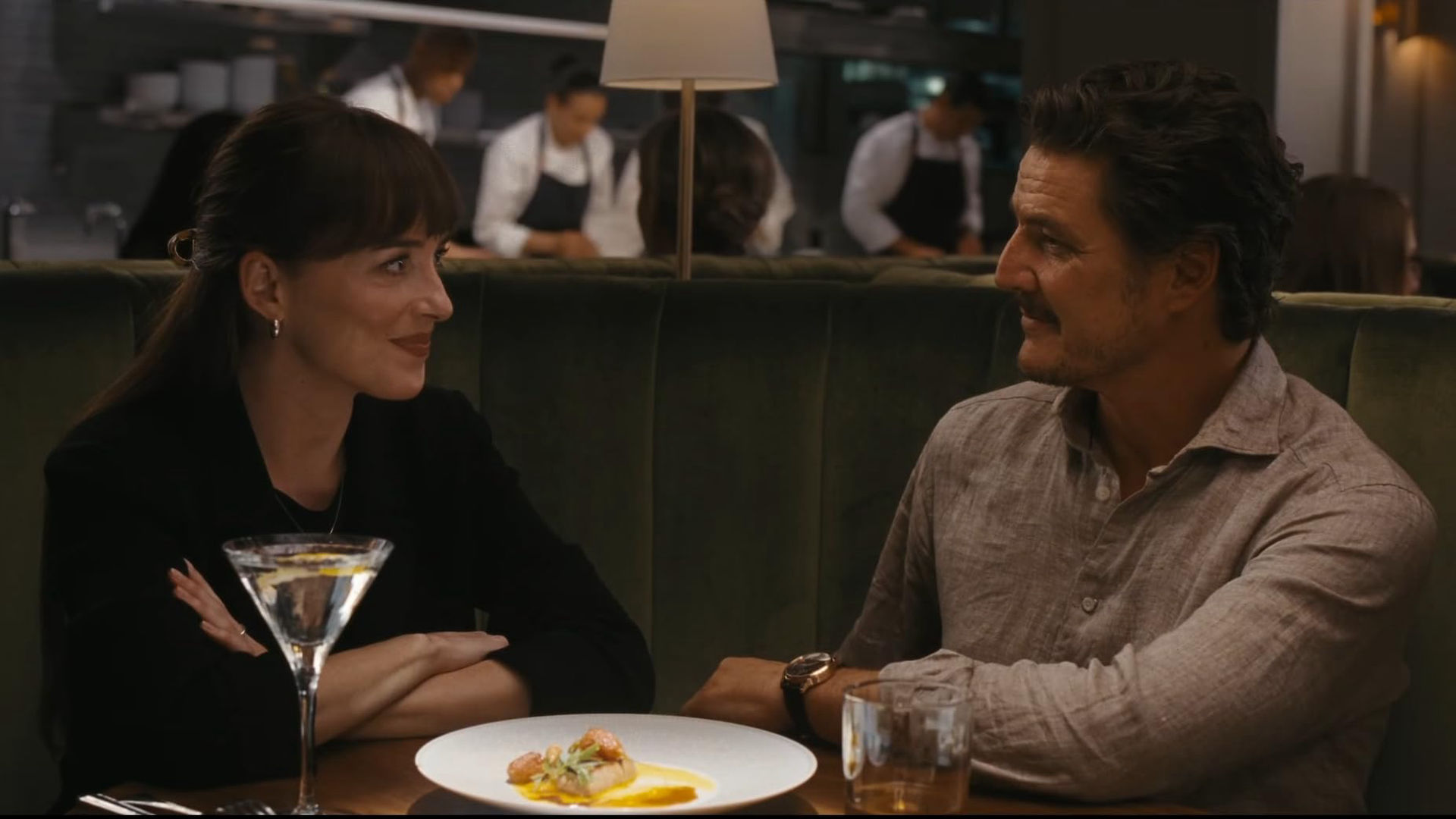
Pascal’s Harry is the dream on paper. Tall, handsome, charming, and emotionally available. But Song is too savvy to sell a fantasy. Harry is a unicorn, yes — but a unicorn bred in captivity. Even his vulnerability feels curated. There’s a scene where Lucy stands in his penthouse, more entranced by the space than the man, and the film lingers just long enough to make you wonder: is it him, or the view?
Harry scans her the way she scans her clients. They’re perfect for each other, perhaps because they both know what the game is. There’s no illusion. No sweeping gestures. Just mutual attraction, economic compatibility, and a desire to be chosen by someone who understands the rules of the game.
In contrast, Evans’s John is all frayed edges and unhealed wounds — the kind of man who’d be perfect if only he didn’t remind you of how hard it was to be broke together. He’s tender, wounded, and crucially, not rich. Evans has never felt more grounded, or frankly, more interesting. There are at least two scenes here that will make viewers see him not as Captain America but as a man worth falling apart over. One, especially — no spoilers — hinges on a single look, and it’s devastating.
The romance unfolds not in grand gestures but in half-smiles, loaded silences, and sharp, economical dialogue. Song’s gift — and it’s a rare one — is her ability to say everything by saying very little. She can make silences feel like monologues. She can turn a sidelong glance across a cocktail glass into an existential crisis. And she has a rare ability to write about love without lying to us — no sugar-coating, no fairy dust, just the brutal, beautiful truth.
So yes, in the wake of Past Lives, a film that glowed with tender ache, Materialists feels sharper-edged, more brittle, and more knowingly cynical. But scratch at the surface—beneath the whip-smart dialogue, the tonal tightrope of satire and sincerity—and what emerges is a film just as interested in the quiet devastation of desire. Song, again, is still drawn to people who teeter on the edge of decisions they may never fully understand. But this time, the triangle is no longer childhood sweethearts yearning across continents. It is built instead on something thornier and more modern. Where Past Lives lingered on nostalgia and the spiritual weight of alternate timelines, Materialists is anchored in the exhausting realism of the now.
There are flickers of the classic rom-com blueprint here: meet-cutes, rival lovers, misunderstandings, emotional crescendos. But they’re all shot through a haze of realism and restraint. Nobody runs through an airport. Nobody screams “I love you” in the rain. Instead, Materialists gives us a kind of love that exists in the push-pull of economics and emotion. You can tick every box and still feel something missing. You can fall in love and still ask, “But can I live like this?”
The film flirts with genre, then retreats. It gives us a wedding, but not a fairy tale. It builds toward a choice, but refuses to make one for us. Even the love triangle feels less like a tug-of-war and more like a referendum on modern dating: the stability of money versus the ache of memory. One gives you safety. The other, connection. Maybe. Sometimes. If you squint.
It’s not perfect — no film that tries to straddle the romantic and the ruthlessly pragmatic can be — and Song doesn’t quite thread every narrative detour. A subplot about sexual violence, while politically admirable, feels underdeveloped. And Materialists doesn’t land with the emotional gut-punch of Past Lives. But perhaps that’s by design. This isn’t a story about what we feel. It’s about what we suppress, postpone, and negotiate.
It would be easy to call Materialists a film about a woman choosing between two men. But to do so would miss the point. This is not a story about choosing a partner. It’s a story about choosing a self. About confronting the gap between the life you imagined and the one you’ve constructed, brick by curated brick. It’s about the kind of love that doesn’t just spark—it calcifies, becomes architecture.
That said, the questions Materialists poses stay with you. When the credits roll, you don’t leave holding hands with the person next to you. You leave wondering: Do I love him because I love him? Or because he checks all my boxes? Would I still choose him if he were broke? If he lost his hair? If he never reached six feet?
And somewhere deep inside, even if you hate the answer, you’ll be grateful that Song asked.